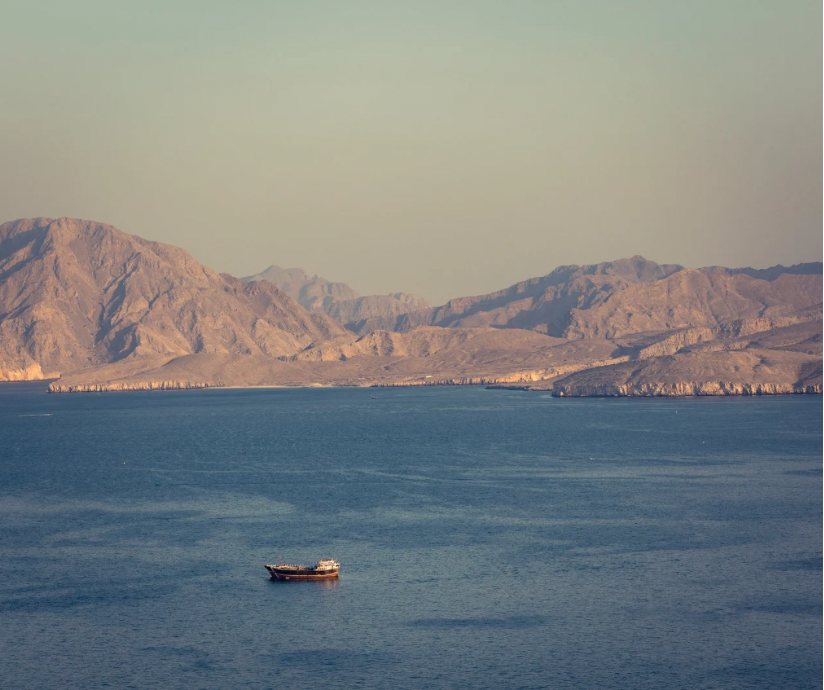
A narrow stretch of water — just 33 kilometers wide at its tightest point — carries roughly twenty percent of the world's oil. When Iran closed the Strait of Hormuz, global markets panicked, oil prices spiked, and airline stocks cratered. When it reopened, the relief was immediate — but fragile. In this episode, we use this high-stakes geopolitical story to learn five B2 expressions that travel far beyond international news: broker, cautious optimism, tip off, alleviate, and conduit.
⚡ 5 Key Expressions
Expression 01
Broker (a deal / a ceasefire)
To negotiate and arrange an agreement between two parties who are in conflict or at a distance. The person who brokers a deal acts as the go-between — they don't own the outcome, but they make it possible. You may already know the word from finance: a stockbroker buys and sells on your behalf. The verb works the same way. When the US brokered a ceasefire between Israel and Lebanon, it stepped into the middle of a conflict and made both sides agree to terms. The word always implies effort, skill, and the presence of at least two sides that needed help reaching each other.
- "After weeks of tension, the HR director finally brokered an agreement between the two department heads."
- "I had to broker a peace deal between my two roommates over the thermostat. It was exhausting."
Expression 02
Cautious optimism
A careful, guarded sense of hope — you believe things might improve, but you're not ready to celebrate because the situation is still fragile. The two words create a productive tension: optimism pulls you forward, cautious holds you back. Together, they describe the feeling of a situation that's improving but could still go wrong. You'll find this phrase everywhere in diplomacy, finance, medicine, and business reporting. It's also useful as an adverb phrase: "I'm cautiously optimistic." Both forms are natural and professional. When the strait reopened, nobody threw a party — there was cautious optimism at best.
- "Analysts expressed cautious optimism after the central bank signaled it might pause rate hikes."
- "I'm cautiously optimistic about the new job — the first week went well, but it's still early."
Expression 03
Tip off
To give someone advance information — quietly, selectively, and usually before something becomes public or official. To be tipped off is to receive a heads-up that not everyone has access to. The phrase carries a slight insider quality: the person being tipped off is getting something others aren't. It can be entirely neutral and helpful ("my colleague tipped me off that the deadline moved up"), or it can have higher stakes ("the whistleblower tipped off the journalist before the report was published"). As a noun, a tip-off is the piece of information itself — or, in basketball, the opening jump ball that starts a game. Same idea: something that signals what's coming.
- "A source tipped off the investigation team before the official audit began, giving them time to prepare."
- "She tipped me off that the manager was in a bad mood — I rescheduled my feedback meeting immediately."
Expression 04
Alleviate
To make something less severe — to ease pain, worry, pressure, or difficulty without necessarily eliminating it completely. The key distinction is between alleviate and solve: you alleviate a problem when you reduce its impact, not when you remove it entirely. This makes it ideal for situations that are improving but not yet resolved. It pairs naturally with concern, tension, pressure, stress, symptoms, and suffering — almost always with something negative. You would not alleviate something good. The article notes that airline stocks surged on hope that jet fuel shortages would be alleviated — not fixed, not ended, but made less painful.
- "The new remote work policy was introduced to alleviate pressure on employees during the restructuring."
- "A long walk usually alleviates my stress better than anything else."
Expression 05
Conduit
A channel through which something passes or flows — physically or figuratively. The word comes from engineering: a conduit is a pipe or duct that carries water, cables, or electricity from one place to another. In everyday English, it's used far more broadly. A strait is a conduit for oil. A university is a conduit for talent into an industry. A trusted colleague is a conduit for information between teams. What makes conduit more precise than simply "channel" or "connection" is the implication of reliable, consistent flow — the conduit doesn't generate what passes through it, it just carries it efficiently. When Maya calls the Strait of Hormuz a conduit, she's reminding Alex that it's not just about oil — it's the delivery mechanism for much of what the global economy runs on.
- "The new partnership positions the firm as a conduit between European investors and Southeast Asian markets."
- "She became the conduit between the technical team and the clients — both sides trusted her completely."
🎭 The Dialogue: Strait Talk
Maya and Alex work at a global shipping and logistics firm. It's Friday afternoon — the kind that should involve leaving early, not refreshing tanker trackers. Alex walks over with two coffees and the conversation goes exactly where you'd expect.
📍 Open-plan office, Friday afternoon. Maya is staring at her screen. Alex arrives with coffee.
Maya: I cannot believe we are still watching oil tanker trackers on a Friday afternoon. This week has been a nightmare.
Alex: Tell me about it. But I heard someone tipped off our regional director two days before Iran made the official announcement. He moved three of our tankers out early.
Maya: Seriously? That was smart. So who actually brokered the ceasefire that got the strait reopened?
Alex: The US stepped in and negotiated between Israel and Lebanon. Once that deal was in place, Iran agreed to reopen.
Maya: I'll take it. Even some cautious optimism is better than what we had on Monday.
Alex: Agreed. But shipping experts are still nervous — even with the strait open, crews are worried about security. It's going to take time to alleviate those concerns.
Maya: Right. And people forget that Hormuz isn't just about oil. It's a conduit for fertilizer, industrial goods — basically half the stuff the global economy runs on.
Alex: Exactly. Let's just hope it stays open long enough for us to actually enjoy the weekend.
🧠 Episode Quiz
Can you answer this?
The Strait of Hormuz sits between Iran and which other country?
- A — Saudi Arabia
- B — Oman
- C — the United Arab Emirates
✅ Answer: B — Oman. The strait runs between Iran to the north and the Musandam Peninsula, a small Omani territory, to the south. The UAE is nearby — which is why C is tempting — but it's Oman that technically borders the strait. Saudi Arabia is further west along the Gulf.
📚 Bonus Vocabulary
Ceasefire (noun) — a formal agreement to stop fighting, usually temporarily while negotiations continue. It doesn't mean the conflict is over — it means the guns have gone quiet for now. "The two sides agreed to a 72-hour ceasefire to allow humanitarian aid to pass through."
Reign (verb) — to be the dominant or prevailing force in a situation. You know this word from royalty — a king or queen reigns over a kingdom. In journalism, it's used figuratively: "uncertainty reigned" means uncertainty was in charge of everything. "Before the announcement, confusion reigned across the trading floors."
Windfall (noun) — a sudden, unexpected financial gain — usually from external circumstances rather than your own effort. When oil prices spiked, energy companies experienced a windfall. It's not something they planned; it just happened in their favor. "The sharp rise in commodity prices turned into a windfall for the company's raw materials division."