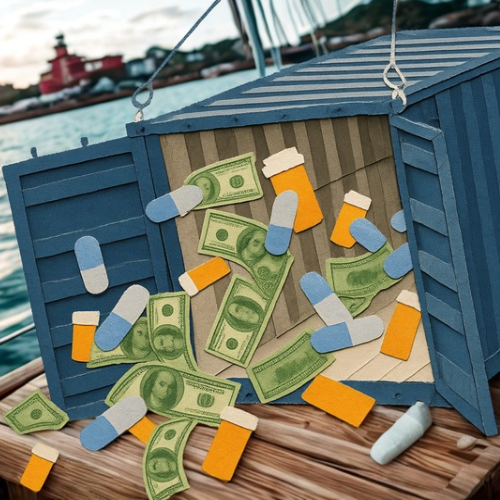
What does a narrow strip of ocean in the Middle East have to do with the medicine in your local pharmacy? More than you'd think. When the Strait of Hormuz — a waterway that carries roughly one fifth of the world's oil supply — closes, the consequences ripple outward in ways most people never see coming. In this episode, we follow the global pharmaceutical supply chain under pressure, and pick up five B2 expressions you'll use in business, professional conversations, and everyday life.
⚡ 5 Key Expressions
Expression 01
Rely on
To depend on something or someone in an ongoing, essential way — not occasionally, but as a core requirement for functioning. The phrase captures a real, structural dependency. If you rely on something and it disappears, things break. The global pharmaceutical industry relies on petroleum-derived ingredients that travel through the Strait of Hormuz. Remove that route, and the entire production chain feels it. "Rely on" works equally well for people, systems, habits, and relationships — and it carries no negative judgment. Dependence isn't weakness here; it's just the truth of how things work.
- "Our entire distribution model relies on a network of regional partners we've built over fifteen years."
- "I completely rely on my morning walk to clear my head before work."
Expression 02
Buffer
A protective reserve — of time, money, inventory, or capacity — that absorbs the impact of unexpected disruptions. A buffer doesn't prevent problems from happening; it buys you time to respond before things become critical. Think of it as a cushion built into a system in advance. In supply chain management, a buffer of medications means that even if new shipments stop arriving, hospitals can keep functioning for weeks or months. The word comes from the same root as "buffet" — something that absorbs a blow. In business and everyday life, a buffer is planned breathing room.
- "We built a three-week buffer into the production schedule to account for potential supplier delays."
- "I always leave a thirty-minute buffer before flights. I genuinely cannot handle rushing."
Expression 03
Stockpile
To accumulate a large supply of something — deliberately and in advance — because you anticipate a shortage or crisis ahead. "Stockpile" is stronger and more urgent than simply "store" or "save." It implies scale, foresight, and a degree of urgency. You stockpile when you believe that what you need may soon become unavailable. In 2025, the US government ordered a six-month stockpile of 26 essential medicines — a proactive move that now looks prescient. The word works as both a verb ("to stockpile supplies") and a noun ("a stockpile of medication"), and it travels well into everyday usage.
- "The company stockpiled raw materials for months ahead of the new tariff deadline."
- "Every time a long holiday approaches, my mom stockpiles enough rice to feed a small village."
Expression 04
Ripple effect
The way a single event spreads outward and produces a series of consequences — often in areas that seem unrelated at first glance. The image is precise: drop a stone in still water, and concentric rings spread outward in every direction. The original event is small and local; its effects are wide and far-reaching. The Strait of Hormuz closure is a textbook ripple effect story — one waterway affects oil prices, which affects chemical production, which affects pharmaceutical manufacturing, which affects hospital stock rooms. The expression works for positive consequences too, though it most often describes disruption or unintended impact.
- "The factory closure had a ripple effect across the entire regional economy — suppliers, logistics firms, and local restaurants all felt it."
- "One honest conversation with her manager had a ripple effect on the whole team's culture."
Expression 05
Closely monitor
To watch a situation carefully, systematically, and over time — especially when you cannot control it but need to catch changes quickly. "Closely monitor" is a fixed collocation in professional English. You wouldn't say "carefully watch" in a business report or press release; you'd say "closely monitor." The phrase implies active, ongoing vigilance rather than a single check. It's the language of risk management, medical oversight, and institutional caution. When the International Federation of Pharmaceutical Manufacturers says it is "closely monitoring" the situation, it signals that the organization has formal systems in place — not just a worried eye on the news.
- "The regulatory agency is closely monitoring adverse event reports since the drug received emergency approval."
- "We've been closely monitoring customer feedback since the redesign went live — so far the response is mixed."
🎭 The Dialogue: Chain Reaction
Maya works in hospital procurement — the department responsible for ordering medical supplies. Alex is a logistics consultant. They're grabbing lunch and the conversation turns to what a supply chain disruption actually looks like from the inside.
📍 A café near the office, midday. Maya has her laptop open. Alex sits down with two coffees.
Maya: I've been in back-to-back meetings all morning. The hospital is starting to worry about drug availability.
Alex: Because of the Strait situation? Yeah, the whole industry relies on that waterway more than most people realize.
Maya: Exactly. Our suppliers are saying they have a buffer for now, but nobody knows how long this lasts.
Alex: The smarter hospitals started to stockpile critical medications back in 2025, when the government pushed for it. Did yours?
Maya: Some of them, yes. But not nearly enough. The problem is, this has a ripple effect across everything — not just drugs, but medical equipment, packaging, you name it.
Alex: I know. We're closely monitoring three of our key supplier contracts right now. One disruption upstream and the whole chain shifts.
Maya: It's a lot to manage. I just hope the buffer holds long enough for things to stabilize.
Alex: Same. The next few weeks are going to be very telling.
🧠 Episode Quiz
Can you answer this?
The Strait of Hormuz is one of the most strategically important waterways in the world. But roughly how much of the world's oil supply passes through it?
- A — One tenth, about 10%
- B — One fifth, about 20%
- C — One third, about 33%
✅ Answer: B — Approximately one fifth of the world's oil supply passes through the Strait of Hormuz. That makes it one of the most critical chokepoints in the global economy. When it closes, the ripple effect reaches industries — and medicine cabinets — far beyond the Middle East.
📚 Bonus Vocabulary
Chokepoint (noun) — a narrow passage that controls the flow of something critical, making it a point of vulnerability. The Strait of Hormuz is the classic geopolitical chokepoint. In business, a chokepoint is any single bottleneck that, if blocked, brings an entire system to a halt. "The bridge was the chokepoint for the entire region's logistics network — when it flooded, deliveries stopped for days."
Uninterrupted (adjective) — continuing without any break, pause, or disruption. Industry groups working to ensure an "uninterrupted drug supply" are promising that medications will keep flowing no matter what. "She needed three hours of uninterrupted focus to finish the report — no meetings, no messages."
Upstream (adjective/adverb) — earlier in the production or supply chain process, closer to the original source. An upstream disruption — a raw material shortage, a closed port — sends shockwaves downstream toward the final consumer. "The delay was caused by an upstream supplier who couldn't source the key component in time."