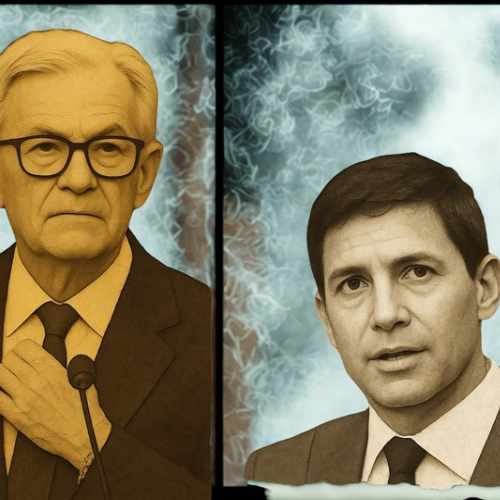
He survived political pressure, a criminal investigation, and markets swinging in every direction. And this week, Jerome Powell stepped down as chair of the Federal Reserve — the most powerful central bank in the world. But in true Powell fashion, he didn't fully leave. In this episode, we break down the story of one of the most consequential careers in modern economic history, and pick up five B2+ expressions that work in boardrooms, job interviews, and everyday life.
⚡ 5 Key Expressions
Expression 01
Swan song
A final performance, act, or achievement before someone retires or leaves. The phrase comes from an ancient Greek belief — later a recurring myth — that swans, which are normally silent birds, sing one extraordinarily beautiful song right before they die. It became a metaphor for a final, memorable act. The important rule: it must genuinely be the last one. You cannot have multiple swan songs. The moment you come back, the previous one no longer counts. Powell's farewell press conference was widely described as his swan song as Fed chair — a final, composed appearance before passing the baton.
- "The director's final film was widely considered his swan song — a masterpiece that summarized everything his career stood for."
- "She gave a brilliant presentation on her last day. A real swan song."
Expression 02
Unflappable
Completely calm and composed under pressure — impossible to fluster or rattle. The word comes from "flap," which in informal English can mean to panic or become agitated (think of a bird flapping frantically when startled). Add the prefix "un-" and you get the opposite: someone nothing can flap. What makes this word interesting is that "unflappable" is far more commonly used than "flappable" — the negative form became the useful one. It is a high compliment in professional settings, implying not just that someone stays calm, but that they appear constitutionally incapable of panic. Powell faced a divided committee, spiking oil prices, and geopolitical crisis — and answered every question in the same measured tone.
- "Even when the product launch failed publicly, our CEO remained unflappable in front of the press — no raised voice, no deflection."
- "My grandmother is unflappable. Last year a bat flew into her kitchen and she just shooed it out with a dish towel."
Expression 03
Stand firm
To hold your position, decision, or belief without giving in — even when someone is actively pressuring you to change. The origin is military: soldiers literally standing firm meant not retreating when the enemy advanced. Today the phrase has no military connotation at all. It applies wherever there is pressure: salary negotiations, policy decisions, personal boundaries, creative disagreements. The key preposition is "on" — you stand firm on something. The phrase implies both conviction and resistance. It is not passive stubbornness; it is deliberate, principled refusal to budge. The question hanging over Powell's successor is precisely this: will he stand firm on rate decisions when political pressure ramps up?
- "Despite investor pressure to rush the release, the development team stood firm on the original timeline."
- "My sister wanted to split the bill evenly, but I stood firm — she had ordered three desserts."
Expression 04
Keep a low profile
To deliberately avoid drawing attention to yourself — staying in the background, making few public appearances, and not making statements that would put you in the spotlight. The phrase implies choice: the person could be visible if they wanted to be, but they are consciously choosing not to be. This is what makes it different from simply being quiet. A celebrity keeping a low profile after a controversy. A senior executive keeping a low profile during a leadership transition. Powell used the phrase himself at his press conference, signaling that even though he will stay on as a Fed governor, he will not be the one driving the conversation. There is only ever one chair, he said. And that will be Kevin Warsh.
- "After the merger controversy, the outgoing CEO kept a low profile for several months — no interviews, no conference appearances."
- "I'm keeping a low profile at my cousin's wedding. Long story."
Expression 05
Shake out
To wait and see how an uncertain situation finally settles after a period of instability or change. The image is physical: you shake a container, and things move around unpredictably — but eventually everything lands somewhere. When we say "let's see how things shake out," we mean the situation is still in motion and we cannot yet know the final result. It is almost always used with "wait" or "see": "wait to see how it shakes out," "once the dust shakes out," "let's see how this shakes out." With a new Fed chair incoming, geopolitical tensions unresolved, and rate decisions on hold, markets are doing exactly that — waiting to see how everything shakes out.
- "We're holding off on new hires until the market shakes out a bit — no point committing before we know which direction things are heading."
- "I don't know who's coming on the trip yet. Let's just see how it shakes out."
🎭 The Dialogue: One Chair at a Time
Maya is an economist at a financial firm and Alex is her colleague. They are grabbing coffee before a big client call — and Powell's press conference is all anyone is talking about.
📍 Office kitchen, Thursday morning. Maya is watching a press conference replay on her phone. Alex walks in and reaches for the coffee.
Maya: Did you watch Powell's press conference this morning? That had to be his swan song as chair.
Alex: Completely. And true to form, he was totally unflappable — divided committee, oil prices spiking, and he just stood there like he was discussing the weather.
Maya: The real question is whether his successor will stand firm when Trump starts pushing for rate cuts.
Alex: That's the whole game now. Powell staying on as governor at least gives the Fed some backbone while things shake out.
Maya: Right. But he said he plans to keep a low profile. One chair at a time, basically.
Alex: Smart move. You don't want to look like you're running things from the back seat.
Maya: Still — after eight years, just walking away quietly? I'd want a parade.
Alex: Powell's not exactly a parade kind of guy. That's kind of the whole point.
🧠 Episode Quiz
Can you answer this?
Jerome Powell was first appointed as chair of the Federal Reserve in 2018. But which US president nominated him?
- A — Barack Obama
- B — Donald Trump
- C — Joe Biden
✅ Answer: B — Donald Trump. Powell was nominated by Trump in 2017 and confirmed in early 2018. Biden later reappointed him for a second term. And now, as his chairmanship ends, Trump is once again in the White House — making Powell's story one of the more ironic arcs in recent economic history.
📚 Bonus Vocabulary
True to form (phrase) — exactly as expected, behaving in the characteristic way you always do. Alex uses it to describe Powell's composure as completely predictable for anyone who has followed his tenure. It can carry admiration or gentle sarcasm depending on context. "True to form, she arrived twenty minutes late — and still managed to be the most prepared person in the room."
Backseat driver (noun/phrase) — someone who is not in control but keeps giving instructions to the person who is. Alex warns that Powell risks looking like a backseat driver if he stays too visible after stepping down. "He means well, but nobody wants a backseat driver on a project they're leading."
Backbone (noun) — courage, strength of character, or institutional resilience in the face of pressure. Having backbone means not collapsing when things get difficult. "The committee showed real backbone by refusing to revise the report under political pressure."