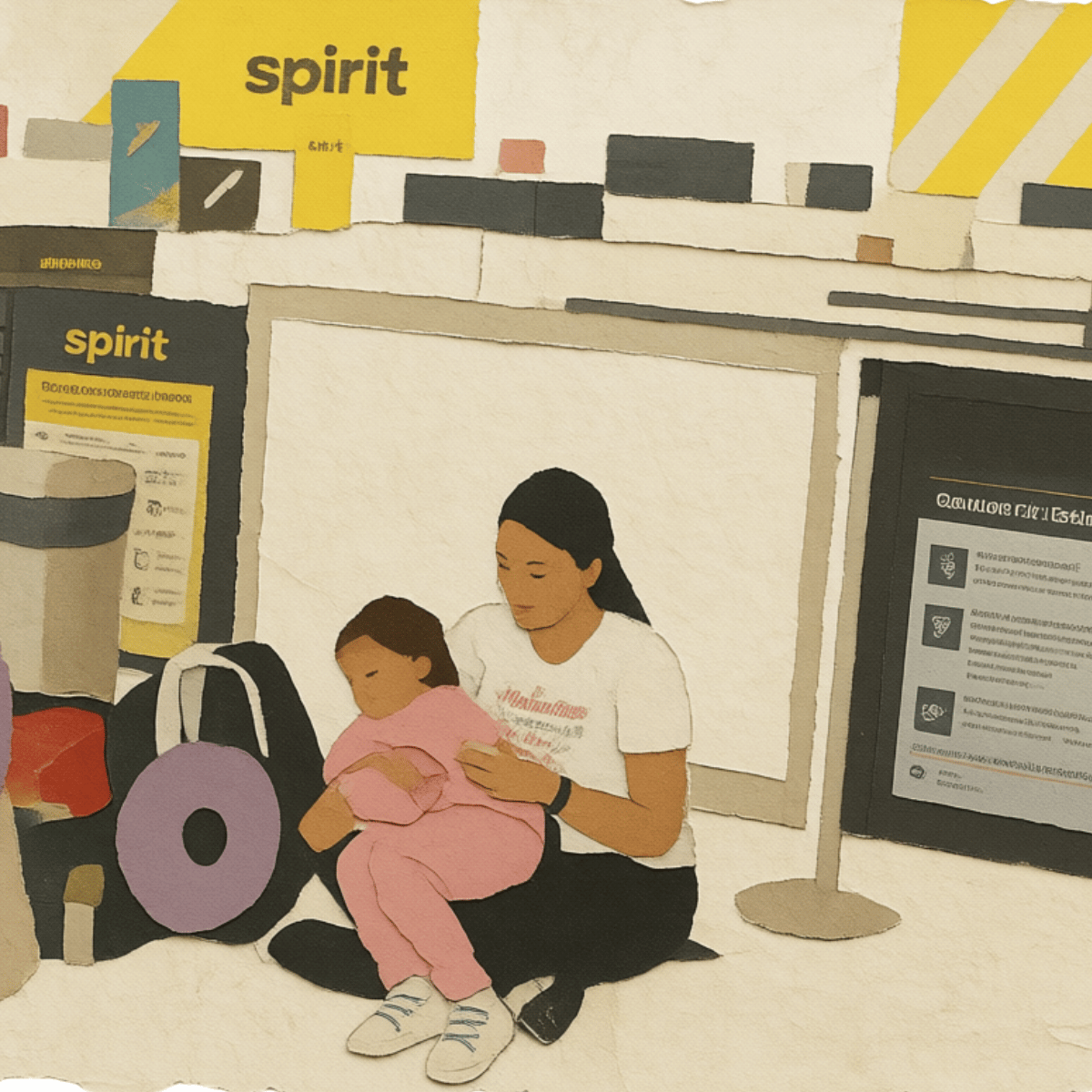
One of America's most recognizable budget airlines shut down overnight — no warning, no soft landing. Spirit Airlines closed up shop for good over the weekend, stranding passengers and putting seventeen thousand people out of work in a single morning. In this episode, we break down what happened and pick up five B2-level expressions that go far beyond the world of aviation.
⚡ 5 Key Expressions
Expression 01
Close up shop
To permanently stop operating — whether that's a business, a project, or any ongoing activity. The phrase comes from the literal act of a shopkeeper locking the door and flipping the sign at the end of the day. But in modern English, it almost always implies something more final than a temporary closure. When Spirit Airlines closed up shop, they didn't pause for restructuring. They stopped entirely. The phrase carries a quiet sense of finality that words like "shut down" or "end operations" don't quite capture. You'll hear it used for companies, committees, careers, and conversations alike.
- "After twenty years, the family restaurant finally closed up shop. The neighborhood hasn't been the same since."
- "We closed up shop on the research project when the funding ran out — there was nothing more we could do."
Expression 02
Up in the air
Uncertain, unresolved, or not yet decided. When something is up in the air, it hasn't landed anywhere — no one knows the outcome, the plan, or the answer. The image is perfectly intuitive: something thrown upward is neither here nor there, suspended between possibilities. In the Spirit story, the fate of seventeen thousand workers was left entirely up in the air after the airline collapsed with almost no notice. The phrase is extremely common across all registers — business meetings, casual conversations, and everything in between. It's also one of those expressions that earns a small smile when used in an aviation context, as it does here.
- "The merger talks are still up in the air — both sides are negotiating but nothing has been signed."
- "My plans for the summer are completely up in the air. I might travel, I might not. Who knows."
Expression 03
Price floor
The lowest level that prices in a market can realistically fall to, usually set by competition, regulation, or cost structure. Think of "floor" literally — it's the ground beneath you, the lowest surface possible. A price floor is the market equivalent: the point below which prices don't go. Spirit Airlines was so aggressively cheap that its fares effectively set a price floor for the entire budget airline industry. Every other carrier had to stay within a reasonable range of Spirit's prices to remain competitive. With Spirit gone, that floor has vanished — and other airlines are now free to charge more. The term is most common in economics and business, but it also appears naturally in salary negotiations and pricing strategy discussions.
- "The union negotiated a price floor on contractor wages — no one on the project could be paid below that rate."
- "I have a floor on what I'll accept for this job. Below that number, I'm not having the conversation."
Expression 04
Headwinds
Conditions or forces that make progress harder — obstacles working against you, often external and difficult to control. The metaphor comes from aviation and sailing: a headwind blows directly against you, slowing your speed even if your engine or effort stays constant. In business and financial reporting, "headwinds" has become one of the most widely used metaphors for market or economic difficulty. High fuel costs, rising interest rates, regulatory pressure, and declining consumer demand are all examples of headwinds. Its opposite — "tailwind" — describes favorable forces that push you forward without extra effort. Knowing both gives you a complete picture of how professionals talk about momentum and resistance.
- "The company delivered solid results despite significant headwinds from currency fluctuations and supply chain disruptions."
- "She's talented, but she's facing real headwinds — the industry is shrinking and the competition is fierce."
Expression 05
Cash in on
To take advantage of a situation — often one created by luck, timing, or someone else's misfortune — and turn it into profit or benefit. The phrase comes from the world of gambling: cashing in your chips means converting them into real money. In everyday English, it means seizing an opportunity before it closes. When Spirit collapsed, its low-cost competitors were positioned to cash in on the sudden availability of millions of budget-conscious travelers with nowhere else to go. Whether the phrase feels opportunistic or perfectly fair depends entirely on context. Cashing in on a rival's failure reads differently than cashing in on a decade of hard work — but the grammar is identical. Context carries the moral weight; the expression itself is neutral.
- "The documentary came out at exactly the right moment — the director cashed in on the public's growing interest in the subject."
- "After years of building her reputation quietly, she finally cashed in on all that groundwork and launched her own firm."
🎭 The Dialogue: No Soft Landing
Maya and Alex are both frequent flyers — or they were, anyway. They run into each other at an airport coffee stand on Monday morning, phones already buzzing with the news.
📍 Airport coffee stand, early Monday morning. Maya has just checked her phone. Alex arrives dragging a carry-on.
Maya: Did you see the news? Spirit just closed up shop. Completely. I had friends on a flight this morning that never took off.
Alex: I heard. Seventeen thousand jobs gone overnight. What happens to all those workers is still totally up in the air.
Maya: The crazy thing is, Spirit was so cheap it basically set the price floor for every other airline. Now that they're gone, fares are going to climb.
Alex: That's the headwind the whole budget airline industry is facing right now — fuel costs are through the roof because of everything going on in the Strait of Hormuz.
Maya: So who benefits from all this? JetBlue? Frontier?
Alex: Probably. The surviving low-cost carriers are going to cash in on Spirit's old customer base. Millions of people still need cheap flights.
Maya: I just feel for the passengers who got stranded. No refund, no rebooking, nothing.
Alex: Yeah. Sometimes there's no silver lining. You just get stuck holding a ticket that's worth exactly zero.
🧠 Episode Quiz
Can you answer this?
Spirit Airlines is famous for its bright yellow planes. But which airline was actually the first in the world to operate an entirely single-color, single-brand low-cost model?
- A — Southwest Airlines in the United States.
- B — Ryanair in Ireland.
- C — EasyJet in the United Kingdom.
✅ Answer: A — Southwest Airlines launched in 1971 in Texas with a radically simple model: one aircraft type, no frills, low fares. They essentially invented the low-cost carrier template that Spirit, Ryanair, and EasyJet all adapted later. In the end, Spirit was following a playbook someone else wrote decades ago — and couldn't make it work.
📚 Bonus Vocabulary
No-frills (adjective) — basic, without extras or luxuries. Spirit built its entire brand around the no-frills model: cheap base fares with fees for everything else, including carry-on bags. The word works in any context where simplicity replaces comfort. "It's a no-frills hotel — clean, functional, and half the price of everywhere else on the block."
Stranded (adjective/verb) — left without a way to continue or escape a situation. Passengers who showed up for Spirit flights on Saturday found themselves stranded at the airport — no flight, no alternative, no clear path forward. "Our connecting flight was canceled and we were stranded in Frankfurt for twelve hours with no luggage."
Silver lining (phrase) — a positive aspect hidden within a bad or difficult situation. From the old proverb: every cloud has a silver lining. Alex uses it at the end of the dialogue to acknowledge that for the stranded passengers, there really isn't one. "Losing the contract was painful, but the silver lining is that it freed us up to pursue something much better."