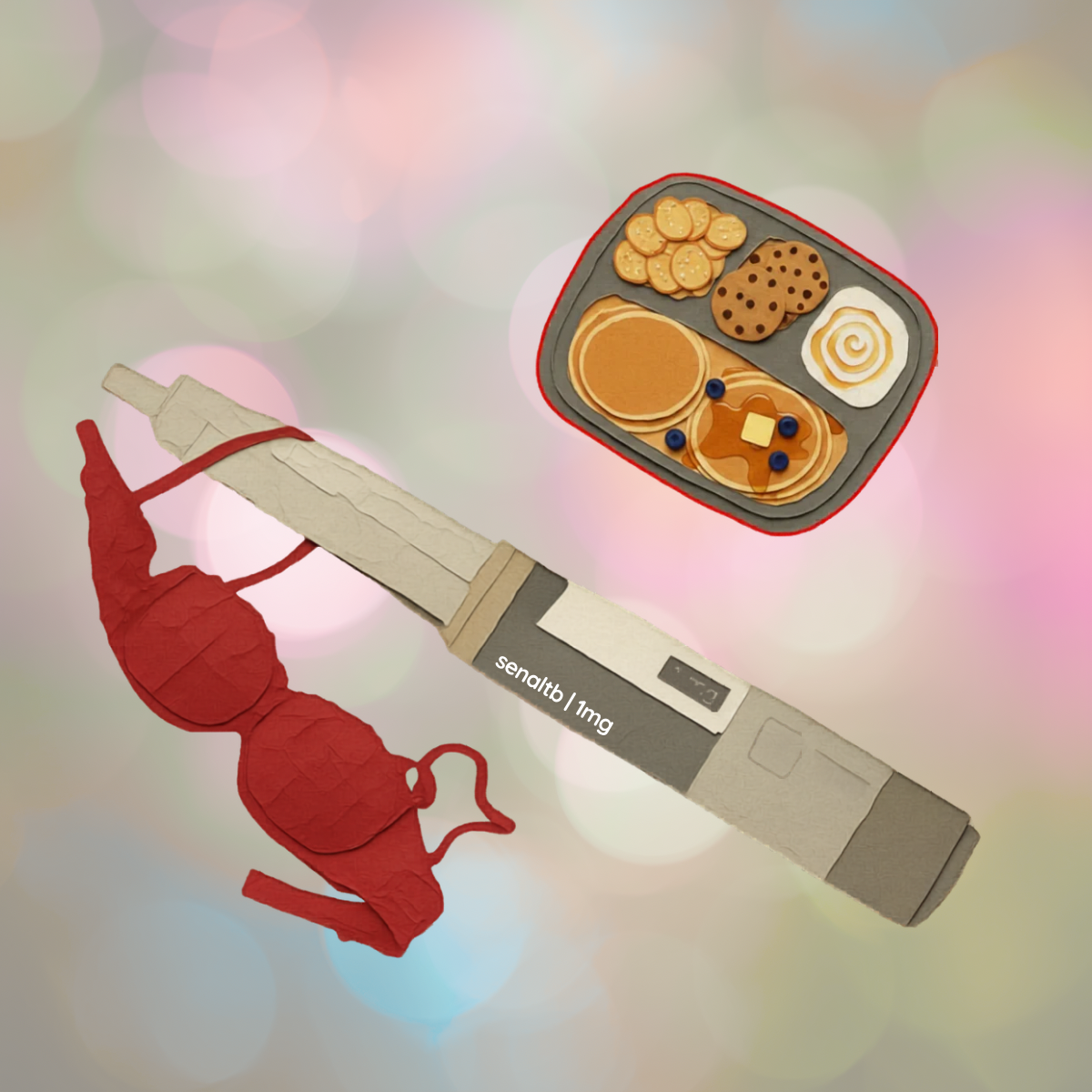
A weight-loss pill hits 1.3 million prescriptions in three months — and suddenly food companies, clothing retailers, and even hair care brands are scrambling to keep up. In this episode, we follow the money behind Novo Nordisk's Wegovy pill and pick up five B2+ expressions that will serve you well in business conversations, news discussions, and everyday life.
⚡ 5 Key Expressions
Expression 01
A bottomless pit
Something that consumes resources, money, or desire endlessly — with no point of satisfaction. The image is vivid: a pit is a deep hole in the ground, and if it has no bottom, you can pour things into it forever without it ever getting full. In business and news, you'll most often see it attached to demand, appetite, or spending. The article describes America's craving for GLP-1 drugs as "a bottomless pit" — meaning no matter how much supply grows, the appetite for these medications keeps outpacing it. The phrase works just as naturally for time, emotion, or ambition.
- "Their legal fees have become a bottomless pit — every month the invoices just keep climbing."
- "Don't ask me to help you move again. You own a bottomless pit of furniture."
Expression 02
Cannibalize
In business, to cannibalize means for one product to steal sales or customers from another product made by the same company. The word is borrowed from its literal sense — to consume one's own kind. Companies try hard to avoid cannibalization, because it means growth in one area comes at a direct cost to another part of the same business. The article raises the concern that Novo Nordisk's new pill version of Wegovy might cannibalize sales of its injectable version — but the data showed the opposite: both grew by reaching different types of customers. A nuance worth knowing: sometimes companies cannibalize themselves deliberately, preferring to disrupt their own product before a competitor does.
- "The streaming service worried its new ad-supported tier would cannibalize subscriptions from its premium plan."
- "I opened a second café downtown, but honestly it just cannibalized my original location."
Expression 03
Spillover effect
The impact of one event or development that flows beyond its original boundary into adjacent areas — often areas that seem unrelated at first. Think of a glass of water overfilling: the water doesn't stay neatly inside, it spills out in every direction. A spillover effect is what happens when the consequences of something can't be contained to where they started. The GLP-1 story is a perfect example: a pharmaceutical development is now producing spillover effects in food manufacturing, fashion retail, and beauty. The term is widely used in economics, business, and journalism, and carries no inherent positive or negative charge — spillovers can be welcome or disruptive.
- "The tech sector layoffs had a significant spillover effect on coffee shops and restaurants near office parks."
- "His bad mood had a spillover effect on the entire team meeting."
Expression 04
Gravitate toward
To be naturally drawn or pulled toward something — often gradually, almost without making a conscious decision. The word comes directly from gravity, the invisible force that pulls objects together. When people or markets gravitate toward something, the movement feels organic and steady rather than sudden or deliberate. This makes it the perfect verb for describing habits, preferences, and long-term trends. The article notes that GLP-1 users naturally gravitate toward smaller food portions and different retailers — not because they sat down and made a list, but because the drug quietly changes what their bodies want. Use it when you want to describe attraction that feels instinctive rather than calculated.
- "Investors tend to gravitate toward stable assets whenever markets get volatile."
- "Whenever we pick a movie together, she always gravitates toward thrillers. Every single time."
Expression 05
Spawn
To produce or give rise to something new — often rapidly, in large numbers, or unexpectedly. The word originally described what fish do when they reproduce, releasing large quantities of eggs. In modern English, it has moved well beyond biology. You'll find it in business journalism, tech writing, and everyday conversation to describe how one thing generates many others. The article notes that GLP-1's side effect of hair thinning has "spawned a budding industry of hair treatments" — meaning it didn't just inspire a product or two, it created an entirely new category. Spawn carries a sense of scale and often a hint of surprise: nobody planned for this, but here we are.
- "The success of that one podcast spawned an entire media company."
- "That one awkward office party story spawned about fifteen inside jokes that are still going three years later."
🎭 The Dialogue: Side Effects May Include Profits
Maya works in consumer goods marketing and Alex is a health-sector analyst. They're catching up over coffee on a Wednesday afternoon — and somehow a weight-loss pill becomes the most interesting thing in the room.
📍 A coffee shop near the office, Wednesday afternoon. Maya has her laptop open. Alex slides into the seat across from her.
Maya: Did you see Novo Nordisk's numbers? Their Wegovy pill is flying off the shelves.
Alex: I did. The demand for these GLP-1 drugs is just a bottomless pit. Every quarter the forecasts go up and the numbers still beat them.
Maya: What I found surprising is that the pill didn't cannibalize their injectable version. Both are growing.
Alex: Right — turns out people who'd never use a needle are a completely different customer. They expanded the market rather than splitting it.
Maya: And the spillover effect is wild. Food companies, clothing retailers, hair care brands — everyone is scrambling to adjust.
Alex: That's what happens when twenty-five million people are expected to be on these drugs by 2030. Consumers naturally gravitate toward smaller portions, different clothing sizes, different brands altogether.
Maya: I saw that L'Oréal already spawned an entire product line for GLP-1 users dealing with hair loss.
Alex: And that's just the beginning. When a drug changes how people eat, dress, and look, every consumer industry eventually feels it.
🧠 Episode Quiz
Can you answer this?
GLP-1 stands for glucagon-like peptide 1. It's a hormone your body produces naturally — but which organ makes it?
- A — The pancreas
- B — The small intestine
- C — The liver
✅ Answer: B — The small intestine. GLP-1 is released by cells in the lining of the small intestine in response to food. The pancreas responds to GLP-1 by releasing insulin — which is why the pancreas is a tempting guess — but it doesn't produce GLP-1 itself.
📚 Bonus Vocabulary
Rack up (phrasal verb) — to accumulate a large amount of something, usually quickly. The article says Wegovy's pill "racked up 1.3 million prescriptions" in three months. It often implies impressive speed or scale. "The startup racked up $10 million in revenue in its first year."
Cannibalize the pen (industry expression) — a specific use of cannibalize referring to the injectable (pen) form of a drug being displaced by a pill version. Broader lesson: English borrows concrete nouns (pen, needle) to stand in for whole categories. "The team worried the oral version would cannibalize the pen before international markets had even opened."
Fatten their margins (phrase) — to increase profit margins, often by cutting costs or pivoting to higher-value products. The article uses it when food companies like Nestlé add GLP-1-friendly labels to boost premium pricing. "They relaunched the product line specifically to fatten their margins ahead of the annual review."