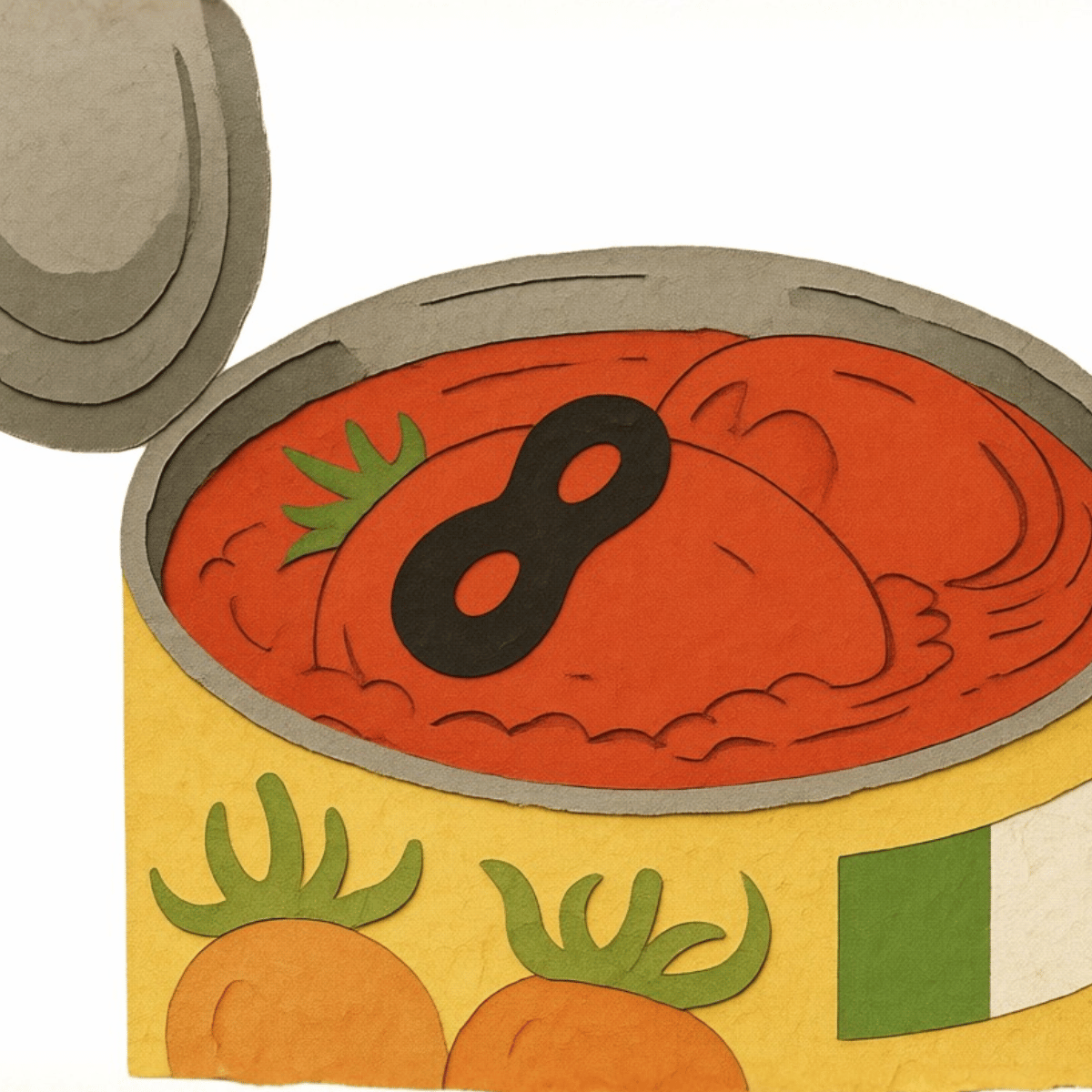
What if the premium Italian tomatoes you've been paying extra for — the ones you trusted for your pasta sauce — weren't actually the real thing? A lawsuit filed in California this week accuses a major food brand of doing exactly that: selling ordinary canned tomatoes under a prestigious label they had no legal right to use. Today we unpack the story of certified fraud, counterfeit labels, and the surprisingly high-stakes world of produce authenticity — and pick up five B2 expressions along the way that are anything but run-of-the-mill.
⚡ 5 Key Expressions
Expression 01
Trick into
To deceive someone so that they believe something false or take an action they wouldn't otherwise take. The structure is always: trick someone into doing or thinking something — the "into" anchors exactly what the deception was aimed at. This phrase implies deliberate manipulation, not accidental misunderstanding. You'll find it in legal contexts, consumer complaints, and everyday conversation wherever someone feels they were misled.
- "The pricing structure was designed to trick customers into subscribing without realizing the annual fee."
- "He tricked me into agreeing to help him move by saying it would only take an hour."
Expression 02
Lob (something) at (someone)
To throw something — physically or figuratively — in a high, forceful arc toward a target. The literal origin is sports: a tennis lob, a grenade lob. But in figurative English, you lob accusations, criticisms, or lawsuits at people. It implies the action is public, directed, and lands with impact. It carries more dramatic weight than simply "filing" or "making" a complaint — there's an aggressive quality to the throw.
- "The opposition lobbed accusations at the minister throughout the entire hearing."
- "She lobbed a few sharp criticisms at the proposal and walked out of the meeting."
Expression 03
Run-of-the-mill
Ordinary. Average. Unremarkable. Nothing special. The image comes from the textile industry — fabric that came straight off a mill without any special finishing or treatment was literally "run of the mill." Standard output, no distinction. Today the phrase describes anything that fails to stand out. It often carries a mildly disappointed or dismissive tone, as if you expected more and didn't get it. It works equally well for people, products, experiences, and ideas.
- "The conference was fine, but the keynote speaker was pretty run-of-the-mill — nothing we hadn't heard before."
- "I was hoping for something memorable, but the meal was honestly a bit run-of-the-mill."
Expression 04
Track down
To search for and successfully locate something or someone — usually after sustained effort. The "down" in this phrasal verb adds a sense of completion and persistence: you pursued it until you found it. You track down people, documents, sources, evidence, or anything that requires hunting. Importantly, you don't track down things that are easy to find — the phrase implies the search took real work. It's common in both formal (legal, journalistic) and casual contexts.
- "Our legal team spent weeks trying to track down the original purchase contracts from 2014."
- "I finally tracked down the name of that song I had stuck in my head for a month."
Expression 05
Meritless
Having no valid basis, substance, or justification. If something is meritless, it doesn't just fail to persuade — it has nothing worth taking seriously in the first place. The word lives mostly in formal and professional registers: legal proceedings, business decisions, policy debates. When someone calls an argument or claim meritless, they are making a strong, confident dismissal. It is the kind of word you use when you want to sound authoritative and final — which is exactly why Cento reached for it in their statement.
- "The board reviewed the complaint and found it entirely meritless — no further action was taken."
- "His argument isn't just weak. It's completely meritless and I'm surprised anyone is still discussing it."
🎭 The Dialogue: Something Doesn't Smell Right
Maya is a home cook who takes her pasta very seriously. Alex is her colleague who just read something online that is about to ruin her week. They're at the office, grabbing lunch.
📍 Office lunch area, midday. Maya is reheating pasta. Alex walks in looking like he has news.
Maya: Alex, I need to tell you something and I need you not to panic.
Alex: That is the most alarming way to start a Monday. What happened?
Maya: You know those San Marzano tomatoes I've been buying for years? The premium ones? Apparently there's a lawsuit saying the company has been trying to trick customers into thinking they're the real thing.
Alex: You're kidding. I thought those were certified. It says so right on the can.
Maya: That's exactly the problem. They switched to a different certifier a decade ago, and now someone has lobbed a fraud lawsuit at them claiming the label is basically counterfeit.
Alex: So what we've been buying is just... run-of-the-mill tomatoes in a fancy can?
Maya: Maybe! And now lawyers are trying to track down anyone who bought them to build the case.
Alex: What does the company say?
Maya: They called the whole thing meritless. Said they beat a similar lawsuit back in 2019 and they'll do it again.
Alex: Well. I guess my pasta was never as authentic as I thought.
Maya: Don't say that. I cannot live with that information.
🧠 Episode Quiz
Can you answer this?
San Marzano tomatoes carry a DOP certification in Italy — the Italian version of a European legal protection for food products tied to a specific region. But what does PDO — the English name for this protection — actually stand for?
- A — Protected Designation of Origin
- B — Protected Geographical Indication
- C — Premium Denomination of Origin
✅ Answer: A — PDO stands for Protected Designation of Origin. San Marzano tomatoes carry the Italian equivalent, DOP (Denominazione di Origine Protetta), which means the entire product — from seed to can — must come from a specific zone near Naples. Option B (PGI) is a real but looser standard that allows some processing outside the origin region. Option C doesn't exist. The distinction between PDO and PGI is exactly what's at the heart of this lawsuit.
📚 Bonus Vocabulary
Legitimacy (noun) — the quality of being legal, genuine, or properly authorized. The lawsuit centers on the legitimacy of Cento's San Marzano label. In broader use: "She questioned the legitimacy of the election results." A formal, high-utility word across law, politics, and business.
Counterfeit (adjective / noun) — made in imitation of something genuine, with intent to deceive. The lawsuit alleges the label is essentially counterfeit — not the real certification it appears to be. You'll see this word most often with currency, luxury goods, and documents. "Customs agents seized a large shipment of counterfeit handbags at the port."
Meritless is today's key expression, but worth noting as bonus too: the company called the allegations meritless — which is the formal legal language of confident denial. Compare with "baseless" (no factual foundation) and "frivolous" (not worth the court's time). All three dismiss a claim, but with slightly different shades.