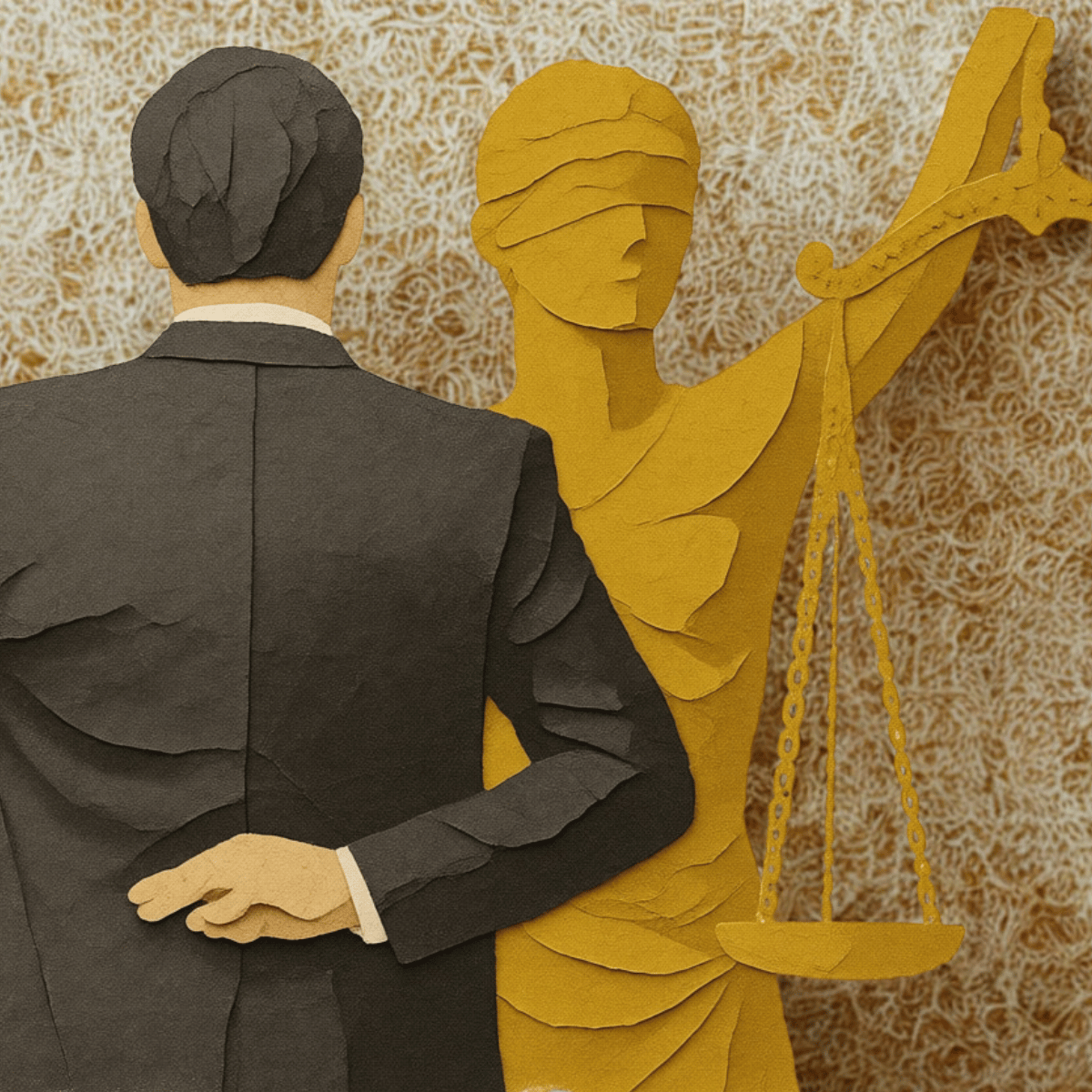
What happens when the lawyers who know the law best decide to break it? A decade-long insider trading ring, thirty defendants, secret codewords — and somehow, a hairdresser. In this episode, we dig into one of Wall Street's most brazen scandals and pick up five B2 expressions that work just as well in a boardroom as they do in everyday conversation.
⚡ 5 Key Expressions
Expression 01
Sound the alarm
To warn others that something is wrong — usually before the situation gets worse. The image is literal: you pull the fire alarm to alert people to danger. But in English, the phrase broke free from its physical origin long ago. When analysts noticed suspicious trading patterns in this story, some tried to sound the alarm for years before anyone listened. Use it whenever someone is raising a serious warning: about a business risk, a health issue, or a situation quietly heading off the rails. It carries a sense of urgency that simple words like "warn" don't quite capture.
- "The CFO sounded the alarm about the company's cash flow problems six months before the board took action."
- "I've been trying to sound the alarm about that guy's behavior for weeks — nobody wants to hear it."
Expression 02
Come under scrutiny
To become the subject of close, critical examination — usually from someone in authority. "Scrutiny" means intense, careful attention, and when something comes under scrutiny, a spotlight turns on it. The phrase almost always implies that something may be wrong, or at least questionable. In today's story, the trading scheme only came under scrutiny when the FBI noticed a pattern that was too perfect to be coincidence. You'll see this phrase constantly in news, law, and business contexts — it's a go-to for journalists and analysts alike. Worth noting: you come under scrutiny; you don't put yourself there willingly.
- "The merger came under scrutiny from regulators who questioned whether it would reduce competition in the market."
- "My expense reports came under scrutiny after the new finance team took over. Very uncomfortable."
Expression 03
Tip off
To give someone secret or advance information — a private heads-up that they aren't supposed to have. The noun form is "a tip-off." Tipping someone off can be protective (warning a friend that the boss is in a bad mood) or illegal (leaking confidential deal information to traders, as happened here). The phrase is common in crime reporting, sports, and casual conversation. Grammatically, it's a separable phrasal verb: you can tip off someone, or tip someone off — both are correct. As a noun, use a hyphen: "The tip-off came through a group chat."
- "An anonymous tip-off led investigators to the warehouse where the stolen goods were being stored."
- "She tipped me off that the meeting was going to run long, so I rescheduled my afternoon."
Expression 04
Brazen
Shockingly bold or shameless — doing something wrong without attempting to hide it, almost daring people to notice. "Brazen" is stronger than simply "bold" or "daring." It carries a layer of arrogance: the person committing a brazen act isn't just taking a risk, they seem almost contemptuous of the rules. The word has an interesting origin — it originally meant "made of brass," and brass was associated with hardness and shamelessness in old English usage. Today it shows up in serious news writing but also in casual speech. A brazen lie. A brazen foul on the court. A brazen attempt to cut the queue.
- "It was a brazen attempt to mislead investors — the company buried the loss in a footnote and hoped nobody would find it."
- "He walked into the meeting twenty minutes late and didn't even apologize. Completely brazen."
Expression 05
Ringleader
The person who organizes and leads a group — almost always a group doing something wrong or illegal. The word traces back to the circus: the ringmaster commands the ring. A "ring" in older English also referred to a gang or criminal network, so a ringleader is literally the one running the operation. It is almost never used positively. You would never call a community organizer or a startup founder a ringleader unless you were being deliberately sarcastic. In law enforcement, politics, and investigative journalism, identifying the ringleader is usually the goal — because cutting off the head of an operation is how you end it.
- "Prosecutors argued that although many people were involved, one man was clearly the ringleader of the entire conspiracy."
- "Okay, who's the ringleader of this surprise party plan? Someone's been very organized about keeping it secret."
🎭 The Dialogue: Inside Information
Maya and Alex work at the same company. It's a Tuesday morning and Maya has just read the news over coffee. Alex sits down and immediately gets an earful.
📍 A coffee shop near the office. Maya is scrolling through news on her phone. Alex sits down across from her with two cups.
Maya: Have you seen this? A lawyer ran an insider trading ring for over a decade. Thirty defendants so far.
Alex: I know. Apparently some analysts had been trying to sound the alarm about suspicious trading patterns for years.
Maya: And it only came under scrutiny when the FBI noticed trades lined up perfectly before every single acquisition at the same law firm.
Alex: The ringleader would tip off traders in Russia and New York right before a deal was announced. Via group chats, of all things.
Maya: They even used codewords. A company about to announce a merger was called a "rabbi" preparing for "surgery."
Alex: What I find incredible is how brazen it was. We're talking M&A lawyers at elite firms — people who literally know the laws they were breaking.
Maya: And the worst part? One of the traders actually called the scheme "genius" on a recorded phone call.
Alex: Well, he's probably rethinking that word right about now.
🧠 Episode Quiz
Can you answer this?
Today's story is about insider trading — using secret information to make money on the stock market. The most famous insider trading conviction in US history involved a very well-known lifestyle personality. Who was it?
- A — Martha Stewart
- B — Ralph Lauren
- C — Oprah Winfrey
✅ Answer: A — Martha Stewart was convicted in 2004, though technically for obstruction of justice — she lied to investigators about why she sold her shares in a biotech company called ImClone. The sale itself stemmed from an insider tip. She served five months in federal prison and went on to rebuild her brand entirely. Option B is a tempting guess because Ralph Lauren is also a lifestyle mogul, but he has never faced such charges. Oprah was never involved.
📚 Bonus Vocabulary
Defendant (noun) — a person accused of a crime in a court of law. Maya uses it in the opening line of the dialogue: "Thirty defendants so far." In civil cases, defendants are sued; in criminal cases, they are prosecuted. "The defendant pleaded not guilty and requested a jury trial."
Kickback (noun) — a secret payment made to someone in exchange for helping them make money illegally or unethically. In this story, traders who profited from the lawyer's tips would wire him a percentage of their gains. "The contractor was fired after investigators found evidence of kickbacks from subcontractors."
Hubris (noun) — excessive pride or self-confidence, especially the kind that leads to downfall. The article notes that the lawyers committed a "brazen crime" and attributes it partly to hubris — the belief that they were too smart to get caught. The word comes from ancient Greek and remains a favorite in journalism and literature. "His hubris was his undoing — he genuinely believed nobody would check the numbers."