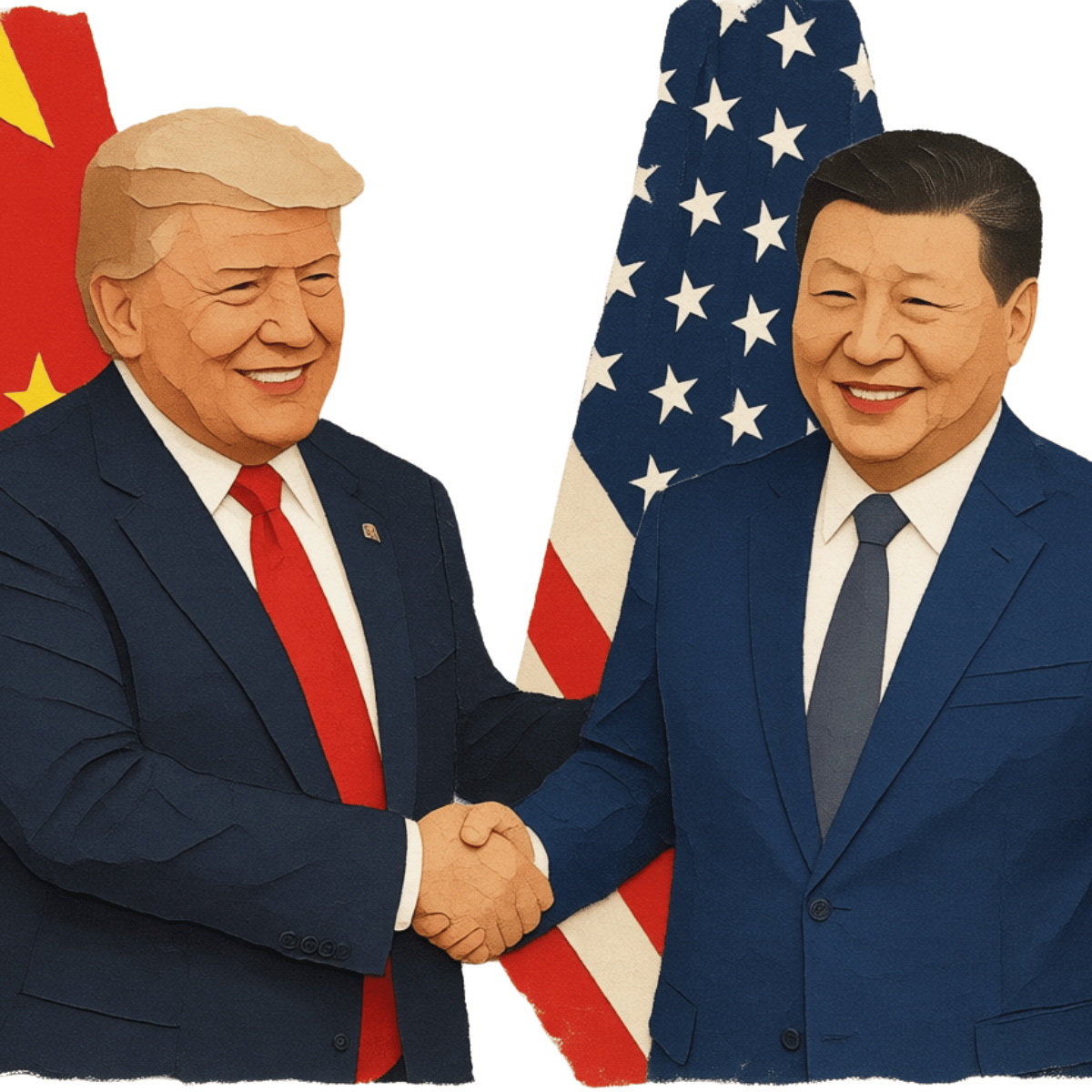
President Trump has just landed in Beijing for a two-day summit with Xi Jinping — and the stakes couldn't be higher. Trade deals, AI chip sanctions, Taiwan, and hundreds of billions of dollars are all on the line. In this episode, we use one of the most consequential diplomatic meetings in years to learn five essential B2 expressions that work in business, news conversations, and everyday life.
⚡ 5 Key Expressions
Expression 01
Set the stage
To create the conditions that make something important possible or likely. The image comes from theater — before a play begins, the crew arranges the set so the performance can happen. In the same way, when an event or decision "sets the stage" for something, it puts all the pieces in place for what comes next. The Trump-Xi summit sets the stage for how trade, technology, and global markets will move for the rest of the year. You'll hear this in business strategy, politics, and everyday planning — any time one thing prepares the ground for another.
- "Her early experience in finance set the stage for a highly successful career as a CFO."
- "That conversation set the stage for everything that happened between us afterward."
Expression 02
Caught in the crossfire
To be harmed or affected by a conflict between two other parties — even though the fight is not really about you. Crossfire literally means bullets coming from two directions at once; if you're caught in it, you're in the middle and taking damage despite being a bystander. In the summit context, companies like Boeing and Nvidia are caught in the crossfire of US-China tensions — they aren't the ones negotiating, but the outcome directly determines whether they win or lose billions. The phrase works wherever there's a two-sided conflict with collateral victims.
- "During the merger dispute, junior employees got caught in the crossfire and lost their jobs."
- "My two best friends had a falling out, and somehow I ended up caught in the crossfire."
Expression 03
Skin in the game
To have a real personal stake in an outcome — meaning you personally win or lose depending on what happens. The phrase comes from gambling and sports, where "putting skin in the game" meant betting something of your own. Today it signals genuine personal investment, not just interest or opinion. When Nvidia's CEO Jensen Huang flew to Beijing in person, that was a clear signal his company has serious skin in the game — billions in potential chip sales hang on the summit's outcome. Investor Warren Buffett uses this phrase often; it implies that someone with skin in the game has credibility because they're personally exposed to the risk.
- "The founder kept a large equity stake — she wanted to make sure she had skin in the game alongside her investors."
- "He keeps giving advice, but he has no skin in the game, so it's easy for him to say."
Expression 04
Back on the table
To be reconsidered as a live option after previously being dismissed or set aside. Picture a negotiating table — proposals and decisions sit on the table when they are actively being discussed. When something is "taken off the table," it's no longer in play. When it comes "back on the table," it has returned as a real possibility. In the episode, a potential trade deal puts Federal Reserve rate cuts back on the table — meaning cuts were looking unlikely due to inflation, but a deal could change the calculation. The word "back" is doing the crucial work: it signals that this option had a history of being rejected before its return.
- "After the new evidence emerged, the possibility of a retrial was back on the table."
- "I thought the job offer was gone, but they called me again — it's back on the table."
Expression 05
Woo
To charm, court, or strategically persuade someone in order to win their favor, support, or agreement. The word originally meant romantic courtship — to woo someone was to pursue them with attention and affection. That meaning still exists, but "woo" has long expanded into business and politics with a slightly knowing, ironic edge. When Xi Jinping met Trump in 2017, he arrived with a $253 billion trade package — a classic act of wooing a counterpart. You can woo investors, clients, voters, or partners. The romantic root gives the word a subtle implication: the charming is deliberate, calculated, and the other person may or may not see through it.
- "The startup spent months wooing venture capitalists before finally closing their Series A."
- "She completely wooed the interview panel — they offered her the job on the spot."
🎭 The Dialogue: Eyes on Beijing
Maya works in international trade consulting and Alex is a financial analyst. They ran into each other at a rooftop café in Seoul on the morning the summit began — and the conversation went exactly where you'd expect.
📍 Rooftop café, Seoul. Maya is scrolling through her phone. Alex arrives with two coffees.
Maya: I've been glued to the news all morning. Trump just landed in Beijing.
Alex: I know. This meeting has been months in the making — it really sets the stage for everything that happens in the markets this year.
Maya: Absolutely. And a lot of companies are going to get caught in the crossfire if the talks go badly.
Alex: Boeing, for one. And all the chipmakers. Jensen Huang flew there himself — that tells you Nvidia has serious skin in the game.
Maya: Do you think the AI chip restrictions will actually come up?
Alex: They have to. China wants those sanctions lifted. That puts rate cuts back on the table too, if a deal calms things down.
Maya: It's interesting — back in 2017, Xi basically wooed Trump with $253 billion in trade deals. Think he'll try the same playbook?
Alex: Probably. But China's in a much stronger position now. The wooing might go both ways this time.
🧠 Episode Quiz
Can you answer this?
We use the word "summit" to mean a high-level meeting between world leaders. But where does that diplomatic meaning actually come from?
- A — From the Latin word for "secret meeting," used in medieval diplomacy.
- B — From the literal meaning of summit — the top of a mountain — used as a metaphor for a top-level meeting.
- C — From a 1950s NATO document that first applied the term to diplomatic talks.
✅ Answer: B — The word "summit" in the diplomatic sense is a direct metaphor from mountain-climbing. The idea: the most powerful people in the world meeting at the very top. Winston Churchill helped popularize the usage in the early 1950s, and it stuck. Option C is tempting, but no single NATO document coined it — Churchill did most of the heavy lifting.
📚 Bonus Vocabulary
Glued to (phrase) — unable to stop watching or reading something because it's so compelling. Maya says she's been "glued to the news all morning." Think of glue: your attention is stuck and won't come away. "I was completely glued to the final episode — I didn't move for two hours."
Playbook (noun) — a set of strategies or tactics that someone relies on, originally from American football where plays are drawn up in a book. When Maya asks if Xi will "try the same playbook," she means the same strategic approach he used in 2017. "The company always uses the same playbook when entering a new market: low prices first, then expand."
Ceasefire (noun) — a temporary agreement to stop fighting, most commonly used in military or political conflicts. The newsletter mentions that the US and China reached a trade war ceasefire last fall. The word is increasingly common in business and trade contexts. "After months of legal back-and-forth, both companies agreed to a ceasefire while negotiations continued."