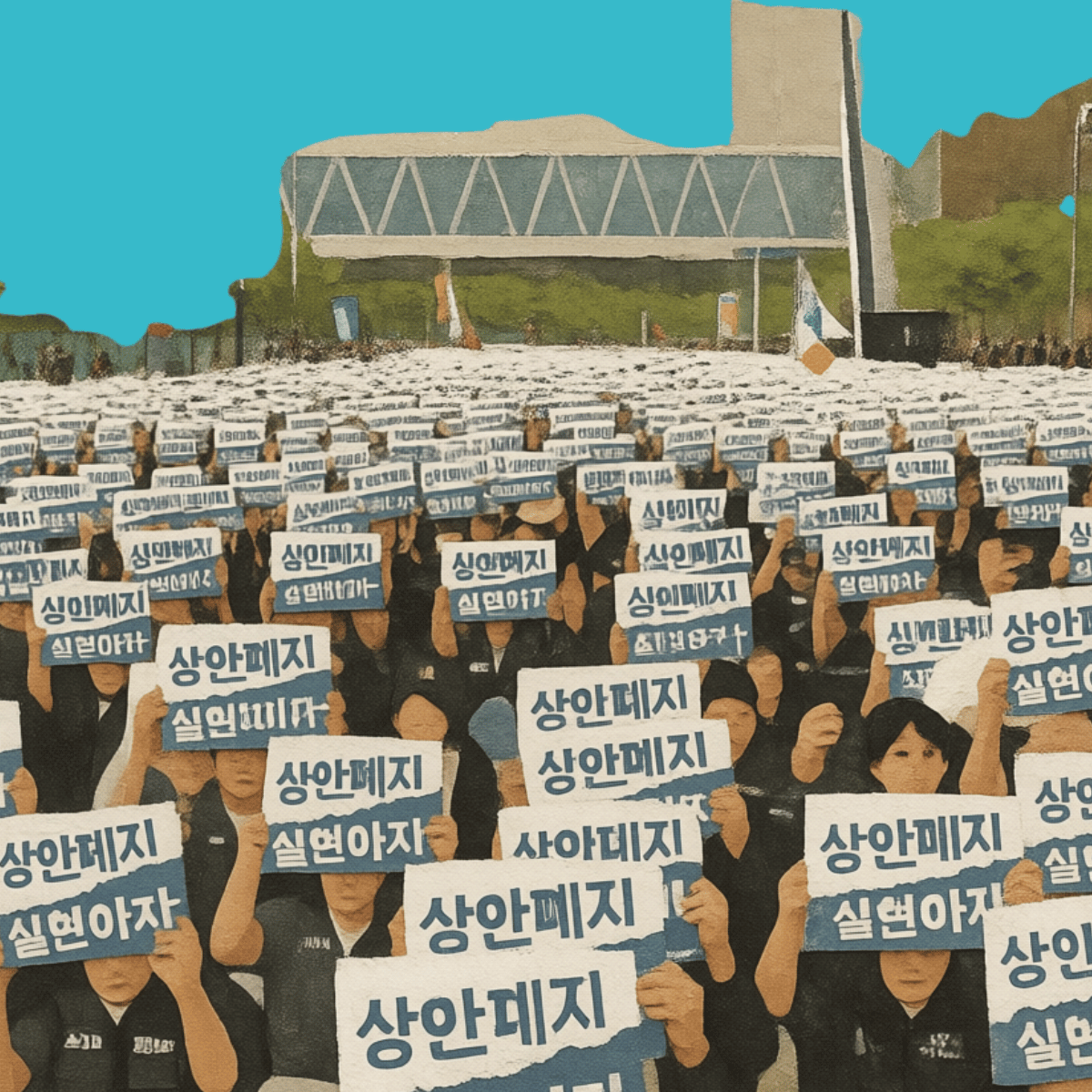
45,000 Samsung workers were three days away from walking out. The chips they make power AI servers, smartphones, and data centers worldwide — so a strike wouldn't just hurt Samsung. The disruption would ripple outward, hitting Nvidia, Apple, and every company that depends on memory chips. In this episode, we break down the Samsung DRAM strike story and pick up five B2 expressions that work in business conversations, career talks, and everyday life.
⚡ 5 Key Expressions
Expression 01
Stare down the barrel of
To face something dangerous, disastrous, or deeply unpleasant that feels unavoidable — like it's aimed directly at you. The image comes from staring into the end of a gun: the threat is real, it's close, and you can see it coming. In English, we use this figuratively any time a person, company, or industry is confronted with a serious crisis that seems hard to escape. The key feeling is not just danger, but inevitability. You can see what's coming, and you can't look away. When the Samsung strike was announced, the entire memory chip industry was staring down the barrel of a global supply disruption.
- "The team is staring down the barrel of a product launch with three engineers out sick and a deadline that won't move."
- "I stayed up until two AM and now I'm staring down the barrel of a seven AM call. Send help."
Expression 02
Dodge a bullet
To narrowly escape something that could have been very harmful — usually through luck rather than planning. To dodge means to move quickly out of the way, and a bullet moves fast: if you dodge one, the escape was close and the danger was real. This expression always implies a near miss. It wasn't a comfortable, well-managed outcome — it was a last-moment escape. That's why you can't use it when you prepared well and avoided a problem through skill. "Dodged a bullet" is for situations where things could very easily have gone the other way. Samsung dodged a bullet when a judge granted an injunction just days before the planned walkout.
- "The startup dodged a bullet when their lead investor pulled out before the product completely failed."
- "I almost said the wrong thing in that meeting. I really dodged a bullet when my phone rang."
Expression 03
Walk out
To leave a place or situation abruptly as a form of protest or rejection — not just as a neutral departure. When workers walk out, they leave their workplace collectively to make a point, usually as a strike or act of defiance. But the expression travels well beyond labor disputes. You can walk out of a meeting that's wasting your time, a negotiation that's going nowhere, a movie that's unbearable, or a relationship that's run its course. The noun form — a walkout — describes the act itself. What makes "walk out" distinct from simply "leave" is the attitude behind it: you're making a statement, not just going home.
- "Three board members staged a walkout during the vote, signaling they had no confidence in the direction."
- "He walked out of the movie after twenty minutes. Said it was the worst thing he'd ever seen."
Expression 04
Reap the rewards
To enjoy the benefits or profits that come from earlier effort, investment, or sacrifice. The verb reap comes from farming — it means to harvest crops. When you reap the rewards, you are collecting what you planted and tended. The phrase implies that the benefit was earned, not accidental. It sounds like a deserved payoff. Samsung's profits soared 750% in one quarter — a stunning result from years of investment in memory chip technology. The workers' argument was simple: they helped build that success, and they deserved to reap the rewards too. The phrase works equally well in business, career conversations, and personal life.
- "After three years of building her client base, she's finally reaping the rewards — referrals come in on their own now."
- "I started exercising six months ago and I'm finally reaping the rewards. I actually have energy in the mornings."
Expression 05
Further afield
Beyond the immediate or obvious area — at a greater distance from the starting point, whether physically, geographically, or conceptually. "Afield" comes from the image of a field: the space around you. "Further afield" means further out from that center. In business and news contexts, it's used to describe how an impact, influence, or problem spreads beyond its original source. But it's equally natural in personal contexts — describing a job search that expands to other cities, interests that range across topics, or research that reaches into unexpected territory. It's a precise and elegant phrase that signals broader reach without sounding dramatic.
- "The policy changes are affecting workers in Seoul, but the consequences are being felt further afield — in supply chains across Southeast Asia."
- "I started my job search locally, but I've been looking further afield — Tokyo, Berlin, maybe Toronto."
🎭 The Dialogue: Chips Are Down
Maya is a supply chain analyst and Alex works in tech investment. They're catching up over lunch — and the Samsung story comes up fast.
📍 A lunch spot near the office. Maya has her laptop open. Alex slides into the seat across from her.
Maya: Did you see what's happening with Samsung? Forty-five thousand workers almost went on strike.
Alex: I know. The whole memory chip industry was staring down the barrel of a massive supply disruption.
Maya: Exactly. And the pain wouldn't have stopped at Samsung — it would have been felt much further afield. Nvidia, Apple, every AI company buying DRAM.
Alex: For now though, Samsung dodged a bullet. A judge granted an injunction this morning and blocked the strike.
Maya: Barely. The workers were ready to walk out on May 21st. Three days away.
Alex: And honestly? I get it. Samsung's profits soared seven hundred and fifty percent last quarter. The workers want to reap the rewards too.
Maya: Right. Meanwhile SK Hynix already removed its bonus cap. Their employees stand to make nearly half a million dollars each.
Alex: That's how you keep people from walking out. Samsung is going to have to learn that lesson fast.
🧠 Episode Quiz
Can you answer this?
Samsung is one of the world's biggest tech companies — famous for chips, smartphones, and screens. But what did Samsung originally sell when it was founded in 1938?
- A — Insurance products
- B — Groceries and noodles
- C — Electronics components
✅ Answer: B — Groceries and noodles. Samsung was founded in 1938 as a small trading company in Daegu, South Korea, selling dried fish, locally grown groceries, and noodles. From dried fish to DRAM chips powering global AI — if that's not a story about reaping the rewards of playing a very long game, nothing is.
📚 Bonus Vocabulary
Injunction (noun) — a legal order from a court that requires someone to stop doing something, or prevents an action from taking place. In this story, a South Korean judge granted Samsung an injunction blocking the planned strike. "The court issued an injunction preventing the company from releasing the product until the patent dispute was resolved."
Windfall (noun) — a sudden and unexpected amount of money or good fortune, usually larger than anticipated. SK Hynix employees stand to make windfalls in excess of $470,000 after the company removed its bonus cap. The word originally referred to fruit blown down from trees by the wind — a lucky find that required no effort to harvest. "The surprise acquisition turned into a windfall for early investors who had held on through years of losses."
Upheaval (noun) — a major disruption, disturbance, or sudden change — usually one that throws an existing system into chaos. Analysts noted that any further upheaval at Samsung would benefit competitors like Micron. "The sudden leadership change caused upheaval across every department — no one knew what the new priorities were."