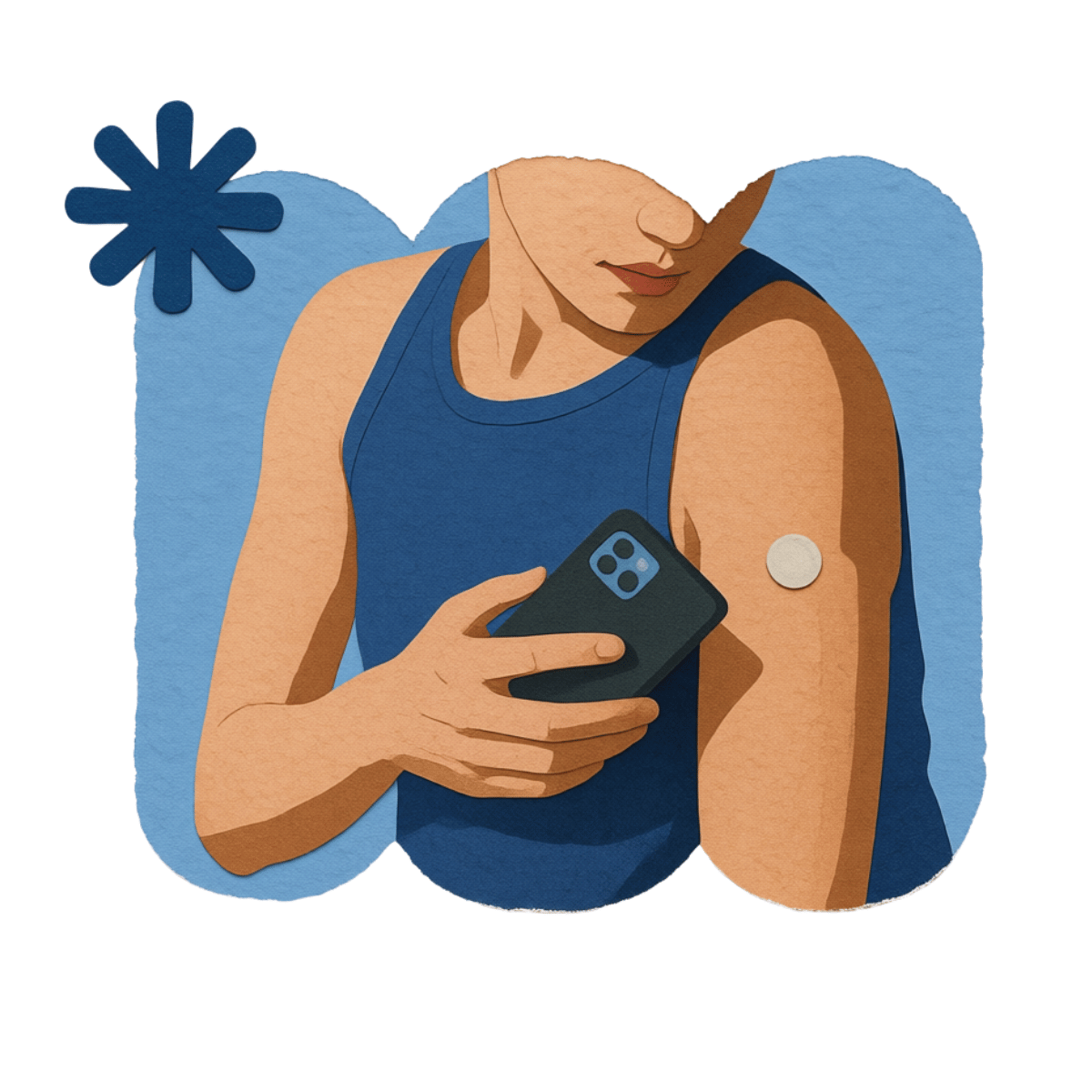
Eleven adults with Type 1 diabetes stopped using insulin after an experimental treatment. Could this be a cure? Scientists say: maybe — but it's still early days. In this episode, we dig into one of the most exciting medical headlines of the year and pick up five B2 expressions that go far beyond the lab. Whether you're talking about science, business, or everyday life, these phrases belong in your vocabulary.
⚡ 5 Key Expressions
Expression 01
Stay off
To successfully avoid or abstain from something — usually a substance, habit, or device — on an ongoing basis. The key difference between "stop" and "stay off" is duration and effort: stopping is a single moment, but staying off implies you kept it up. It always suggests discipline and conscious choice. When scientists reported that eleven patients had stayed off insulin, they weren't just saying those patients stopped one day — they meant the abstinence lasted. You can stay off alcohol, stay off social media, stay off a medication, or stay off junk food. The phrase works in formal and casual contexts alike.
- "His doctor told him to stay off caffeine for at least three months after the procedure."
- "I've been trying to stay off my phone before bed — it actually makes a huge difference."
Expression 02
Game-changing
Something that is game-changing doesn't just improve a situation — it fundamentally transforms how we approach it. The whole playing field looks different afterward. The metaphor comes from sports: a single move or player can shift the entire dynamics of a game. In English, we attach it to discoveries, technologies, policies, people, or decisions that create a before-and-after moment. A promising medical treatment, a new business model, a product launch — any of these can be game-changing if it rewrites the rules rather than just tweaking them. It is one of the most common adjectives in business journalism, so recognising it — and using it correctly — is genuinely useful.
- "The new remote work policy was game-changing for employee retention across the entire industry."
- "That documentary was game-changing for me — I see the whole issue completely differently now."
Expression 03
Hold out hope
To continue hoping for something even when the outcome is uncertain, difficult, or far away. The image buried in this phrase is physical: you are holding something out — extending it, refusing to let go. It is optimism with endurance built in. "Hold out hope" is used when the situation isn't guaranteed but giving up feels wrong. Scientists, advocates, and patients all hold out hope for a cure. It is more emotionally charged than simply "hope for" — it implies that hope requires effort and stubbornness. You can hold out hope for a person, a result, or that a particular thing will happen.
- "Despite the delays, the research team continued to hold out hope that the trial would yield results."
- "I know she hasn't replied in weeks, but I'm still holding out hope that everything is okay."
Expression 04
It's early days
A phrase used to express that a process or situation is still at an early stage, and it is too soon to draw firm conclusions. "Early days" does not necessarily refer to calendar time — a technology that has existed for two years can still be in its early days if its full impact hasn't emerged yet. The phrase signals cautious optimism: things are moving, but we should not overinterpret what we have seen so far. You will hear it frequently in science, finance, politics, and business — any time a speaker wants to acknowledge progress without overpromising. In American English, people often say "it's too early to tell" instead, but "early days" is widely understood globally.
- "The partnership looks promising, but it's still early days — we'll know more after the pilot quarter."
- "They've only been dating for a month. It's early days, so let's not get ahead of ourselves."
Expression 05
More questions than answers
A fixed idiomatic phrase used when a situation raises as many new uncertainties as it resolves. It does not mean failure — in fact, in science and research, generating good questions is a sign of genuine progress. The phrase is used to describe early-stage results, inconclusive investigations, surprising news, or any situation where clarity is still far away. Crucially, the tone depends entirely on context: "more questions than answers" can signal excitement, frustration, caution, or all three at once. You will see it in journalism, academic writing, business reports, and everyday speech. It pairs naturally with words like "raised," "left us with," and "still."
- "After two hours of the board meeting, we had more questions than answers about the merger timeline."
- "The documentary was fascinating but left me with more questions than answers about the whole case."
🎭 The Dialogue: A Shot at a Cure
Maya and Alex are both following the diabetes treatment story — and processing it very differently. Maya is hopeful. Alex is more measured. Over coffee on a Saturday morning, they find common ground.
📍 A coffee shop near their office. Saturday morning. Maya is nursing her second latte. Alex is trying to eat a croissant in peace.
Maya: Have you seen this? Eleven people with Type 1 diabetes completely stayed off insulin after some experimental treatment. Like, stopped entirely.
Alex: I saw that. It sounds game-changing — but I'm trying not to get too excited yet.
Maya: Why not? If this works, it could help millions of people. My cousin has Type 1. She gives herself injections every single day.
Alex: I get it. And I do hold out hope for her and everyone like her. But it's still early days. Eleven people is a tiny sample.
Maya: So what happens next? Do they just wait and see if it lasts?
Alex: Basically. The scientists aren't divulging much about the long-term plan yet, but there will need to be much bigger trials over many years.
Maya: So right now it's more questions than answers.
Alex: Exactly. But more questions than answers on something this big is still a pretty incredible place to be.
🧠 Episode Quiz
Can you answer this?
Insulin was first successfully used to treat a human patient in 1922 — a moment that changed medicine forever. But which animal provided the insulin used in that very first injection?
- A — A pig
- B — A cow
- C — A dog
✅ Answer: C — A dog. The first patient was a fourteen-year-old boy named Leonard Thompson, treated in Toronto by researchers Frederick Banting and Charles Best. The insulin was extracted from a dog's pancreas. It saved his life. Banting won the Nobel Prize the following year. Animal-derived insulin was used for decades before synthetic versions became available.
📚 Bonus Vocabulary
Promising (adjective) — showing signs of future success, but not yet confirmed. Scientists described the diabetes trial results as "promising" — a deliberately careful word. It means things look good, but more evidence is needed. "The early data is promising, but we're waiting for the full study before drawing conclusions."
Divulge (verb) — to reveal information, especially something that was previously private or withheld. It carries a slight sense of secrecy being broken. Stronger and more deliberate than simply "share." "The company refused to divulge the terms of the settlement."
Sample size (noun phrase) — the number of participants in a study or experiment. A small sample size, like eleven people, means results may not apply broadly. Scientists always push for larger samples before drawing firm conclusions. "The findings are interesting, but the sample size is too small to be statistically significant."