
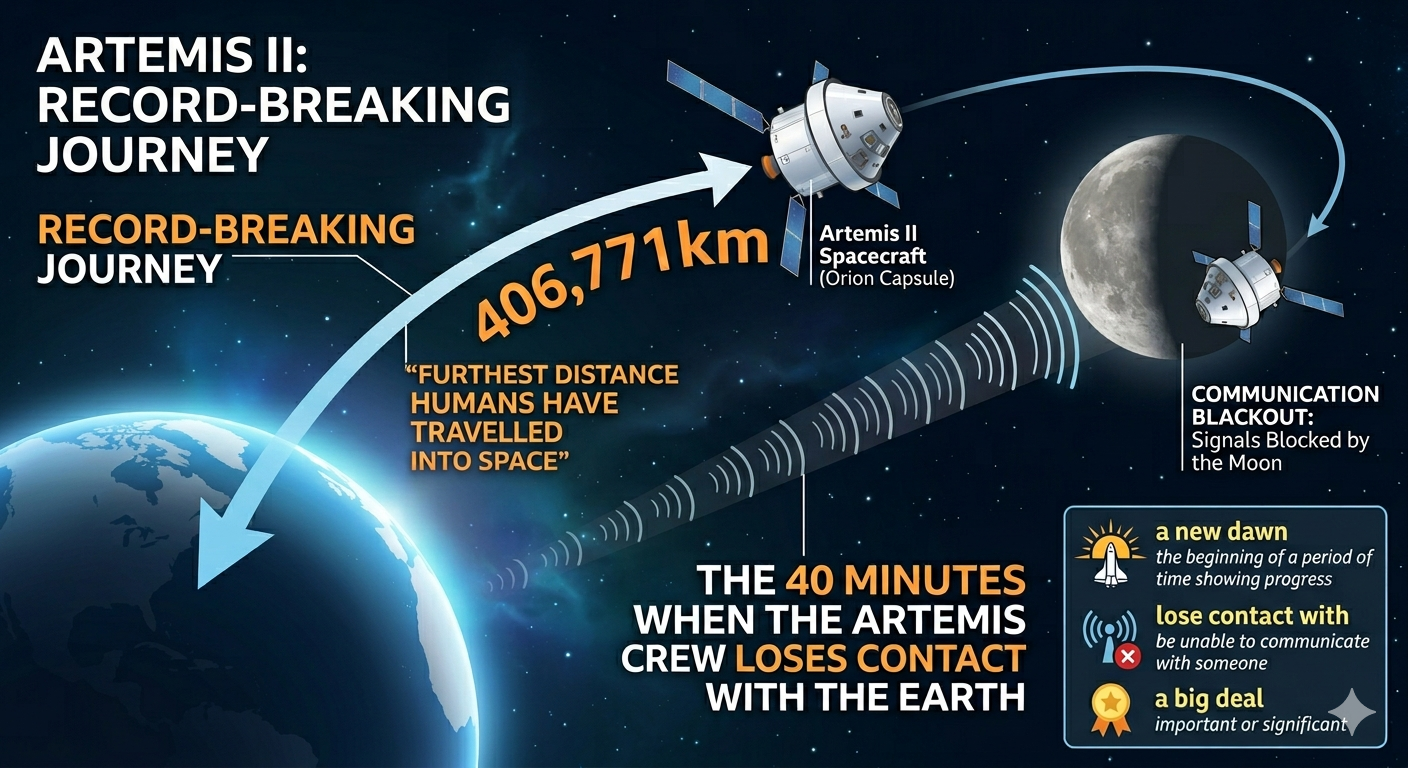
1. a new dawn
Basic Definition: The beginning of a period of time showing progress.
Detailed Explanation: The Linguistic Boost
This is a powerful, metaphorical expression derived directly from nature. Literally, "dawn" is the time when the sun first appears in the sky, marking the definitive end of the night and the beginning of a new day.
Metaphorically, "a new dawn" is used to describe the start of a significantly changed, completely new period of time. It signals a major historical era, a fundamental technological shift, or a dramatic social transformation. This phrase almost always carries positive connotations, implying hope, progress, fresh opportunities, or a recovery from a previous difficult period (like the darkness before the dawn). When used in the context of Artemis II (as in the "new dawn in spaceflight" headline), it signifies a fundamental shift, moving beyond past eras like Apollo towards something unprecedented in lunar exploration.
Extra Examples:
- "The global adoption of renewable energy technologies marked a new dawn for sustainable urban planning." (Focus on innovation and progress).
- "Following years of isolation, the opening of the new trade route was described by locals as a new dawn for the city's economy." (Focus on recovery and new opportunities).
- "Her first exhibition was more than just a gallery show; it was a new dawn for her entire career as an artist." (Focus on personal transformation and start).
2. lose contact with
Basic Definition: Be unable to communicate with someone.
Detailed Explanation: The Linguistic Boost
This phrase describes a state where the ability to communicate has ceased or is impossible. It is extremely versatile, used in both a precise technical sense and a broader social sense.
- In a technical/physical sense: (as seen in the Artemis II example where signals are blocked by the Moon): It means communication links (radio, telemetry, phone connection) are physically broken, either temporarily or permanently, often by distance, environmental interference, or hardware failure.
- In a social/personal sense: It means you simply have not communicated with or heard from a person for an extended period. This can happen accidentally (losing track of someone), intentionally (choosing not to speak), or by drifting apart naturally. It often implies a gap in the timeline of communication. (Note: Compare to the simpler "lose touch with" for social drifting).
Extra Examples:
- "The deep-sea research vessel lost contact with mission control after descending below the thermocline." (Technical: physical block).
- "I tried calling my old business partner, but I realized I have completely lost contact with him over the last five years." (Social: gap over time).
- "She has lost contact with all her former classmates since they all moved to different continents." (Social: distance-based separation).
3. a big deal
Basic Definition: Important or significant.
Detailed Explanation: The Linguistic Boost
This is a widely used, informal idiomatic expression. While 'deal' might imply a business transaction, in this context, it is metaphorical. Calling something "a big deal" emphasizes that it is very important, crucial, serious, impressive, or highly consequential.
The phrase is highly subjective; whether something is "a big deal" depends entirely on the context and the speaker’s values. It’s often used in contrast with "no big deal" (for trivial matters) or "a little deal" (rarely, but possible). It is heavily used in spoken and journalistic English to quickly emphasize the magnitude or impact of an event. In the context of Artemis II (the phys.org headline), calling the mission "a big deal" highlights its immense significance compared to ordinary space activity.
Extra Examples:
- "For many scientists, publishing their first major research paper in a renowned journal is a really big deal." (Focus on achievement and career importance).
- "Getting the opportunity to pitch our idea directly to the CEO was a huge deal for our startup team." (Focus on unique opportunity).
- "Winning the local spelling bee might seem small to some, but to his parents, it was a big deal." (Focus on relative, personal significance).