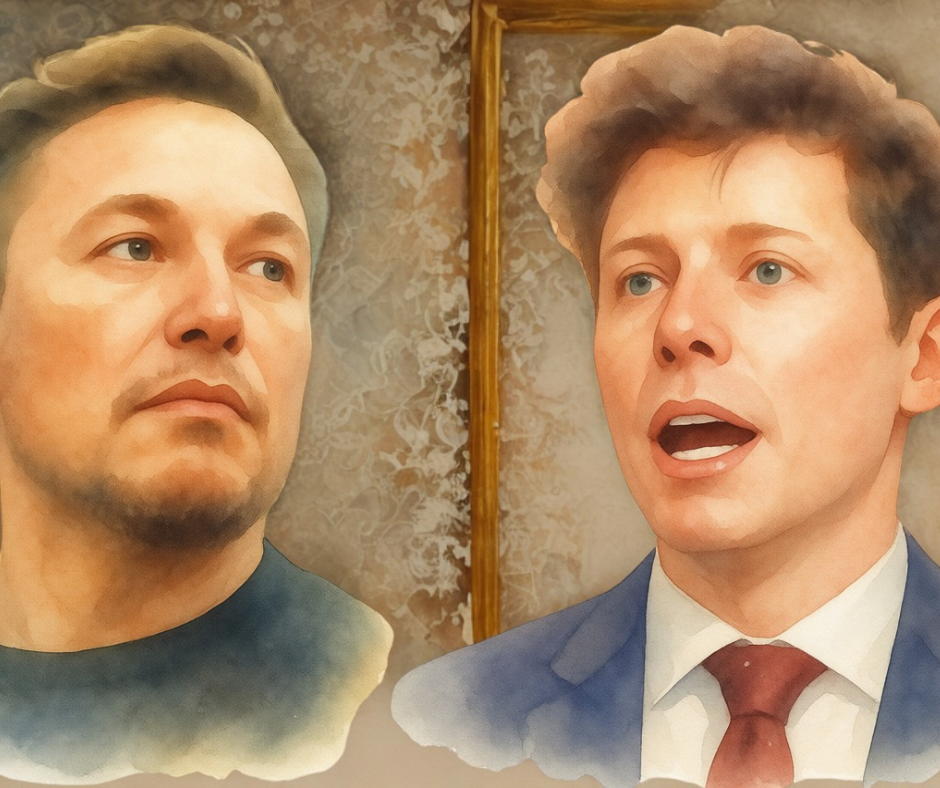
Two tech titans. One courtroom. And five expressions you can use for the rest of your life. Elon Musk and Sam Altman — once collaborators, now sworn rivals — are facing off in a California trial that could reshape the entire AI industry. In this episode, we break down the drama, unpack the legal vocabulary, and pick up five B2 expressions that go far beyond the courtroom.
⚡ 5 Key Expressions
Expression 01
Culmination
The highest or final point of a long process — the moment when everything that has been building finally arrives. It comes from the Latin culmen, meaning "peak" or "summit." When you describe something as the culmination of a process, you are saying it didn't happen suddenly. It was the result of everything that came before it. The Musk-Altman trial is the culmination of a friendship that turned into a rivalry over nearly a decade. You'll hear this word in journalism, formal speeches, and anywhere a long arc reaches its conclusion.
- "The product launch was the culmination of eighteen months of development — and it showed."
- "Finishing the marathon felt like the culmination of everything I'd worked toward for two years."
Expression 02
The crux of
The central, most essential point of something — the part that everything else depends on. Strip away the noise, the details, the side arguments, and the crux is what remains. The word comes from Latin, meaning "cross," and the image of a crossroads is useful: the crux is the point where all the paths meet. In this trial, the crux of Musk's case is a single claim — that OpenAI broke a founding promise. In professional settings, saying "the crux of the matter is..." signals that you are cutting through complexity and getting to what truly counts.
- "Let me get to the crux of the issue — we're not disagreeing on the goal, we're disagreeing on the timeline."
- "The crux of her argument was simple: the data didn't support the conclusion."
Expression 03
Baseless
Without any foundation, evidence, or justification. The prefix "base" in English refers to a foundation — the base of a building, the base of an argument. If something is baseless, it has no base. Nothing is holding it up. OpenAI used this word deliberately when responding to Musk's accusations: calling something "baseless" is not just saying it's wrong. It's saying there was never anything there to begin with. The word carries a slightly formal, prosecutorial tone, which makes it powerful in arguments, reports, and professional writing.
- "The report was based on baseless assumptions — none of the figures had been independently verified."
- "That rumor is completely baseless. No one has any evidence for it."
Expression 04
Derail
To cause something to go off course, fail, or collapse — especially something that was previously on track. The image is literal: a train that derails leaves its tracks and everything goes wrong. In everyday English, you can derail a plan, a project, a conversation, a career, or — as in this trial — a competitor's future. What makes the word particularly useful is that derailing can be accidental or deliberate. Bad weather can derail a schedule. A person can deliberately derail a meeting. Context tells you which. OpenAI argues that Musk's lawsuit is a calculated attempt to derail the company before its IPO.
- "Budget cuts derailed the entire project just three weeks before launch."
- "One critical comment from the director was enough to derail the whole presentation."
Expression 05
Slated to
Officially scheduled, expected, or planned to do something. When someone is "slated to" do something, it has been formally arranged or announced — though it hasn't happened yet. The word "slate" originally referred to a writing slate, the kind used to post schedules and announcements in public places. If your name was on the slate, you were up next. Today, "slated to" is used in journalism, business, and professional conversation to describe what is planned: who will speak, what will happen, when things are expected to occur. It adds a sense of formality and certainty — while leaving room for things to change.
- "She is slated to become the youngest partner in the firm's history when the announcement is made next month."
- "The new policy is slated to take effect in January, but the details are still being finalized."
🎭 The Dialogue: Front Row Seats
Maya works in tech and Alex is a journalist covering the AI industry. They ran into each other at a coffee shop on a Saturday morning — and the conversation went exactly where you'd expect.
📍 A coffee shop, Saturday morning. Maya is on her laptop with a cold brew. Alex walks in and spots her immediately.
Alex: Maya! You're the perfect person to run into right now. Are you following the Musk-Altman trial?
Maya: Are you kidding me? It's the culmination of years of bad blood. I've been refreshing the news all morning.
Alex: I'm covering it for the magazine. The crux of the case is that Musk claims OpenAI broke its original promise to stay nonprofit.
Maya: And OpenAI says that's completely baseless — that Musk is just trying to derail a competitor.
Alex: Exactly. Both sides have a point, honestly. But the real tea is who's slated to testify.
Maya: I know — Musk, Altman, and apparently even the CEO of Microsoft. That courtroom is going to be chaos.
Alex: One legal expert called it "the Hindenburg landing on the deck of the Titanic."
Maya: Which means everyone is going down, and somehow we're all watching from the front row.
🧠 Episode Quiz
Can you answer this?
You know that the "v." in a court case name — like Musk v. Altman — stands for "versus." But in which country did the legal tradition of using "v." between two parties in a court case actually originate?
- A — The United States, where adversarial court proceedings were formalized after independence.
- B — England, through centuries of common law tradition.
- C — Ancient Rome, where the Latin word "versus" was first used in legal disputes.
✅ Answer: B — England. The tradition comes from English common law, which became the foundation of legal systems across the UK, the United States, Canada, Australia, and beyond. While "versus" is Latin in origin, the convention of naming cases with "v." between the parties developed through English courts over centuries. Rome gave us the word. England gave us the format.
📚 Bonus Vocabulary
Bad blood (noun phrase) — long-standing hostility or bad feeling between people. Maya uses it to describe the years of tension between Musk and Altman before the trial. It's idiomatic and slightly informal, but widely understood. "There's been bad blood between those two departments ever since the merger."
Nonprofit (noun / adjective) — an organization that operates for a public or social purpose rather than to generate profit for owners or shareholders. At the crux of this trial is whether OpenAI violated its founding commitment to remain one. "She left her corporate job to run a nonprofit focused on digital literacy."
Testify (verb) — to give formal evidence or a statement under oath in a court of law. Multiple major figures in the AI industry are slated to testify in this trial. "The whistleblower agreed to testify before the committee despite the risks."