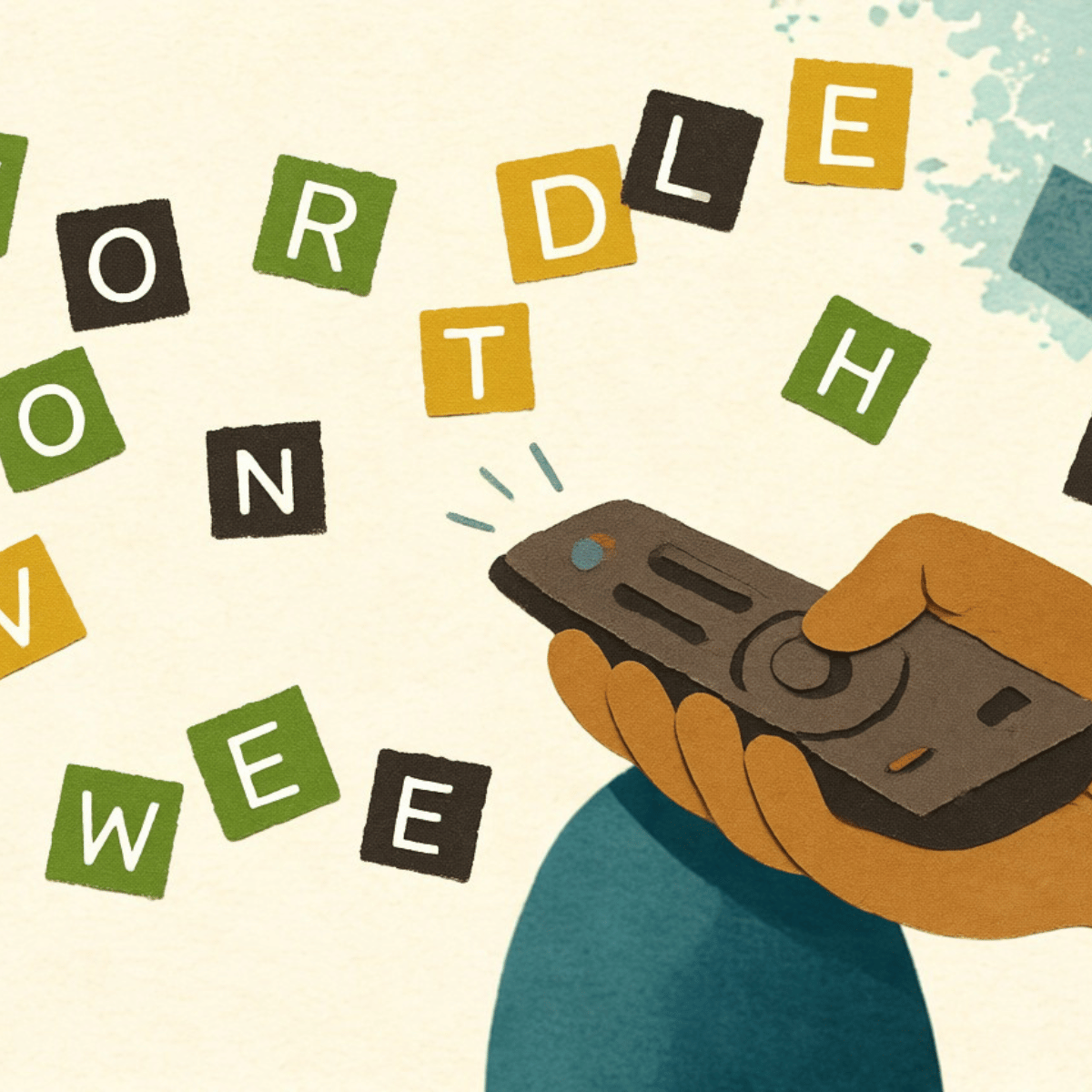
A free browser game with one puzzle per day somehow became one of the most talked-about things on the internet — and now it's heading to NBC primetime. The New York Times bought Wordle for around a million dollars in 2022, and the move has paid off in ways nobody predicted. In this episode, we break down that story and pick up five B2 expressions that work everywhere: in business, in job interviews, and in everyday conversation.
⚡ 5 Key Expressions
Expression 01
Set to
Scheduled or expected to happen — with a sense that plans are already in place and the outcome is likely. It's stronger than "planning to," which still leaves room for things to fall through. "Set to" implies something is locked in. You'll find it constantly in news headlines and professional communication: "The company is set to report earnings next Friday." "She's set to take over as director in June." The structure is always the same: subject + is/are + set to + verb.
- "The merger is set to close by the end of the quarter, pending regulatory approval."
- "We're set to leave at eight — don't be late."
Expression 02
Expand beyond
To grow into areas outside your original focus or identity. The phrase always implies a before-and-after: there was a lane you operated in, and now you're moving into new territory. The New York Times started as a newspaper, added puzzles, and is now entering primetime TV — each step is expanding beyond the previous one. The structure is flexible: you can expand beyond a market, a product, a role, a city, or a comfort zone. It's especially useful in career conversations and business strategy discussions.
- "The brand has successfully expanded beyond its core demographic to attract younger consumers."
- "After five years in customer service, she was ready to expand beyond her current role."
Expression 03
Bid to
An attempt or effort to achieve something — especially a deliberate, strategic one. The word comes from auctions, where a "bid" is an offer you make to win something. But "a bid to do something" means you're actively trying to make it happen. It always carries a sense of ambition. "Their latest bid to break into the entertainment market." "Her bid to become the first woman in the role." Grammatically, note that "bid to" is always followed by a verb in its base form — never "bid for expanding" or "bid for entering."
- "The startup's bid to challenge the industry's biggest players has drawn significant investor attention."
- "His bid to finish the project before the deadline didn't quite work out."
Expression 04
Shield from
To protect something or someone from harm, damage, or negative effects. The image is deliberate — a shield is held up on purpose. This is what makes "shield from" stronger than simply "protect from": it implies active, intentional effort. In the Wordle story, the NYT's Games section shielded the company's revenue from the broader decline in news readership. The expression works literally ("the awning shielded us from the rain") and figuratively ("the savings shielded the family from the worst of the recession").
- "A diversified portfolio can help shield your investments from short-term market volatility."
- "Working from home has somewhat shielded her from the stress of office politics."
Expression 05
Roll out
To officially introduce or launch something — usually in a planned, staged way rather than all at once. The image is of unrolling a scroll or a carpet: slow, deliberate, controlled. Tech companies roll out software updates. Governments roll out new policies. Brands roll out new products. The key nuance is that a rollout implies stages and intentionality. If something happens all at once without planning, you wouldn't call it a rollout. "The new feature will be rolled out to all users by the end of the month."
- "The company plans to roll out the updated platform across all regional offices before the summer."
- "They're rolling out a new rewards program — I think it starts next week."
🎭 The Dialogue: Game On
Maya works in digital media and Alex is a product manager. They're grabbing lunch and the conversation somehow lands on a word game that's taking over television.
📍 Office lunch spot, midday. Maya has her phone out. Alex sits down with a tray.
Maya: Did you hear? The New York Times is set to launch a Wordle game show on NBC next year.
Alex: No way. So they're finally trying to expand beyond just news and puzzles?
Maya: Exactly. It's their latest bid to break into primetime entertainment. Apparently Jimmy Fallon is co-producing it.
Alex: That's a smart move. Games have helped shield the Times from the worst of the decline in print and digital news.
Maya: Right. And now they're ready to roll out the whole thing on broadcast TV — cash prizes, a live audience, the works.
Alex: I just hope they don't ruin it. Half the appeal of Wordle is that it's one quiet puzzle a day.
Maya: True. But if they pull it off, it could introduce the brand to a completely different audience.
Alex: Or it bombs and we all go back to just doing it on our phones at breakfast.
🧠 Episode Quiz
Can you answer this?
Wordle became a global phenomenon almost overnight — but the game wasn't built by the New York Times. Who actually created Wordle, and what was his original reason for making it?
- A — A Google engineer who built it as a side project to practice coding.
- B — A software developer who made it as a gift for his partner, who loved word games.
- C — A linguistics professor who designed it to help students learn vocabulary.
✅ Answer: B — Wordle was created by Josh Wardle, a software engineer, as a gift for his partner Palak Shah, who loved word games. He released it publicly in October 2021. Within months, it had gone from a few dozen players to millions. The New York Times bought it in January 2022 for a price reported to be in the low seven figures.
📚 Bonus Vocabulary
Primetime (noun / adjective) — the evening hours of television broadcasting, typically between 8 and 11 PM, when the largest audiences are watching. "Primetime" also functions as an adjective meaning high-profile or peak. "Getting a primetime slot on a major network is a huge deal for any production."
Pull it off (phrasal verb) — to succeed at something difficult or risky. Maya uses it to say that if the NYT can actually make a successful TV show out of Wordle, that would be impressive. "Nobody thought they could launch a new product in three months, but they pulled it off."
Low seven figures (phrase) — a way of describing a number between roughly one and three million dollars without stating the exact amount. "Seven figures" means a number with seven digits (one million to nine point nine million). "Low" means toward the bottom of that range. Common in business and financial reporting when exact terms aren't disclosed. "The acquisition was completed for a price in the low seven figures."