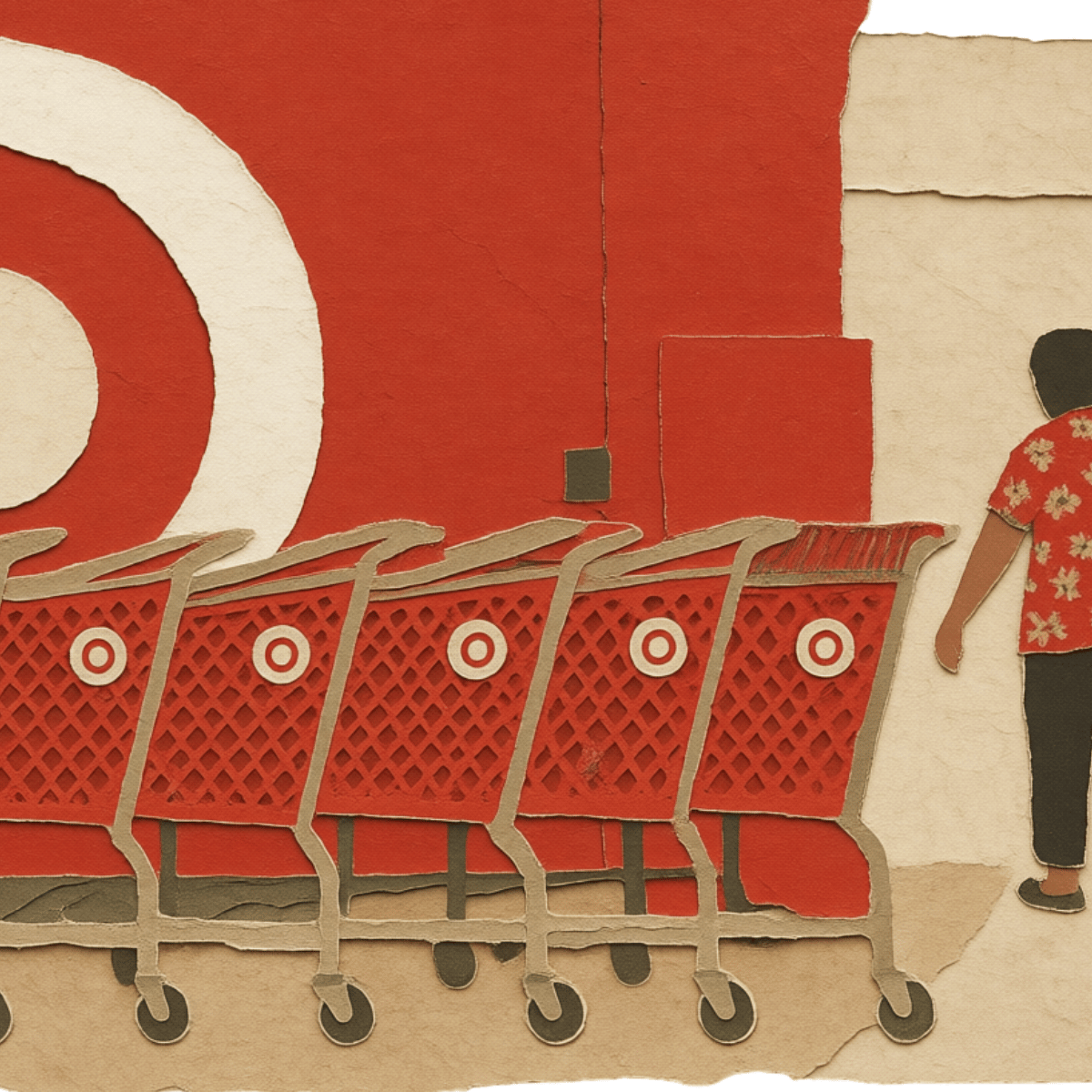
After years of slumping sales, Target walked into its latest earnings report and did something nobody expected — it hit the bullseye. The retailer posted a 5.6% jump in comparable store sales, tripling Wall Street's forecast, and it did it with cheap toys and clever brand collabs. In this episode, we break down one of the biggest retail comebacks of the year and pick up five B2+ expressions that work just as well in the boardroom as they do in everyday conversation.
⚡ 5 Key Expressions
Expression 01
Hit the bullseye
To achieve exactly the right result — to succeed with precision, not just by luck. A bullseye is the small center circle of a target in archery or darts. When you hit it, you've landed exactly where you were aiming. The phrase carries a sense of accuracy and skill: you didn't just get close, you nailed it. It works beautifully in this story because the store is literally called Target — making the idiom a double-layered pun. But beyond retail headlines, you'll hear it whenever someone wants to say a decision, argument, or piece of work was exactly right.
- "She hit the bullseye with her proposal — the client approved the budget on the spot."
- "I tried a new recipe last night and honestly, I hit the bullseye on the first try."
Expression 02
Surpass expectations
To perform better than what was predicted, hoped for, or required. The verb surpass means to go beyond a limit or standard — to exceed it. When paired with expectations, it describes a result that was better than anyone anticipated. The gap can be small or enormous: you can surpass expectations narrowly, or — as Alex puts it in today's dialogue — by a mile. This phrase appears constantly in professional English: performance reviews, earnings calls, project updates, and job interviews all rely on it. Note that the plural expectations is standard; the singular sounds unnatural in most contexts.
- "The engineering team surpassed expectations, delivering the final product two weeks ahead of schedule."
- "I wasn't expecting much from that film, but it completely surpassed my expectations."
Expression 03
Slated for
Officially planned or scheduled for a specific time or purpose. When something is slated for a date or event, it's already on the calendar — it has been decided, not just considered. The word slated comes from the old practice of writing schedules on a slate board, the kind used in schools and offices before whiteboards. Today, it carries a slightly formal tone that makes it well-suited to business writing, news articles, and professional announcements. It's always followed by a time, event, or purpose: slated for Q2, slated for release, slated for review. One interesting quirk: you can also use it before bad news, which creates an ironic contrast.
- "The new policy is slated for implementation in July, pending final approval from the board."
- "We have a team dinner slated for Friday — you should come."
Expression 04
Canary in the coal mine
An early warning sign — something small that signals a much larger danger or problem may be on the way. The origin is literal and fascinating. Before electronic gas detectors existed, coal miners carried caged canaries into the tunnels with them. Canaries are far more sensitive to toxic gases like carbon monoxide than humans are. If the canary stopped singing or collapsed, the miners knew to evacuate immediately. The bird's distress was the warning that saved lives. Today, the idiom has escaped the mine entirely. A canary in the coal mine is anything — a data point, a trend, a news story — that serves as a small but significant signal of something bigger brewing beneath the surface.
- "The spike in credit card defaults could be a canary in the coal mine for the broader economy."
- "My phone battery dying at noon is always a canary in the coal mine — means I forgot my portable charger too."
Expression 05
Cautious outlook
A careful, reserved view of what the future holds — neither optimistic nor pessimistic, but deliberately measured. An outlook is simply your expectation or prediction about what's ahead. Cautious modifies it to mean: we're not celebrating yet, we're watching closely, and we're not making promises we can't keep. This phrase sits at the heart of how executives, analysts, and institutions communicate in uncertain times. It's honest without being alarming. In this story, Target's CEO uses it after a strong quarter — because strong numbers in one quarter don't erase macroeconomic headwinds. The phrase works just as well in personal contexts: job searches, health updates, or any situation where hope and uncertainty coexist.
- "The bank maintained a cautious outlook on consumer lending for the second half of the year."
- "After two tough interviews in a row, I'm keeping a cautious outlook about the job hunt."
🎭 The Dialogue: On the Clock
Maya works in retail marketing and Alex follows the stock market. They ran into each other at the office coffee machine on a Thursday morning — and somehow ended up deep in a conversation about a big red bullseye.
📍 Office kitchen, Thursday morning. Maya is scrolling through her phone. Alex walks over and pours a coffee.
Maya: Did you see Target's earnings this morning? They finally hit the bullseye.
Alex: I know — they surpassed expectations by a mile. Wall Street was only predicting about a 2% bump, and they came in at 5.6%.
Maya: And apparently it was cheap toys and brand collabs that did it. Like, a Roller Rabbit collab made six million dollars in its first hour.
Alex: Honestly, that tracks. People are cutting back on big purchases but still treating themselves to small things.
Maya: There's a ton more slated for Q2 too — a beauty studio rollout, a food and beverage overhaul. They're going all in.
Alex: Right, but the CEO was very careful. He's not doing a victory lap. He basically said they have a cautious outlook because the macro environment is still rough.
Maya: Which makes sense. Consumer sentiment just hit a record low. Target could be a canary in the coal mine for the whole retail sector.
Alex: Exactly. If people stop spending at Target, that tells you something much bigger is going on.
🧠 Episode Quiz
Can you answer this?
Target is famous for its red and white bullseye logo — one of the most recognized retail symbols in the world. But which country did that bullseye logo originally come from?
- A — The United States
- B — The United Kingdom
- C — Japan
✅ Answer: A — The United States. Target was founded in Minnesota in 1962, and the bullseye logo was designed by an American firm that same year. It has been the brand's symbol ever since — and despite looking like it could belong anywhere, it's entirely American in origin.
📚 Bonus Vocabulary
That tracks (informal phrase) — that makes sense; that fits with what I already know or suspected. Alex uses it when Maya mentions people spending on small treats instead of big purchases. It's a casual but very current expression in spoken English. "She got promoted after only six months? Honestly, that tracks — she works harder than anyone."
Victory lap (noun phrase) — a moment of public celebration after a win, often implying the celebration is premature or excessive. Originally from motorsport, where the winning driver circles the track after a race. In business, not doing a victory lap means staying humble despite good results. "The team shipped the product on time, but the manager didn't want to do a victory lap until the client actually signed off."
Macroeconomic environment (noun phrase) — the broad economic conditions affecting an entire country or market: inflation, interest rates, employment levels, and consumer confidence. Often shortened to macro environment in spoken English. "Even strong companies struggle when the macroeconomic environment turns against them."