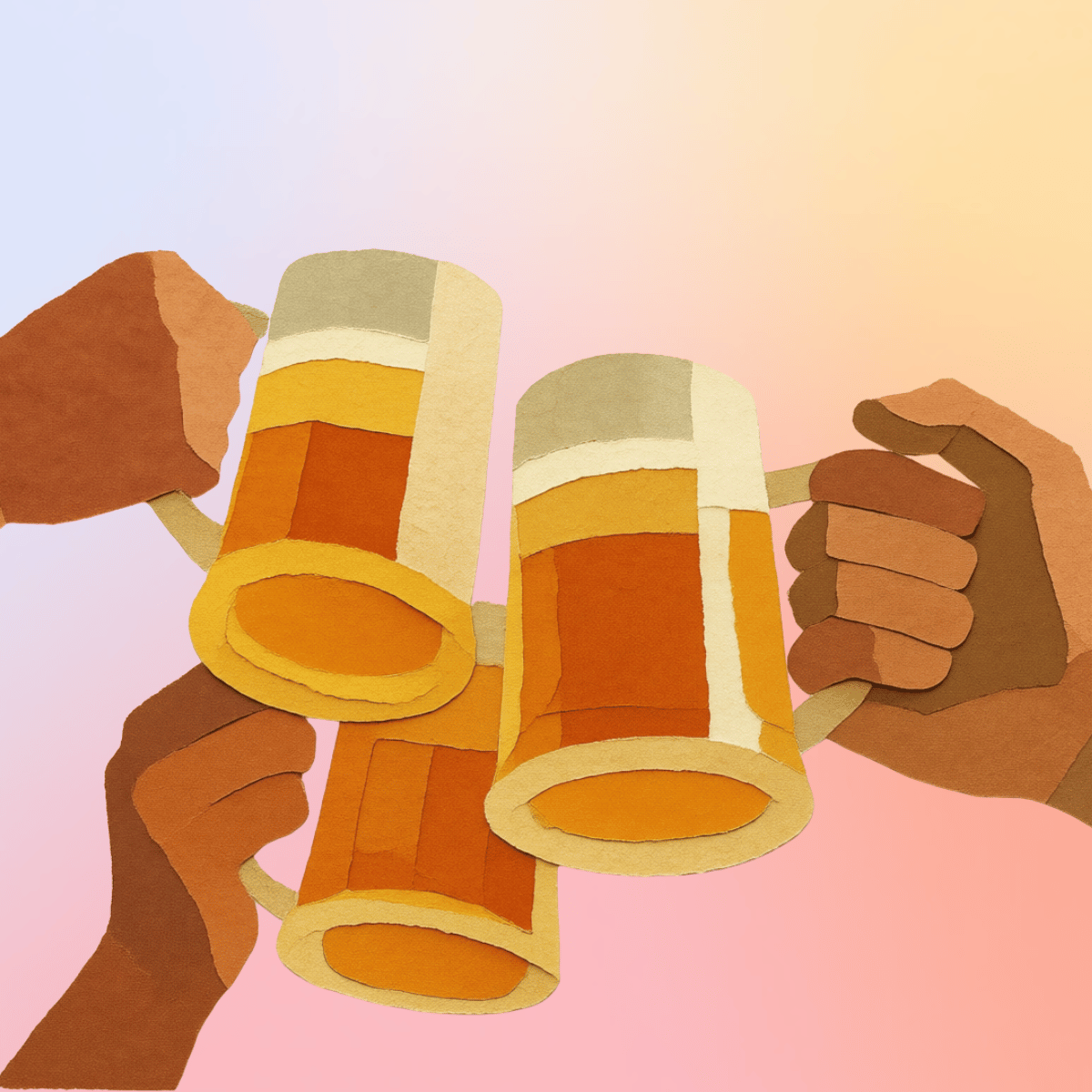
After three years of slumping sales, the world's largest beer company just reported growth for the first time since 2022 — and the numbers out of Latin America are turning heads. In this episode, we follow the global beer industry's revival and pick up five B2 expressions that work beautifully in business, news, and everyday conversation.
⚡ 5 Key Expressions
Expression 01
Make a comeback
To return to success, popularity, or relevance after a period of decline or absence. The word comeback suggests there was a "going" before the coming back — a dip, a fall, a disappearance. What makes this phrase so versatile is how broadly it applies: a brand, a person, a trend, a sport, even a musical style can all make a comeback. When AB InBev reported rising drink volumes for the first time in three years, analysts called it exactly that — a comeback for the global beer industry. You can also say "stage a comeback" for a more dramatic, intentional feel.
- "After a difficult restructuring, the retail brand made a surprising comeback, posting its highest profits in a decade."
- "I stopped running for a year, but I'm making a comeback — did five kilometers this morning."
Expression 02
Thaw
Literally, to thaw means to go from frozen to fluid — ice becoming water again. Figuratively, a thaw describes the easing of something cold, stiff, or stuck. It's used with great effect in business journalism to describe industries, markets, or relationships that were in a freeze and are now starting to loosen up. The beer story described the industry's rough period as a "broader chill" that "may be thawing" — a beautifully consistent metaphor. A thaw always implies gradual movement, not a sudden reversal. Things don't explode out of a thaw; they slowly start to flow again.
- "After months of tension, analysts noted a thaw in trade negotiations between the two countries."
- "Things were weird between us after the argument, but I think we're starting to thaw."
Expression 03
Notch
To notch something means to achieve or record it — to mark it as a win. The origin is literal: before paper, people kept score by carving notches into a stick or bone. Each cut meant one point. In modern usage, the scoring feeling remains. When you notch a record, a milestone, or a victory, you're tallying it up. It's a short, punchy word that journalists and business writers love precisely because it conveys achievement without excess. AB InBev's Brazil unit "notched record growth in sales volumes" — that one word carries the weight of a headline.
- "The startup notched its fifth consecutive quarter of double-digit growth."
- "She notched another win at the chess tournament — undefeated this season."
Expression 04
Buoyed by
A buoy is the floating marker you see in the ocean — it keeps things on the surface, prevents them from sinking. When something is buoyed by something else, it is being lifted up or kept afloat by an external force. The phrase almost always appears in passive form: results were buoyed by strong exports; confidence was buoyed by good reviews. That external element is key — you're not thriving on your own strength alone, but being supported from outside. In the beer story, Heineken's overall volumes "were buoyed by sales of mixers and ciders" — meaning without that support, the numbers would have gone under.
- "The company's annual results were buoyed by a strong performance in Southeast Asian markets."
- "I was really buoyed by all the positive feedback I got on my presentation."
Expression 05
Beat out
To beat out a competitor means to defeat them in a direct comparison — to come out clearly on top. The "out" carries important meaning: it suggests you've pushed the other person or company out of a position they held. It's not just winning in general; it's winning against a specific rival in a specific context. AB InBev beat out Heineken in Mexico — Heineken's home turf in Latin America — which made the achievement all the more significant. The phrase works equally well for job candidates, product proposals, sports teams, and business deals.
- "Our proposal beat out twelve other agencies to win the contract."
- "He beat out two hundred applicants for that internship."
🎭 The Dialogue: Cheers to That
Maya and Alex are catching up over drinks at a bar on a Friday evening. The conversation turns to a business story that's hard to ignore — especially given where they're sitting.
📍 A casual bar, Friday evening. Alex sets two glasses down. Maya is scrolling through her phone.
Maya: Did you see AB InBev's earnings? Beer sales are finally making a comeback after three years of falling numbers.
Alex: I know — it feels like the whole industry is starting to thaw. Even Carlsberg had a positive quarter.
Maya: AB InBev notched record growth in Brazil. Their stock in São Paulo went crazy.
Alex: And they beat out Heineken in Mexico too. That's a big deal — Heineken owned that market.
Maya: The recovery was definitely buoyed by Latin America. North America is still struggling though — inflation and the sober-curious trend aren't helping.
Alex: True. But they've got the World Cup this summer. That should give them a serious boost.
Maya: Good point. Nothing sells beer like football.
Alex: Let's just hope the momentum holds. Cheers.
🧠 Episode Quiz
Can you answer this?
Michelob Ultra is now the best-selling beer in the United States. But which brand held that top spot for over two decades before it?
- A — Budweiser
- B — Bud Light
- C — Coors Light
✅ Answer: B — Bud Light was America's best-selling beer for more than twenty years. It lost the crown in 2023 following a widespread consumer boycott over a marketing campaign. Michelob Ultra — also made by AB InBev — stepped in and claimed the top spot. Budweiser is the classic icon, but Bud Light was the volume king.
📚 Bonus Vocabulary
Momentum (noun) — the energy or force that builds as things continue to go well. From physics: a moving object in motion tends to stay in motion. In business, momentum is what you build during a strong run — and what you desperately try not to lose. "The team had real momentum going into the second half of the year."
Sober-curious (adjective) — describing a cultural trend where people consciously reduce or reconsider their alcohol consumption, not necessarily for health reasons but out of lifestyle interest. The article cites it as one reason North American beer sales continued to fall. "The rise of the sober-curious movement has pushed beverage companies to invest heavily in non-alcoholic options."
On-brand (adjective) — consistent with a person's or company's known identity, style, or values. Used informally to describe something that fits perfectly with what you'd expect from someone. "Of course he showed up in a suit to a beach party — very on-brand for him."