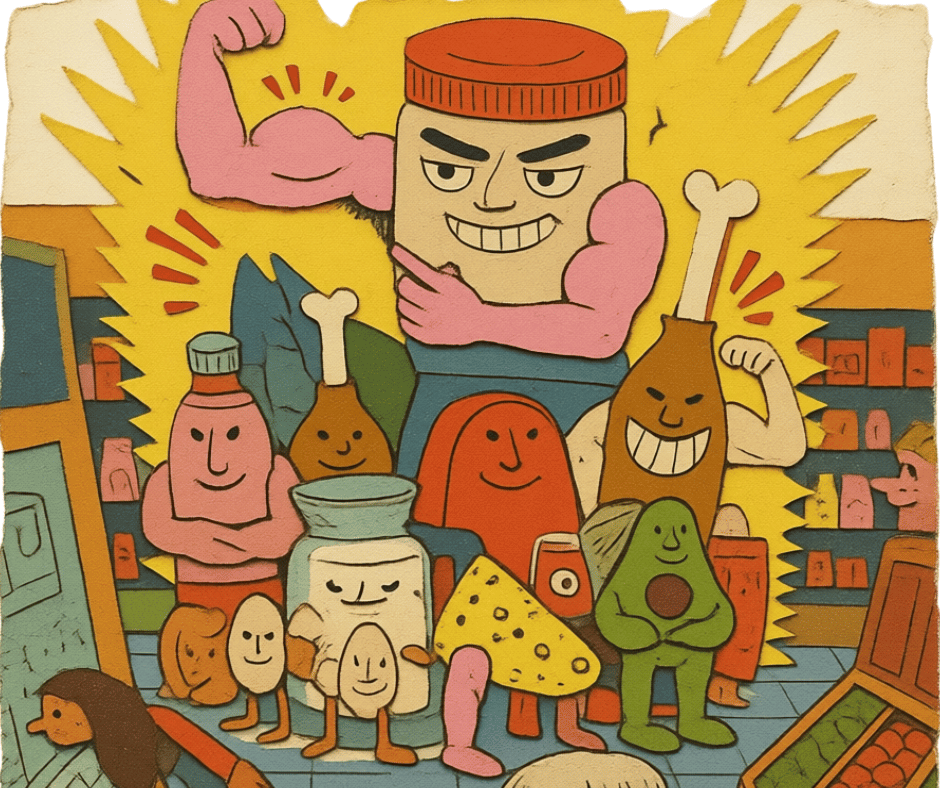
Protein used to belong to bodybuilders and gym bags. Now it's in your pasta, your chips, your coffee creamer, and — yes — your water. In this episode, we follow the money behind one of the biggest food industry shifts in decades, and pick up five B2-level expressions that work just as well in the boardroom as they do at the grocery store checkout.
⚡ 5 Key Expressions
Expression 01
Tectonic shift
A massive, deep, and permanent change — one that fundamentally reshapes the way something works. The metaphor comes from plate tectonics: the enormous slabs of rock under the Earth's surface move slowly, but when they shift, the results are seismic. In English, a "tectonic shift" isn't just a trend or a fluctuation — it signals a structural transformation that won't be reversed. Use it when a change is large enough to alter an entire industry, culture, or way of thinking. The move toward high-protein eating is precisely that: not a diet fad, but a permanent rewiring of how millions of people think about food.
- "Remote work has caused a tectonic shift in how companies think about office space and talent."
- "There's been a tectonic shift in how young people consume news — it's all short video now."
Expression 02
Pivot to
To make a deliberate, strategic shift in direction — usually in response to changing conditions. The word "pivot" comes from basketball, where a player plants one foot and turns to face a new direction without lifting that foot. In business and everyday English, "pivot to" carries the same sense of intentional redirection. It implies that something prompted the change — a challenge, a better opportunity, or a market signal — and that the turn was a conscious decision, not an accident. This makes it feel more active and purposeful than simply saying "switch to" or "change to."
- "After three years in finance, she pivoted to the nonprofit sector and never looked back."
- "The restaurant pivoted to a delivery-only model during the lockdown and actually grew its revenue."
Expression 03
Sticker shock
The surprise — and often dismay — you feel when you see a price that is much higher than you expected. The "sticker" refers to the price tag sticker on a product. When the number on that sticker is so high it jolts you, that's sticker shock. The phrase captures both the cognitive surprise and the emotional reaction in a single image. It works for individuals reacting to grocery bills, car prices, and medical bills, but it scales equally well to businesses absorbing the cost of raw materials or corporate acquisitions. Beef prices hitting nearly seven dollars a pound at the supermarket? Classic sticker shock.
- "I asked about the surgery cost without insurance, and the sticker shock kept me up that night."
- "The sticker shock of San Francisco rents sends a lot of young professionals to Oakland instead."
Expression 04
Trade down
To switch from something more premium or expensive to a cheaper or lower-quality alternative, usually for practical reasons. It's the opposite of "trading up." In consumer behavior, people trade down when budgets tighten — choosing store brands over name brands, economy class over business, sirloin over ribeye. The phrase is largely neutral in commercial and economic contexts, though it can carry a slightly deflated tone when applied to personal choices. It's widely used in retail analysis, market research, and financial reporting to describe how consumer spending habits shift under pressure.
- "With inflation still high, many shoppers are trading down to generic brands without much hesitation."
- "I used to fly business class for long-haul trips, but I've traded down to premium economy since going freelance."
Expression 05
Cover one's bases
To take care of all the important things — to prepare thoroughly enough that no critical point is left unattended. The expression comes from baseball: the fielding team needs a player covering each base so no runner can score. In everyday English, "cover your bases" means you've addressed all the key angles, prepared for the likely outcomes, and haven't left any obvious gaps. It's one of the most flexible idioms in business and professional English, appearing in legal discussions, project management, negotiation, and casual planning alike. A shorter form — "bases covered" — works as a confident standalone reply meaning: everything has been handled.
- "Before the board presentation, run it by legal and finance — you want to make sure you've covered your bases."
- "I booked the flights, confirmed the hotel, and got travel insurance. Bases covered."
🎭 The Dialogue: Protein at the Break Room
Maya and Alex work at the same company. It's midday, and Maya has just returned from a grocery run during her lunch break — with a shopping basket that raises some questions.
📍 Office break room, midday. Maya is reading the nutrition label on a bag of protein chips. Alex walks in and does a double take.
Maya: Have you actually looked at the grocery store lately? I just bought protein pasta, protein chips, and — I kid you not — something called protein water.
Alex: I believe it. It really is a tectonic shift in how people think about food. Five years ago this stuff was only for people who wore tank tops to the gym.
Maya: And now beef prices are through the roof, so half the country is pivoting to chicken as their main protein source.
Alex: Don't remind me. I went to grab some ground beef last weekend and the sticker shock hit me hard — nearly seven dollars a pound.
Maya: So what are you actually doing about it?
Alex: Trading down, honestly. Sirloin instead of ribeye. Not my first choice, but the wallet wins.
Maya: I've been mixing plant and animal sources to cover my bases — helps with both the nutrition and the budget.
Alex: That's the play. Diversify the plate, not just the portfolio.
🧠 Episode Quiz
Can you answer this?
GLP-1 drugs like Ozempic are now taken by roughly 30 million Americans, and they're directly fueling the protein boom. But what does GLP actually stand for?
- A — Glucose-Lowering Peptide
- B — Glucagon-Like Peptide
- C — Gut-Linked Protein
✅ Answer: B — Glucagon-Like Peptide. GLP-1 is a hormone your gut naturally produces after eating. It signals your brain that you're full and slows digestion. The drugs mimic that signal — which is why people on Ozempic feel satisfied with less food. And because they eat less overall, nutritionists urge them to prioritize protein to protect muscle mass. That's a big reason the protein market is exploding right now.
📚 Bonus Vocabulary
I kid you not (spoken phrase) — used to emphasize that something surprising is genuinely true. "Kid" means to joke or tease, so "I kid you not" means: I am not joking, this is real. Maya uses it when she reveals that protein water is now a real product on real shelves. "They actually hired someone just to manage the office plants. I kid you not."
Through the roof (phrase) — rising sharply, often to an extreme or unexpected level. Used for prices, demand, popularity, or emotions. "Ever since the review went viral, traffic to the site has gone through the roof."
Diversify (verb) — to spread across different types so you're not dependent on any single one. Originally an investment term — diversify your portfolio — but now used broadly for skills, income streams, food choices, and more. Alex's closing line in the dialogue is a direct play on investment advice: "Diversify the plate, not just the portfolio." "She diversified her client base so one lost contract wouldn't sink the business."