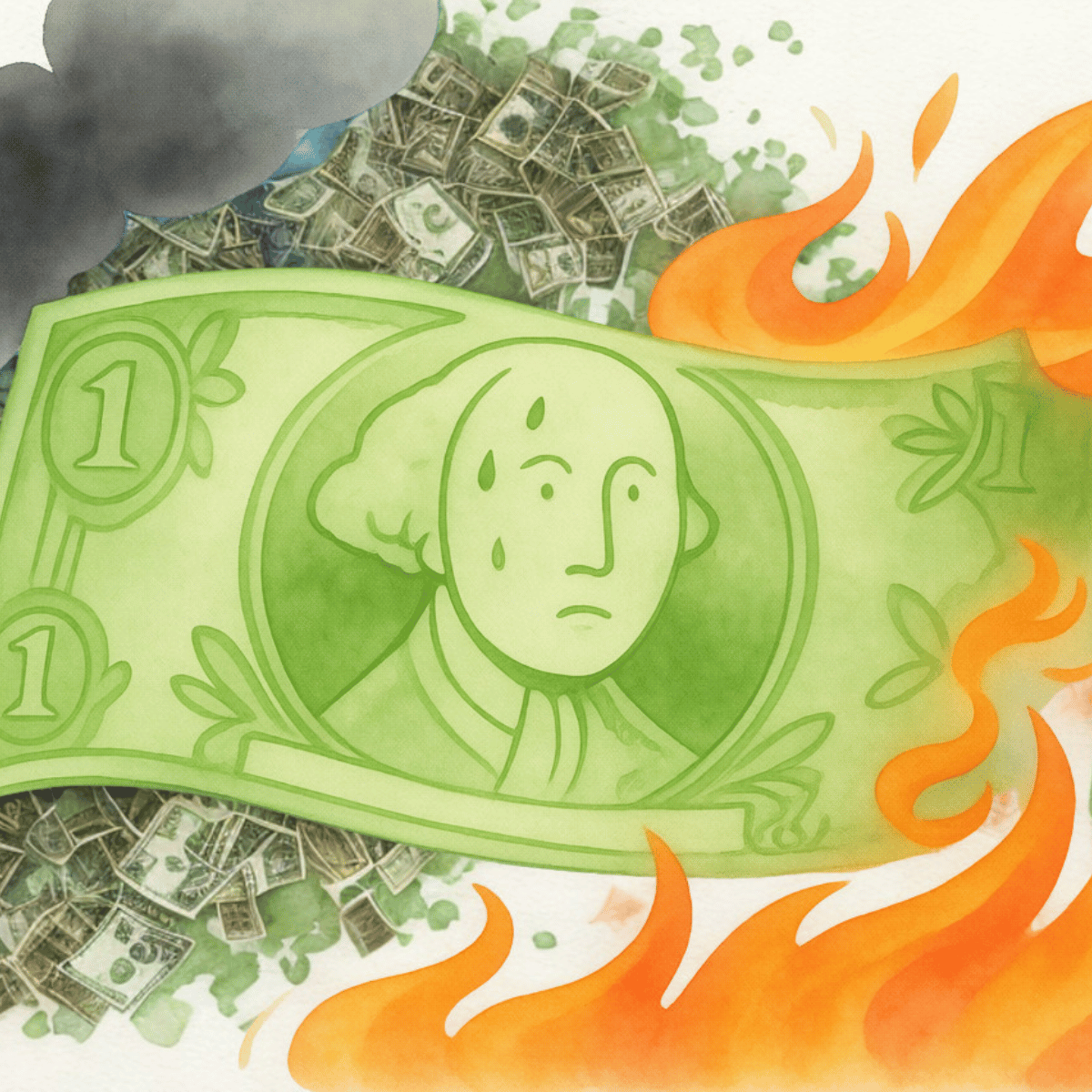
Your paycheck went up — so why does everything still feel impossibly expensive? In April, the cost of living in the US rose faster than wages for the first time in three years. Energy prices, food, airfare — all climbing faster than the average raise. In this episode, we break down what's driving inflation and pick up five B2 expressions that go far beyond economics — into careers, daily conversation, and anywhere momentum matters.
⚡ 5 Key Expressions
Expression 01
Eat up
To consume or deplete something so completely that nothing useful remains. The image is vivid and physical — whatever was there simply gets devoured. In everyday English, you'll hear it applied to money, time, energy, storage space, and patience. When inflation "eats up" a wage increase, it means that by the time rising prices take their share, the real-world value of the raise has vanished. The raise existed on paper. In practice, it was gone before it arrived.
- "The whole afternoon got eaten up by back-to-back meetings — I didn't get a single thing done."
- "I had leftover pizza for tomorrow, but my roommate ate it all up."
Expression 02
On a roll
Experiencing a sustained streak of momentum — things keep moving in the same direction, one after another. The phrase usually describes something positive: a team winning game after game, a salesperson closing deal after deal. But English allows irony, and that's exactly what happens in this episode. When Alex says inflation has been "on a roll in the worst possible way," he's borrowing the positive energy of the phrase and flipping it. Inflation has momentum — it just happens to be the kind no one wants.
- "The sales team has been on a roll — three record-breaking months in a row."
- "I've been on a roll at the gym lately. Haven't missed a session in two weeks."
Expression 03
Herd mentality
The tendency to follow the crowd and make decisions based on what everyone else is doing, rather than independent thinking. A herd of animals moves together instinctively — there is no individual analysis, just collective motion. When applied to people, the phrase carries a gentle but clear criticism: the group acted together not because each person thought it through, but because everyone else was doing it. In financial markets, herd mentality is a well-documented force — panic spreads, calm spreads, and individual judgment often disappears in the crowd.
- "Everyone on the committee approved the proposal without a single question. Classic herd mentality."
- "I almost bought that stock just because it was trending, but I caught myself — that's pure herd mentality."
Expression 04
Buoyed by
Lifted or kept afloat by an external force. The word comes directly from "buoy" — the floating marker anchored in the sea that keeps boats from drifting into danger. When something is buoyed by something else, it is being held up, supported, or energized from the outside rather than rising entirely on its own. Crucially, "buoyed" always implies an upward direction — you would never use it for something falling or worsening. The external force is what makes the difference between staying afloat and sinking.
- "The company's quarterly results were buoyed by an unexpectedly strong performance in Asian markets."
- "I was really buoyed by all the kind messages I got after the presentation — I hadn't expected that."
Expression 05
Run out of steam
To lose energy, momentum, or drive after a strong start — and eventually slow to a stop. The phrase comes from the age of steam engines: when a locomotive burned through all its fuel, the engine could no longer maintain speed and gradually ground to a halt. Today, the expression applies to anything with momentum that begins to fade: a project, a campaign, a market rally, a person pushing through a long day. Importantly, running out of steam is not a sudden crash — it is a gradual winding down, which is exactly why Maya prefers it to a sharp rate hike.
- "The rebranding campaign ran out of steam after the first month — engagement dropped and no one followed up."
- "We were going strong at the party until midnight, and then everyone just ran out of steam."
🎭 The Dialogue: Did the Math
Maya and Alex work at the same company. They're catching up over coffee — and Maya just opened her pay review email. The numbers are technically good. The reality is not.
📍 A café near the office, mid-morning. Maya is staring at her phone. Alex drops into the chair across from her.
Maya: I finally got my raise. Three percent. I smiled, said thank you, and then went home and did the math.
Alex: And?
Maya: Inflation is at three point eight. My raise didn't even keep up. It got completely eaten up before I could enjoy it.
Alex: I know — energy prices alone are up eighteen percent from last year. It's been on a roll in the worst possible way.
Maya: What I don't get is why the stock market didn't crash. I thought bad inflation news always tanks everything.
Alex: Stocks dropped in the morning, but then recovered. A lot of that was just herd mentality — traders panicking, then realizing everyone else was panicking, and calming down.
Maya: Intel's been doing well though, right?
Alex: It's been buoyed by a rumored Apple chip deal. But I hope the broader rally gets a chance to run out of steam on its own — a rate hike right now would be brutal.
🧠 Episode Quiz
Can you answer this?
The US government tracks inflation using a measure called the CPI. What does CPI stand for?
- A — Consumer Price Index
- B — Central Payment Indicator
- C — Cost of Production Index
✅ Answer: A — Consumer Price Index. The CPI measures how the price of a typical "basket" of everyday goods and services — groceries, gas, rent, streaming subscriptions — changes over time. When economists say inflation hit 3.8%, they mean that same basket costs 3.8% more than it did a year ago. Every tomato, every tank of gas, every Netflix price hike goes into the calculation.
📚 Bonus Vocabulary
Tank (verb, informal) — to fall sharply and suddenly, usually referring to prices, stocks, or performance. Maya uses it when she says bad inflation news "always tanks everything." It's punchy, visual, and widely used in business conversation. "The stock tanked after the earnings report missed expectations by a wide margin."
Prop up (phrasal verb) — to support something that would otherwise collapse or fall. Alex says a positive headline "can prop up the whole market for a day." Like physically propping a door open with a wedge, something external is doing the work of keeping things standing. "The government stepped in to prop up the failing bank and prevent a wider crisis."
Count on (phrasal verb) — to rely on or expect something with confidence. Alex closes with "I wouldn't count on it" — meaning: don't assume that will happen. A small phrase that carries a lot of weight in professional conversations. "You can count on her to deliver — she's never missed a deadline in three years."