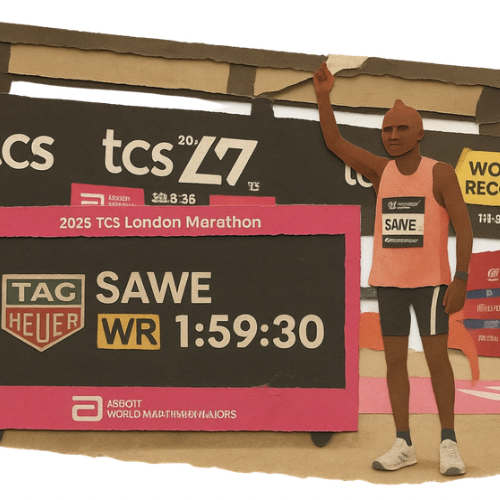
Two runners just did what scientists once said was physically impossible: they broke the two-hour marathon barrier at the London Marathon. Kenya's Sabastian Sawe crossed the finish line in 1 hour, 59 minutes, and 30 seconds — shattering the world record by over a minute. Ethiopia's Yomif Kejelcha finished just 11 seconds later, on his very first marathon ever. And Adidas, whose shoes all three top finishers were wearing, got a tailwind that money can't buy. In this episode, we use this record-breaking story to pick up five essential B2 expressions you'll use in business, career conversations, and everyday life.
⚡ 5 Key Expressions
Expression 01
Shatter a record
To break a record by a dramatic, impressive margin — not just barely, but decisively. The verb "shatter" brings the image of glass breaking into pieces: what was solid is now completely destroyed. This is the key difference between "break a record" and "shatter a record." Breaking sounds ordinary. Shattering sounds extraordinary. Sawe didn't edge past the previous world record by a second or two — he beat it by over a minute. That's shattering. The verb collocates naturally with "record," "expectations," and "stereotypes," always implying something that felt like a solid barrier has been blown apart.
- "The startup shattered investor expectations by turning profitable in its very first year."
- "She shattered every stereotype about what a tech founder is supposed to look like."
Expression 02
Feat
An impressive achievement that requires exceptional skill, strength, or courage. The word always carries a sense of difficulty — a truly easy task cannot be a feat. You'll often hear it in the phrase "no small feat," which is used to describe something that sounds simple but is actually quite hard. Running a sub-2 marathon is an absolute feat. Coordinating a global product launch on a tight deadline is no small feat. The word elevates whatever it describes, signaling that real effort and ability were involved. It works in both formal and casual contexts, and it never goes out of style.
- "Coordinating thirty international teams under one deadline was no small feat."
- "Getting my grandmother to use a smartphone — honestly, no small feat."
Expression 03
Tailwind
A force or condition that helps you move faster or succeed more easily — without you having to create it yourself. The word comes from aviation and running: a tailwind is wind blowing in the same direction you're traveling, pushing you forward with less effort. In business, a tailwind is any external factor — a market trend, a news event, economic conditions — that works in your favor. Adidas didn't engineer their moment at the London Marathon. The result just happened to go their way, and that visibility became a powerful tailwind for their brand. The opposite — "headwind" — means an external force working against you.
- "Rising consumer confidence gave the retail sector a strong tailwind this quarter."
- "Moving to a city where your industry is booming — that's a real tailwind for your career."
Expression 04
Year over year
A standard business phrase comparing a metric from one time period to the exact same period in the previous year. If the US running shoe market was "up 13% year over year through February," it means February this year performed 13% better than February last year. This method of comparison filters out seasonal fluctuations and reveals genuine growth trends. You'll encounter "year over year" — often abbreviated as YoY — constantly in earnings reports, market analyses, business presentations, and financial journalism. It's one of those phrases that instantly signals business fluency when used correctly.
- "Revenue grew 8% year over year, driven by expansion in the Southeast Asian market."
- "My rent went up again — it's like 10% year over year at this point."
Expression 05
Get a leg up
To gain an advantage over the competition, especially by acting early. The phrase comes from horse racing — a trainer would give a rider a "leg up" by cupping their hands to boost the rider onto the horse. Today the physical image is gone, but the competitive spirit remains. You get a leg up on someone or on the competition. The phrase almost always implies urgency: if you don't move now, the advantage disappears. Adidas wants to get a leg up in the performance sports market before Nike dominates it. In career contexts, building skills early, making connections in advance, or arriving prepared all count as getting a leg up.
- "The company acquired the startup early to get a leg up on competitors entering the same space."
- "I've been learning Korean for a year — if we ever get a project in Seoul, I'll have a leg up."
🎭 The Dialogue: The Finish Line
Maya recently signed up for her first 10K and hasn't stopped thinking about running. Alex has been a marathon runner for years. They're catching up over coffee on Monday morning, and the conversation turns to the race everyone is talking about.
📍 Office coffee corner, Monday morning. Maya is on her phone. Alex walks in and pours two cups.
Maya: Did you watch the London Marathon yesterday? I couldn't sleep — I stayed up for the finish.
Alex: Are you kidding? That was an absolute feat. Sawe shattered the world record by over a minute.
Maya: I know! And Kejelcha finishing eleven seconds later — on his first marathon. It doesn't seem real.
Alex: What's wild is that Adidas got a serious tailwind from the whole thing. All three top finishers were wearing their shoes.
Maya: I saw that. So does this kind of exposure actually move the needle for a brand?
Alex: Hugely. The US running shoe market was up thirteen percent year over year through February. Adidas wants to get a leg up before Nike locks the whole thing down.
Maya: Well, after watching yesterday, I might need a new pair of shoes myself.
Alex: That's exactly what Adidas is counting on.
🧠 Episode Quiz
Can you answer this?
The marathon distance — 26.2 miles, or 42.195 kilometers — is a very specific and slightly odd number. Why is the marathon exactly that length?
- A — It matches the distance of an ancient Greek battlefield run from Marathon to Athens.
- B — It was set at the 1908 London Olympics so the course could start at Windsor Castle and finish in front of the royal box.
- C — It was standardized by a committee of European athletics officials in 1921.
✅ Answer: B — The specific distance of 26.2 miles was set at the 1908 London Olympics. The course was extended so it could begin at the nursery window of Windsor Castle — where the royal children could watch — and finish in front of the royal box at the Olympic stadium. That slightly awkward number became the global standard forever after. The Greek battle legend (option A) inspired the idea of the marathon, but had nothing to do with the distance.
📚 Bonus Vocabulary
Move the needle (phrase) — to produce a noticeable, measurable change. Maya uses it when asking whether race-day exposure actually makes a difference for a brand's sales. The image comes from a gauge or meter: the needle only moves when something significant happens. "The campaign was creative, but it didn't really move the needle on actual conversions."
Lock down (phrasal verb) — to secure something so completely that no one else can get in or take it away. Alex uses it to describe Nike's potential dominance of the running shoe market: if Nike locks it down, the opportunity for competitors closes. "The incumbent locked down the contract before any other firm could submit a bid."
Count on (phrasal verb) — to rely on something happening, or to expect it with confidence. Alex's closing line — "that's exactly what Adidas is counting on" — is a perfectly placed punchline. It means Adidas anticipated this consumer reaction and built their strategy around it. "Don't count on the weather holding — bring an umbrella just in case."