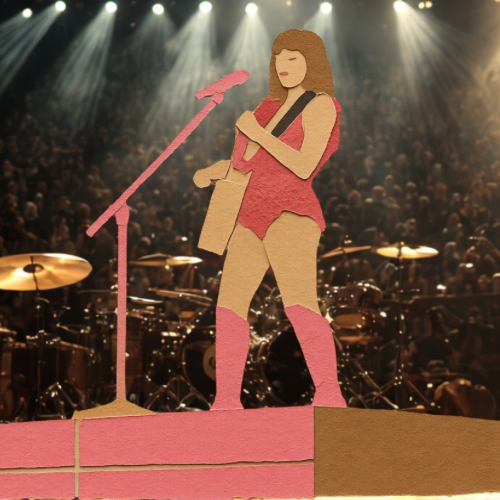
Can you trademark the sound of your own voice? Taylor Swift is trying — and the legal world has no idea what to do with it. AI can clone a celebrity's voice without touching a single copyrighted song, which means copyright law offers almost no protection. Swift's answer: file three trademark applications and force the courts to figure it out. In this episode, we break down the story and pick up five B2 expressions that work across law, business, and everyday conversation.
⚡ 5 Key Expressions
Expression 01
Maneuver
A deliberate, skillful move made under pressure — usually to gain an advantage. The word entered English through military strategy, from a French term meaning "to work by hand." On a battlefield, a maneuver is a tactical repositioning. In modern usage, it has expanded far beyond the military: you'll hear it in law, politics, business, and even everyday life. The key quality of a maneuver is that it is calculated, not desperate. Panic is not a maneuver. Filing an untested trademark to close a legal gap before a court has ever ruled on it? That is a maneuver.
- "The company's acquisition of a smaller rival was seen as a strategic maneuver to block a competitor's expansion."
- "I made a bold maneuver and grabbed the last slice of pizza while he was checking his phone."
Expression 02
Plug the gap
To fix a problem that exists because something is missing or incomplete. The image is physical: a plug stops liquid from escaping through a hole. When something is missing from a system — a law, a policy, a team member, a process — and someone or something steps in to fill that absence, they are plugging the gap. Crucially, this phrase is about absence, not damage. A broken thing needs fixing. A gap needs filling. In the episode, the gap is a legal one: copyright law cannot stop AI deepfakes, so Swift is using trademark law to plug it another way.
- "The new hire was brought in specifically to plug the gap in the team's data analytics capabilities."
- "She plugged the gap perfectly when our lead designer quit two weeks before the launch."
Expression 03
Have standing
To hold the recognized right, authority, or credibility to act — especially in a formal or legal context. In legal English, "standing" (also called "legal standing") means a court has accepted that you have a legitimate stake in the case. Without it, a judge can dismiss your lawsuit before it is ever heard, no matter how strong your argument is. Beyond the courtroom, the phrase is used informally to describe whether someone has the credibility or position to weigh in on a decision. "Does she have standing to challenge that?" simply means: is she in a position where her challenge is legitimate?
- "Without a signed contract, the agency argued it had no standing to pursue damages in court."
- "He's only been on the team for three weeks — does he really have standing to question the whole strategy?"
Expression 04
Flourish
To grow, thrive, and spread with ease. Flourish almost always carries a positive connotation — a business flourishes, a child flourishes in the right environment, creativity flourishes when given space. Which is exactly what makes it powerful when applied to something harmful. When a speaker says "deepfakes flourish because there's nothing to stop them," the choice of word is deliberate. It highlights the absurdity: something dangerous is spreading as freely and naturally as a garden in spring. Learning to notice when a positive-sounding word is used for a negative subject is a mark of real English fluency.
- "Without proper oversight, conflicts of interest tend to flourish in closed organizations."
- "Rumors flourish whenever a company goes quiet — people fill the silence with whatever they imagine."
Expression 05
Take on
To confront or challenge something difficult — especially something bigger than yourself. "Take on" is a phrasal verb with several meanings: you can take on extra work (accept it), take on a new employee (hire them), or take on a rival (challenge them). In this episode's context, it means the last one: deciding to fight something with weight and consequence. The phrase implies a degree of choice and courage. "Deal with a problem" sounds administrative. "Take on a problem" sounds like a decision — you chose to face something you did not have to. Someone has to go first. Taylor Swift took it on.
- "The startup decided to take on the industry's biggest player directly, rather than carve out a niche."
- "I take on my alarm clock every morning. I usually lose."
🎭 The Dialogue: Sound Advice
Maya and Alex work together in digital marketing. They're eating lunch at their desks — screens open, opinions ready — when the Taylor Swift story lands in their feeds.
📍 Open-plan office, lunchtime. Maya is scrolling. Alex is halfway through a sandwich.
Maya: Did you see that Taylor Swift is trying to trademark her actual voice? Like, the sound of her speaking.
Alex: I did. It's a bold maneuver. Nobody has really tried this with AI deepfakes before.
Maya: That's the whole point, right? Copyright law has this massive gap — AI can clone your voice without touching a single copyrighted song. So she's trying to plug the gap another way.
Alex: Smart. And if someone makes a deepfake using her voice, she'd finally have standing to sue them directly.
Maya: Without it, what can you do? Deepfakes just flourish because there's nothing solid to stop them legally.
Alex: It's a huge problem to take on. Even if she wins, it only covers her — every other artist is still exposed.
Maya: True. But someone has to go first. If the trademark holds, it could change the rules for everyone.
Alex: That's the thing about Taylor Swift — she has a history of taking on fights that end up rewriting the playbook.
🧠 Episode Quiz
Can you answer this?
Trademarks protect brands — and some of the most famous ones aren't logos or names at all. They're sounds. Which of these is an officially registered sound trademark?
- A — The roar of the MGM lion.
- B — The four-note Intel chime.
- C — Both of them.
✅ Answer: C — Both. The MGM lion's roar has been a registered sound trademark since the 1980s. The Intel chime — that four-note da-da-da-dum — was registered in 1994. They sit in a very unusual legal category called "sound marks," and Taylor Swift is now trying to join them with the sound of her own speaking voice.
📚 Bonus Vocabulary
Deepfake (noun) — AI-generated audio or video that realistically mimics a real person's appearance or voice without their consent. The word blends "deep learning" (the AI technique) with "fake." "The deepfake video spread quickly before the platform removed it."
Confusingly similar (legal phrase) — the standard used in trademark law to determine whether one mark infringes on another. If an average person might mistake one for the other, it may be "confusingly similar" and therefore infringing. "The court ruled that the two logos were confusingly similar and ordered the smaller company to rebrand."
Rewrite the playbook (phrase) — to change the established rules or strategies of an industry so significantly that everyone else has to adapt. Alex uses it to describe Taylor Swift's track record of winning fights that others assumed were unwinnable. "The streaming revolution rewrote the playbook for how music is distributed and monetized."