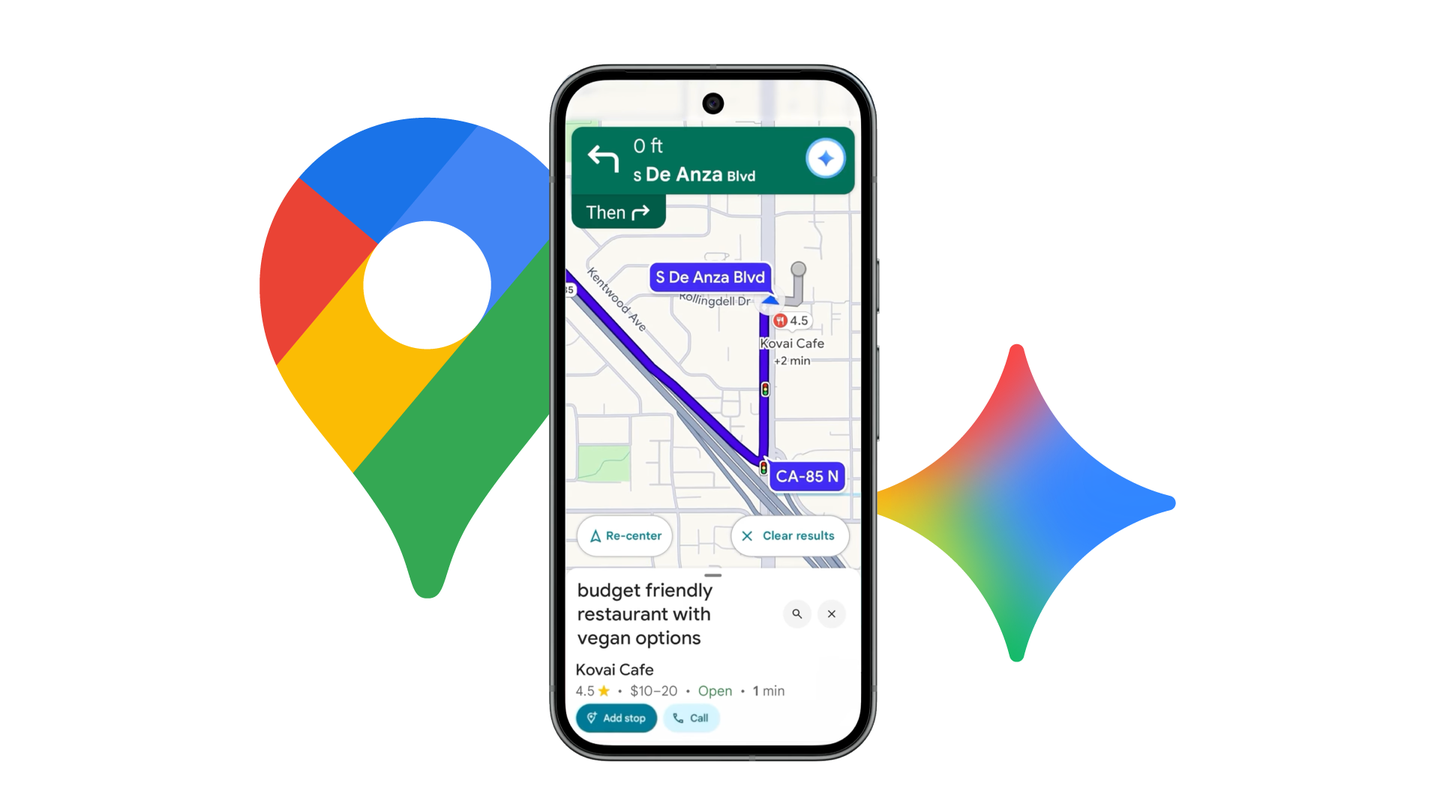
Google Maps just learned to talk back. This week, Alphabet announced it's weaving its Gemini AI directly into Google Maps — so instead of hunting through reviews yourself, you can simply ask: "Find me a café with short lines where I can charge my phone." Maps will answer, pulling from half a billion user reviews. Yelp and Tripadvisor are probably not having a great week. In this episode, Luna and Mimyo unpack the story — and five expressions worth adding to your vocabulary today.
⚡ 5 Key Expressions
Expression 01
Scour
To search somewhere thoroughly and intensely, leaving nothing unchecked. The word comes from the literal act of scrubbing a surface clean — going over every inch until nothing remains. That's the feeling: not a casual glance, but a determined sweep. When someone scours the internet, they're not browsing; they're hunting. It's more urgent, more exhausting, and more vivid than simply "looking."
- "The research team scoured decades of data looking for patterns."
- "I scoured every menu in the neighborhood before picking a place."
Expression 02
Tap into
To access a resource that already exists — to connect to it and draw from it. The image is a tap being drilled into a barrel to release what's stored inside. The key idea: the potential was already there; you just found a way in. This is what separates tap into from simply "use." When you tap into something, you're unlocking something larger than yourself — a network, a talent, a database, a market.
- "We need to tap into the senior market — it's largely ignored by our competitors."
- "She tapped into her theater experience when presenting to five hundred people."
Expression 03
Surrender to
To stop resisting something and let it take over — usually an emotion, a temptation, or a force bigger than yourself. It's more dramatic and expressive than "give in to." What makes this phrase interesting is that it works in two directions: it can feel like defeat (surrendering to anxiety) or like bliss (surrendering to a good meal, a great show, or a perfect afternoon). Context decides the mood — but the core idea stays: something was being held back, and now it isn't.
- "After months of resistance, the company surrendered to the demand for remote work."
- "By episode three, I completely surrendered to the show."
Expression 04
In pursuit of
Actively working toward a goal with sustained effort and determination. More formal and more intentional than "trying to" — it implies a deliberate, ongoing chase. The phrase comes from Old French poursuivre, meaning "to follow through." That sense of active, continued effort is built into every use. A company isn't just hoping to dominate a market — it is in pursuit of domination. The difference is the effort, and the commitment.
- "The startup spent three years in pursuit of its first profitable quarter."
- "He moved to Nashville in pursuit of a music career."
Expression 05
En route
On the way from one place to another. A French loanword that has expanded well beyond physical travel — in business writing, you'll often see it used for processes, legislation, or shipments that are underway. Pronunciation catches many learners off guard: it's on-ROOT (formal) or en-ROWT (casual American English) — not "en ROOT" like a tree. It's clean, professional-sounding, and works equally well in texts, emails, and news articles.
- "The shipment is en route and will arrive by Thursday."
- "I'm en route — be there in ten." (perfect for texts)
🎭 The Dialogue: On the Road
Maya is packing for a road trip. Alex calls her with some news about Google Maps. Listen for all five expressions — pay attention to how surrender to appears twice.
📍 Maya's apartment. She's packing a bag. Her phone rings.
Maya: I'm leaving in an hour. I've been scouring travel blogs all week trying to plan this route, and I'm still not sure about the stops.
Alex: You don't need to do that anymore. Have you seen what Google Maps just launched?
Maya: The AI thing? I saw the headline but I didn't read it.
Alex: It's fully conversational now. It taps into reviews from over five hundred million users to answer whatever you ask.
Maya: So instead of scouring fifteen different websites, I just... ask Maps?
Alex: Exactly. You can even ask for recommended stops en route — like "find me a viewpoint between here and the canyon."
Maya: That's incredible. I've been surrendering to travel anxiety every trip because I can never plan everything perfectly.
Alex: Well, Google is clearly in pursuit of replacing every travel app you've ever used. Yelp, Tripadvisor — all of them.
Maya: Honestly? At this point I'm ready to surrender.
Alex: Just ask Maps. It'll know you're a vegetarian and won't send you to a steakhouse.
Maya: It knows I'm a vegetarian?!
Alex: From your past searches. Go enjoy your trip — Maps has it covered.
🧠 Episode Quiz
Can you answer this?
Google Maps launched in 2005, but its core technology came from a company Google acquired in 2004. Which company was it — and what surprising organisation helped fund it?
- A — MapQuest, funded by AOL
- B — Keyhole Inc., funded by a CIA-backed venture capital firm
- C — Navteq, funded by Nokia
✅ Answer: B — Google acquired Keyhole Inc. in 2004, a satellite imaging company originally backed by In-Q-Tel, the CIA's venture capital arm. Its technology became the foundation of both Google Maps and Google Earth. So yes — your navigation app has spy origins.
📚 Bonus Vocabulary
Conversational — designed for natural, back-and-forth dialogue, as opposed to one-way commands. "The new Maps interface is fully conversational." Useful when describing AI tools, apps, or communication styles.
Immersive — creating the feeling of being surrounded or deeply inside something. "The new 3D navigation mode is described as immersive." Common in tech, gaming, and experience design.
Personalized — adapted to a specific individual based on their data or preferences. "Responses are personalized based on your past searches." You'll hear this constantly in tech and marketing.