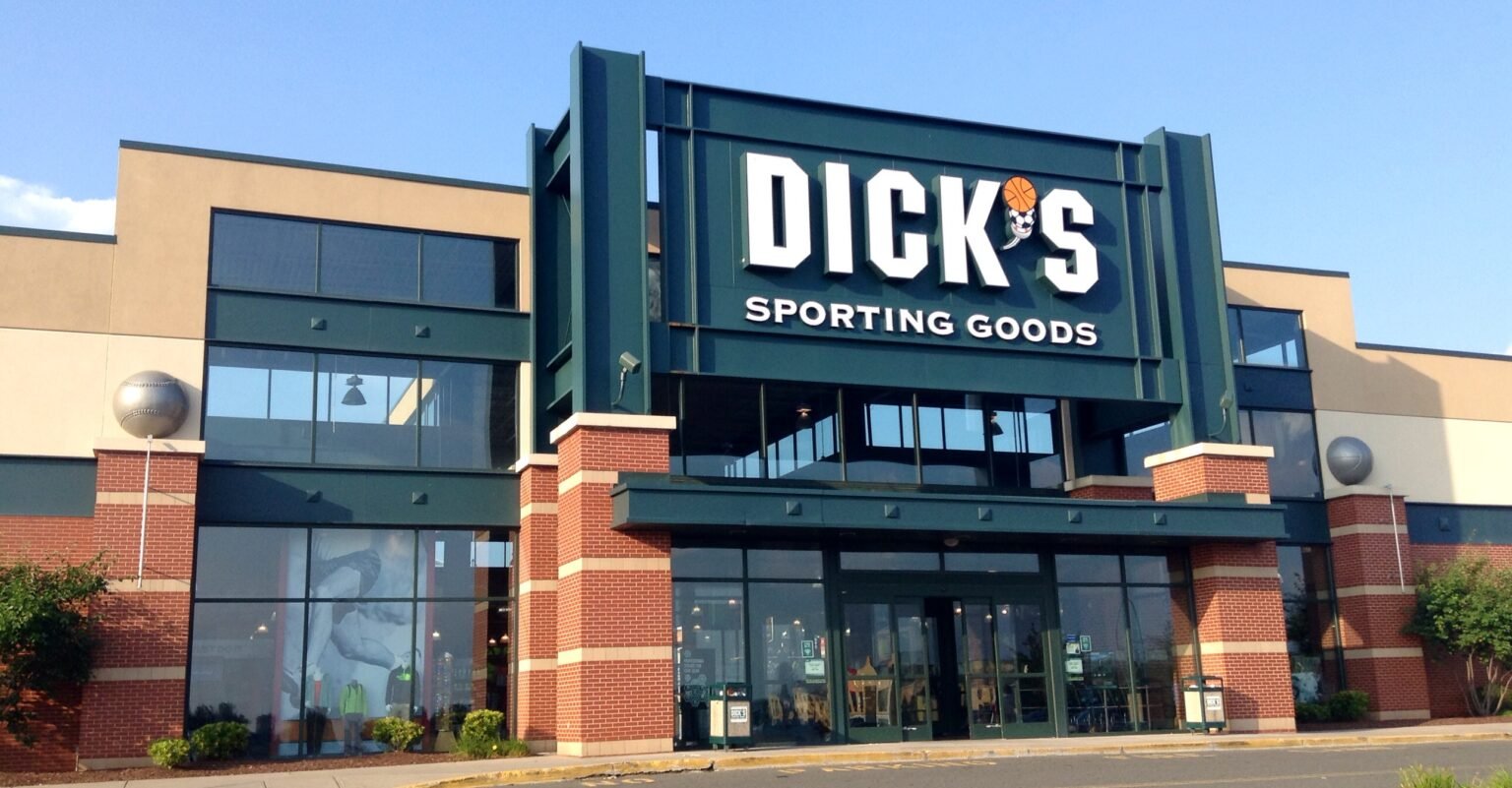
How does a mall store that sells sneakers and baseball gloves quietly become one of the biggest business success stories of the decade? Dick's Sporting Goods roughly doubled its sales in ten years — and the playbook it used is full of English expressions you need to know. In this episode, we break down the rise of a retail juggernaut and pick up five B2+ expressions that will serve you well in business, career conversations, and everyday life.
⚡ 5 Key Expressions
Expression 01
Step up its game
To raise your level of performance or effort, especially when more is expected of you. The phrase comes directly from sports — when pressure is on, a player steps up and performs better. But it has long since escaped the stadium. You'll hear it in boardrooms, classrooms, and casual conversations alike. Importantly, the possessive shifts to match the subject: step up my game, step up your game, step up their game. Morning Brew's headline calls Dick's a company that "stepped up its game" — moving from a forgettable mall chain to a dominant force in retail.
- "The design team really needs to step up its game before the client presentation next week."
- "My cooking has been terrible lately. I seriously need to step up my game."
Expression 02
Juggernaut
An overwhelmingly powerful, unstoppable force — usually an organization, industry, or movement that has grown too large to slow down. The word has a remarkable origin: it comes from Sanskrit, specifically Jagannath, a title for the Hindu god Vishnu. During ancient festivals, a massive temple cart carrying the deity was pulled through crowds — and legend says it crushed anything in its path. British colonial writers brought the word into English, and it stuck. Today, Morning Brew calls the youth sports market "an absolute juggernaut" — and the word choice is deliberate. It doesn't just mean big. It means big and unstoppable.
- "After the acquisition, the merged company became a juggernaut in the Southeast Asian logistics market."
- "K-pop has become a cultural juggernaut — there's really no stopping it now."
Expression 03
Position itself
To deliberately place yourself, your brand, or your company in a strategic spot in order to gain an advantage. The key word is deliberately — this is about calculated moves, not luck. When you position yourself, you are making a conscious decision about where you want to stand relative to competitors, opportunities, or audiences. Morning Brew says Dick's "positioned itself right in the middle of the action" in the youth sports boom — meaning the company saw where the growth was headed and made sure to be there first. The phrase works equally well for people and careers.
- "The startup positioned itself as the affordable alternative to enterprise software, and it worked."
- "She spent three years building her network specifically to position herself for a director role."
Expression 04
Turn around
To reverse a decline and make something successful again. Something that was failing, struggling, or heading in the wrong direction gets turned around when someone intervenes and changes course. The phrase always implies a before-and-after: things were bad, now they are better. It carries a quiet sense of hope — turnarounds are possible. Dick's discovered that scaling back inventory actually turned struggling Foot Locker stores around, a counterintuitive but effective fix. You can turn around a company, a team, a project, a season — or even your own life.
- "The new head coach turned the program around in just two seasons — they went from last place to the finals."
- "After a really rough year, she took six months off and completely turned things around."
Expression 05
Outpace
To move faster, grow more, or perform better than something else over a sustained period. The prefix out- in English frequently means "to do something more or better than" — outrun, outperform, outsell, and outpace all follow the same pattern. Outpace specifically emphasizes a difference in speed or growth rate over time, which makes it ideal for describing trends, markets, and long-term comparisons. Morning Brew notes that Dick's stock has "outpaced the S&P 500 since 2020" — a significant claim, since the S&P 500 is the standard benchmark for strong investment performance.
- "Demand for electric vehicles is beginning to outpace the charging infrastructure available to support them."
- "Her progress in the program completely outpaced everyone else who started at the same time."
🎭 The Dialogue: On the Ball
Maya works in marketing and Alex is a business analyst. They're grabbing coffee in the office kitchen on a Monday morning — and somehow the conversation lands on a sporting goods store that's taking over the world.
📍 Office kitchen, Monday morning. Maya is scrolling through her phone. Alex walks in and pours two cups.
Maya: Did you see the news about Dick's Sporting Goods? Their app was beating ChatGPT on the App Store last week.
Alex: I know. That company has really stepped up its game. Ten years ago it was just another mall store.
Maya: And now it's an absolute juggernaut. Forty billion dollars in the youth sports market alone.
Alex: They saw where the money was going and positioned themselves right in the middle of it. Smart move.
Maya: What about all those Foot Locker stores they bought? I heard a lot of them were struggling.
Alex: They actually turned a bunch of them around just by cutting back on inventory. Less stuff on the shelves, better results.
Maya: That's counterintuitive. And their stock has outpaced the S&P 500 since 2020.
Alex: Look, when a company plays the long game and keeps investing in tech, the numbers follow.
🧠 Episode Quiz
Can you answer this?
March Madness is the famous US college basketball tournament that kicks off this week. But where does the name "March Madness" actually come from?
- A — A sportscaster who coined the phrase on live TV in 1939.
- B — A newspaper headline from a 1982 championship game.
- C — A marketing campaign created by Nike in the 1990s.
✅ Answer: A — The phrase was first used by Henry V. Porter, an Illinois high school official, in a 1939 essay about the state basketball tournament. It was later popularized nationally by broadcaster Brent Musburger in 1982 — which is why option B is tempting. Nike had nothing to do with it.
📚 Bonus Vocabulary
Counterintuitive (adjective) — the opposite of what you would naturally expect. Maya uses it when Alex reveals that removing inventory actually improved store performance. A great word for describing surprising business logic. "It sounds counterintuitive, but working fewer hours often leads to higher productivity."
Buoyed (verb, past tense) — lifted up or supported, usually by something external. The article says the Dick's app was "buoyed by a viral post." Think of a buoy in the ocean — it keeps something afloat. "The team's confidence was buoyed by three consecutive wins."
Play the long game (phrase) — to make decisions based on long-term benefit rather than quick, short-term wins. Alex closes the dialogue with this. It implies patience, strategy, and discipline. "She turned down the higher salary because the other offer had better growth potential. She's playing the long game."