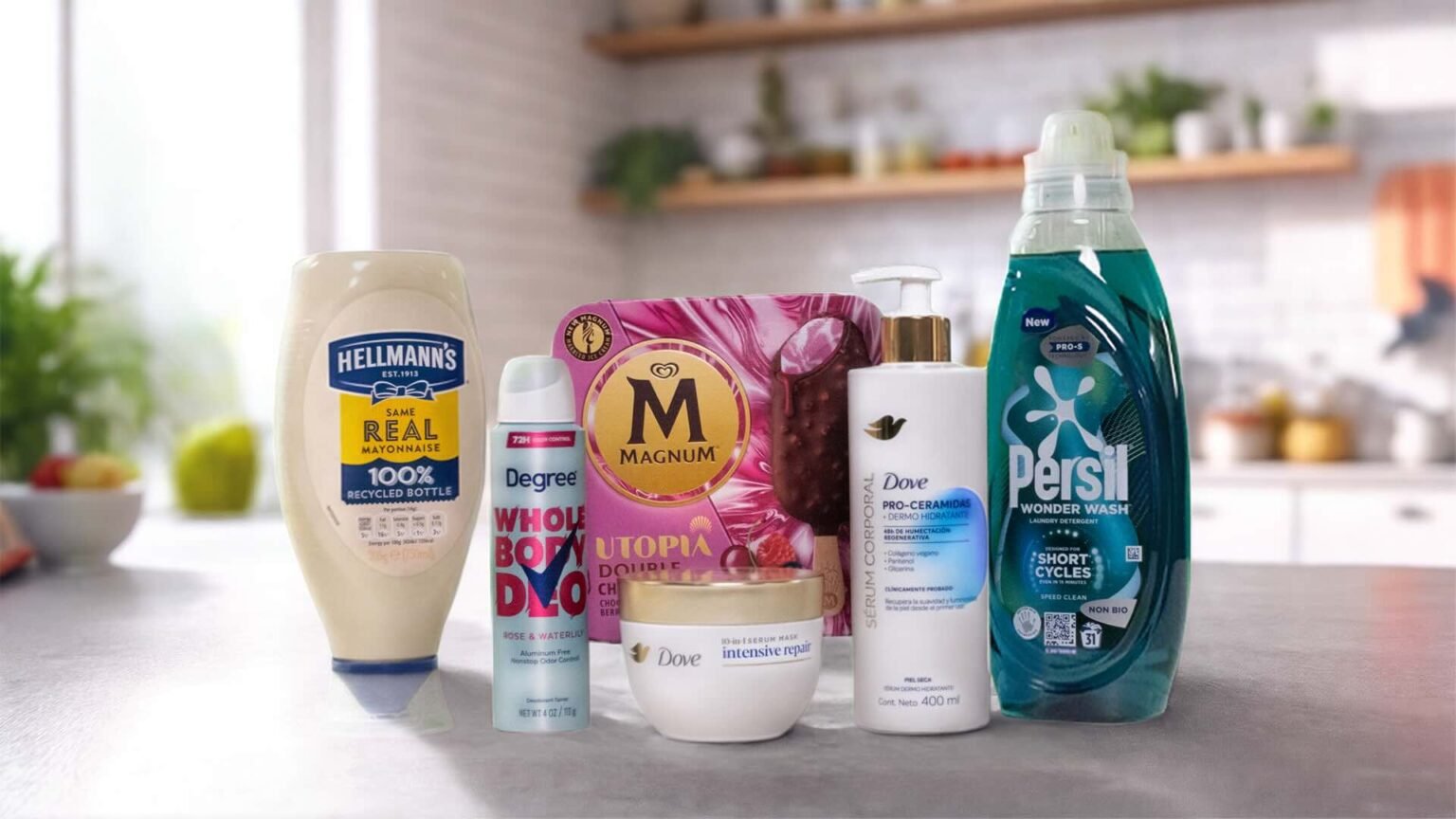
One of the world's most recognizable companies is breaking itself apart — and the story behind it is full of English you actually need. Unilever, the $140 billion giant behind Dove, Hellmann's, and Ben & Jerry's, is selling off its entire food business to focus on beauty and personal care. In this episode, we unpack the strategy, the risks, and five B2+ expressions that native speakers use whenever bold decisions get made.
⚡ 5 Key Expressions
Expression 01
Spin off
To separate a part of something and send it out into the world as its own independent entity. The original still exists — the new piece now stands alone. In business, a parent company spins off a division when it decides that division is better off operating independently. But the phrase has long escaped the boardroom. You'll hear it for TV shows, creative projects, and even careers. When Unilever separated its ice cream unit last year, that was a spinoff. Now the food business is next.
- "The engineering team grew so large that leadership decided to spin it off into its own subsidiary."
- "They loved the podcast so much they spun off a whole YouTube channel from it."
Expression 02
Double down on
To commit even more strongly to a strategy or position — especially when there is pressure or risk involved. The phrase comes directly from blackjack. When you double down in the card game, you double your bet at a high-stakes moment because you believe you are going to win. In everyday English, it carries the same energy: you are not retreating. You are going harder. Crucially, doubling down doesn't mean the decision is smart — politicians double down on bad ideas all the time. It simply means total commitment. Unilever is doubling down on beauty and personal care because that is where growth is heading.
- "After mixed reviews, the team decided to double down on their original design rather than start over."
- "He got one bad review on his cooking and doubled down — now he's doing it twice a week."
Expression 03
Come to terms with
To gradually reach a point of acceptance about something difficult or unexpected. The key word is gradually — this is a process, not a switch. You struggle with a new reality, resist it, sit with it, and eventually come to terms with it. The phrase almost always carries emotional weight. You come to terms with loss, with failure, with change, with something you did not choose. In the episode, Maya uses it when she says the corporate restructuring is moving faster than she expected — she is still processing it. Bond traders in this week's newsletter are "coming to terms with the idea of an interest rate hike." Same feeling, different context.
- "It took the board two quarters to come to terms with the fact that the product wasn't working."
- "She's still coming to terms with the end of that relationship. Give her time."
Expression 04
Weigh on
To act as a persistent, invisible burden that makes progress harder or mood lower. The image is physical — something heavy sitting on top of you, not crushing you outright, but making every step slower. When something weighs on performance, it drags the numbers down without necessarily destroying them. When something weighs on your mind, it sits there quietly, taking up space. The phrase can follow many nouns: weigh on confidence, weigh on morale, weigh on the economy, weigh on a relationship. What stays constant is that quiet, grinding heaviness.
- "The unresolved contract dispute continued to weigh on investor confidence throughout Q2."
- "I can tell something's weighing on you. Do you want to talk about it?"
Expression 05
Capitalize on
To move quickly and deliberately to get maximum benefit from an opportunity. The word comes from capital — money, resources, assets. To capitalize on something is to turn a situation into gain. What makes it different from simply "taking advantage of" is the sense of speed and intention. You see the window, and you move. The opportunity might not last. In the episode, the question is whether McCormick — the spice company buying Unilever's food brands — can capitalize on this moment and build something leaner and more focused. The phrase works equally well in business, sports, politics, and daily life.
- "The competitor was quick to capitalize on the product recall and launched an aggressive campaign the same week."
- "It started raining at the outdoor festival, and the food trucks under the tent completely capitalized on it — lines out the door."
🎭 The Dialogue: The Breakup
Maya and Alex work together at an investment firm. They're in a small glass-walled meeting room — Maya at the whiteboard, Alex walking in with two coffees — and the Unilever news is all either of them can think about.
📍 Investment firm, meeting room. Maya is at the whiteboard. Alex walks in with two coffees and a tablet.
Maya: Have you seen the Unilever news? They're going to spin off the entire food business. Hellmann's, Knorr, all of it.
Alex: I saw. Honestly, it makes sense. They want to double down on beauty and personal care — that's where the margins are.
Maya: True. But I'm still coming to terms with how fast this is all moving. A month ago nobody was talking about this.
Alex: The market saw it coming. Sentiment around big diversified conglomerates has been shifting for a while now.
Maya: Fair. But spinoffs have risks too. The new food company could really struggle without the parent behind it.
Alex: That's the part that might weigh on performance for the first year or two. Smaller companies lose index inclusion, lose institutional buyers.
Maya: So the question is whether McCormick can capitalize on this and turn Unilever's food brands into something leaner and more focused.
Alex: Exactly. Bigger isn't always better. Sometimes the best move is knowing what to let go.
🧠 Episode Quiz
Can you answer this?
Unilever was formed in 1929 through a merger between a British soap company and a Dutch margarine producer. What was the name of the Dutch margarine company that helped create Unilever?
- A — Van den Bergh
- B — Heineken
- C — Philips
✅ Answer: A — Van den Bergh was the Dutch margarine producer that merged with Lever Brothers, the British soap maker, to form Unilever in 1929. Two very different products — fats for cleaning, fats for eating — brought together under one roof. Nearly a hundred years later, Unilever is finally deciding that maybe one roof was one too many.
📚 Bonus Vocabulary
Conglomerate (noun) — a large corporation that owns many different businesses across different industries. Unilever is a classic example: food, soap, ice cream, and skincare all under one roof. The word comes from Latin, meaning things pressed together into a ball. "The media conglomerate owns newspapers, streaming platforms, and radio stations across twelve countries."
Sentiment (noun, uncountable) — the general mood or feeling of a group, especially investors or the public. Not emotion in a personal sense — more like the collective temperature of opinion at a given moment. "Market sentiment turned negative after the earnings report missed expectations."
Leaner (adjective, comparative) — more efficient, with less waste and fewer unnecessary parts. Often used to describe a company or team after cutting back. The idea is that a lean operation does more with less. "After the restructuring, the company emerged leaner and more focused on its core business."