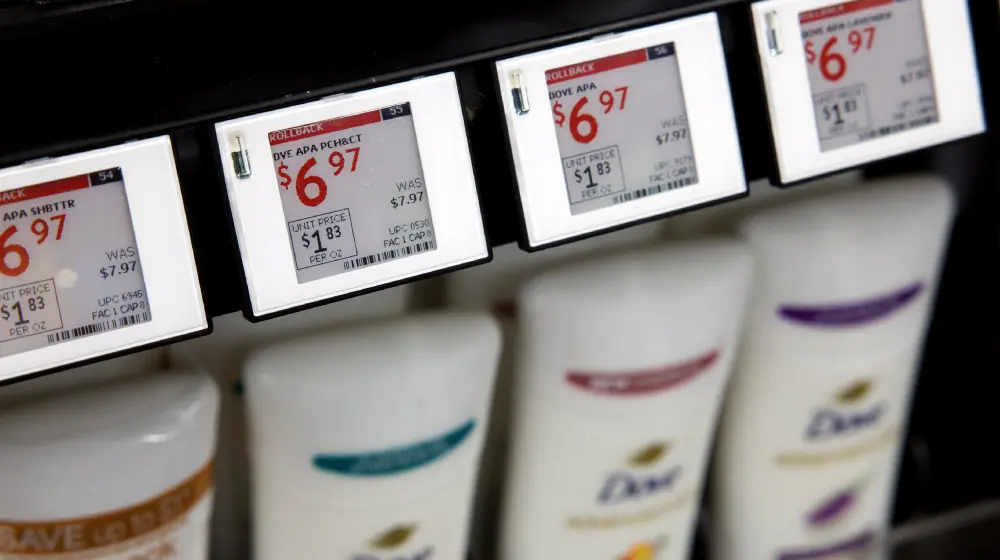
Walmart is about to replace every paper price tag in every US store with a digital screen — and it has filed patents to let artificial intelligence update prices automatically. Is this a smarter shopping experience, or a fast lane to paying more for your groceries? In this episode, we dig into the story and pick up five B2+ expressions that will serve you well in business meetings, news discussions, and everyday conversation.
⚡ 5 Key Expressions
Expression 01
Lay the groundwork
To do the early preparation that makes something bigger possible later. The metaphor comes from construction — before you build anything, you prepare the ground beneath it. To lay the groundwork means your current actions are not the main event; they are setting up the main event. Walmart's digital price labels are just the beginning — the patents for AI-powered pricing are the real structure being built on top. The phrase works equally well for careers, relationships, and long-term strategies.
- "The two companies signed a preliminary agreement to lay the groundwork for a full merger next year."
- "She spent the whole dinner laying the groundwork before finally asking if she could borrow money."
Expression 02
In tandem
Two things working together simultaneously in a coordinated way — not just side by side, but actively linked. The word comes from a tandem bicycle, built for two riders who pedal together at the same time. When Walmart plans to use customer data and AI in tandem, it means these two systems are not running separately — they are connected and feeding each other. This phrase is common in business, technology, and policy contexts wherever coordination matters.
- "The marketing and sales teams worked in tandem to launch the campaign, and the results were twice what they expected."
- "My roommate and I cook in tandem on Sundays — she handles the prep, I handle the stove."
Expression 03
Stoke concerns
To make existing worries grow stronger — to feed them, intensify them, the way you stoke a fire by adding fuel. The key word is stoke: it implies the concern was already there, but something is making it burn bigger. You will almost always see stoke paired with something uncomfortable: stoke fears, stoke tensions, stoke controversy. It rarely appears with positive emotions. Walmart's AI pricing patents are doing exactly this — not creating new public anxiety from scratch, but adding fuel to concerns that were already smoldering.
- "The CEO's vague statement about layoffs only stoked concerns among employees rather than reassuring them."
- "Honestly, reading the comments section just stokes my anxiety. I should stop."
Expression 04
Surge pricing
A pricing system where costs rise automatically during periods of high demand. A surge is a sudden, powerful increase — think of a wave surging toward shore, or a power surge blowing out your electronics. Surge pricing is what makes Uber rides expensive on New Year's Eve and flights double in price during school holidays. The concern at the center of this story is whether grocery stores — selling things people need every day — might start operating the same way. The term is now mainstream enough that most English speakers at B2+ level need to know it.
- "The hotel industry has embraced surge pricing so aggressively that booking a room during a conference has become genuinely unpredictable."
- "I tried to get tickets the night before the concert — surge pricing had them at four hundred dollars. I stayed home."
Expression 05
Push back (on)
To resist, oppose, or apply counter-pressure against something — softer than reject, but stronger than simply disagree. It is a phrasal verb with two useful forms: push back (intransitive, general resistance) and push back on something (transitive, resistance to a specific thing). In professional English, you will hear this constantly — in meetings, in news coverage, in political reporting. Lawmakers pushing back on Walmart's pricing plans means they are not just unhappy; they are actively working to stop it. The physical metaphor — pushing against a force — makes the meaning vivid and memorable.
- "When the consultant proposed cutting the entire customer service team, the board pushed back hard and asked for alternative solutions."
- "I pushed back on my friend's plan to go camping in February. I have limits."
🎭 The Dialogue: Price Check
Maya is a regular Walmart shopper and Alex works in tech. They're catching up over lunch when the conversation lands on a retail giant's plan to hand price tags over to artificial intelligence.
📍 A casual lunch spot near the office. Maya is scrolling through her phone. Alex sits down with a tray.
Maya: Did you see that Walmart is replacing all its price tags with digital screens? They just announced it.
Alex: I know — and that's just laying the groundwork. They've also patented AI systems to manage prices automatically.
Maya: So they want to use customer data and AI in tandem to decide what to charge us?
Alex: Exactly. And that's starting to stoke concerns about whether prices could change by the minute.
Maya: That sounds like surge pricing — like what airlines and Uber do when demand spikes.
Alex: Right. Walmart insists it won't go that far, but a lot of lawmakers are pushing back.
Maya: Good. Because the last thing I need is to pay double for milk just because it's a Monday morning.
Alex: Ha! Honestly though, if your grocery bill is going to surge, at least now you'll know exactly which aisle to blame.
🧠 Episode Quiz
Can you answer this?
Walmart's famous Smiley Face mascot — the one that chops price tags in half — became a retail icon. But in which decade did Walmart actually start using the Smiley Face in its stores?
- A — The 1960s, when the smiley face symbol was first designed.
- B — The 1970s, when Walmart was rapidly expanding across the US.
- C — The 1990s, when Walmart launched its national "rollback" pricing campaign.
✅ Answer: C — The 1990s. The smiley face symbol itself was created in 1963 by graphic artist Harvey Ball for an insurance company morale campaign. But Walmart adopted it for its "rollback" pricing in 1990 — which is why option B is tempting for anyone who knows Walmart's expansion history. The icon and the retailer didn't meet until decades after the symbol was born.
📚 Bonus Vocabulary
Consumer advocates (noun phrase) — people or organizations that protect the interests of buyers and the general public, especially against corporate practices. You will see this phrase constantly in business and policy news. "Consumer advocates are calling for new legislation to prevent airlines from hiding fees."
Insists (verb) — to state something firmly and repeatedly, especially when others are skeptical. Walmart insists it won't use surge pricing — meaning they are pushing back on the accusation with confidence. "He insists the project will be finished on time, despite all evidence to the contrary."
Dynamic pricing (noun phrase) — a broader term for any pricing system that changes based on real-time conditions like demand, time, or user data. Surge pricing is one form of dynamic pricing. "Dynamic pricing has transformed how we buy concert tickets, hotel rooms, and airline seats."