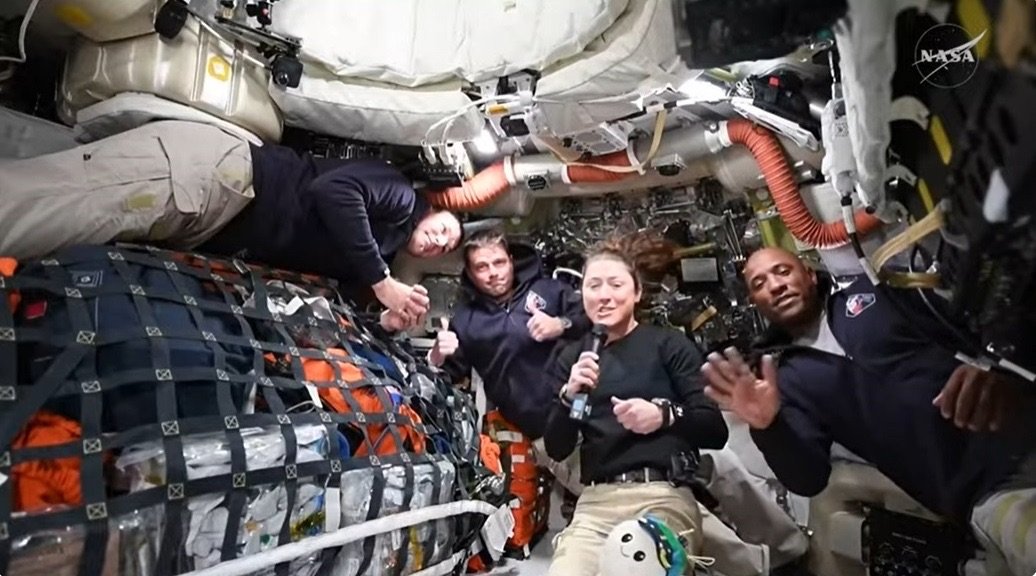
This week, four astronauts left Earth's orbit for the first time in over fifty years — and somewhere between liftoff and the moon, the toilet broke. NASA's Artemis II mission is one of the most significant moments in space exploration history, and the English that surrounds it is just as rich. In this episode, we use the week's biggest headlines — a moon launch, a jobs report, and a jaw-dropping budget proposal — to unpack five B2 expressions you'll reach for long after the astronauts come home.
⚡ 5 Key Expressions
Expression 01
Monumental
Of enormous historical, moral, or personal significance — more than just "big." The word comes from monument, a structure built to commemorate something lasting and important. When you call something monumental, you're saying it matters deeply and will likely be remembered. It's the difference between a big deal and a genuinely historic one. The Artemis II launch is monumental not just because of its scale, but because of what it represents: humanity returning to deep space after more than fifty years away.
- "Passing the bar exam after three attempts was a monumental achievement for her — and for her whole family."
- "That meeting was monumental. It completely changed the direction of the company."
Expression 02
Take (something/somewhere) by storm
To rapidly and completely dominate, impress, or conquer something — making a huge impact in a short amount of time. The phrase has military roots: a "storm" attack is sudden, overwhelming, and leaves little room for resistance. Today, we use it far beyond the battlefield. A product takes the market by storm. A performer takes a city by storm. MLB's new robot umpires took the league by storm this season — arriving, working, and changing the game almost overnight.
- "The Korean drama took streaming platforms by storm — it became the most-watched show in thirty countries within a week."
- "She walked into her first board meeting and basically took the room by storm."
Expression 03
Cautiously optimistic
Hopeful about an outcome, but holding that hope carefully — based on evidence rather than emotion. The two words seem to pull in opposite directions, but together they create something more precise than either alone. Cautiously optimistic means: things look good, the signs are positive, but I'm not ready to celebrate yet. It's one of the most useful phrases in business and professional English because it signals both awareness and restraint. When economists described March's jobs report this way, they were saying: the numbers are better than expected, but let's not get carried away.
- "The oncologist said the latest scans were encouraging and that she was cautiously optimistic about the prognosis."
- "We're cautiously optimistic about Q3 — the data looks good, but we've been surprised before."
Expression 04
On the chopping block
At serious and immediate risk of being cut, eliminated, or ended. The image is vivid: a chopping block is the wooden surface a butcher uses to cut meat. If something is placed on it, the outcome isn't uncertain — it's just a matter of timing. In the context of budget proposals, government programs, jobs, and plans, "on the chopping block" means the threat is real and the decision is coming soon. When half the federal agencies find themselves in this position, it signals not gradual reduction but potential elimination.
- "After the acquisition, three regional offices were put on the chopping block almost immediately."
- "My gym membership has been on the chopping block for months — I really need to actually go."
Expression 05
Tack onto
To add something extra onto something that already exists — usually in a way that feels secondary, unofficial, or slightly forced. The word comes from a small nail called a tack, used to pin something lightly onto a surface. It's not a clean, planned addition — it's something stuck on the side. In policy and finance, you tack amendments onto bills and fees onto contracts. The implication is almost always that the addition wasn't part of the original design, and often that someone isn't entirely happy about it being there.
- "They tacked a $15 service fee onto the final invoice with no explanation."
- "She tacked three more slides onto the presentation at the last minute — the whole thing ran forty minutes over."
🎭 The Dialogue: A Lot to Process
Maya and Alex are colleagues grabbing coffee in the office break room on a Friday morning. It's been a big week in the news, and somehow they end up covering everything from space toilets to federal budget cuts before the second cup is poured.
📍 Office break room, Friday morning. Maya is scrolling her phone. Alex walks in and pours two cups.
Maya: Have you been following the news this week? It feels like everything happened at once.
Alex: I know. The Artemis launch alone was monumental — first crewed moon mission in over fifty years.
Maya: And those photos from space were stunning. Meanwhile, back on Earth, robot umpires have taken baseball by storm apparently.
Alex: Ha! I saw that. And the jobs report came out — economists are cautiously optimistic. A hundred and seventy-eight thousand jobs added in March.
Maya: That's better than expected. Though I heard healthcare was the only sector really pulling its weight.
Alex: True. And then there's the budget proposal — half the federal agencies are on the chopping block.
Maya: I saw that. They want to tack an extra trillion onto the defense budget while cutting education and the EPA.
Alex: It's a lot to process before your second coffee, honestly.
🧠 Episode Quiz
Can you answer this?
The Artemis II mission is the first crewed spaceflight to reach the moon's vicinity since 1972. But which Apollo mission was the last to actually land on the moon?
- A — Apollo 11
- B — Apollo 16
- C — Apollo 17
✅ Answer: C — Apollo 17, launched in December 1972. Commander Gene Cernan was the last human to walk on the moon. Apollo 11 (1969) was the first — Neil Armstrong's famous mission. Apollo 16 also landed, but Apollo 17 was the finale. Cernan's final words before leaving the lunar surface remain one of the most quoted moments in space history.
📚 Bonus Vocabulary
Vicinity (noun) — the area surrounding or near a particular place. NASA describes Artemis II as reaching the moon's "vicinity" — not landing, but flying close. It's a precise, formal word useful in geography, medicine, and everyday description. "There are no good coffee shops in the vicinity of our new office — a genuine problem."
Pull its weight (phrase) — to contribute a fair share of effort within a group or system. Maya says healthcare was the only sector "really pulling its weight" in the jobs report, meaning the other sectors weren't contributing enough to make the numbers move. "Every team member needs to pull their weight if we're going to hit the deadline."
Fiscal (adjective) — relating to government finances, taxes, or public money. It appears in "fiscal 2027" and "fiscal watchdogs" in the budget story. Not to be confused with physical — the sounds are similar, but the meanings are entirely different. "The committee raised serious concerns about the fiscal impact of the proposed cuts."