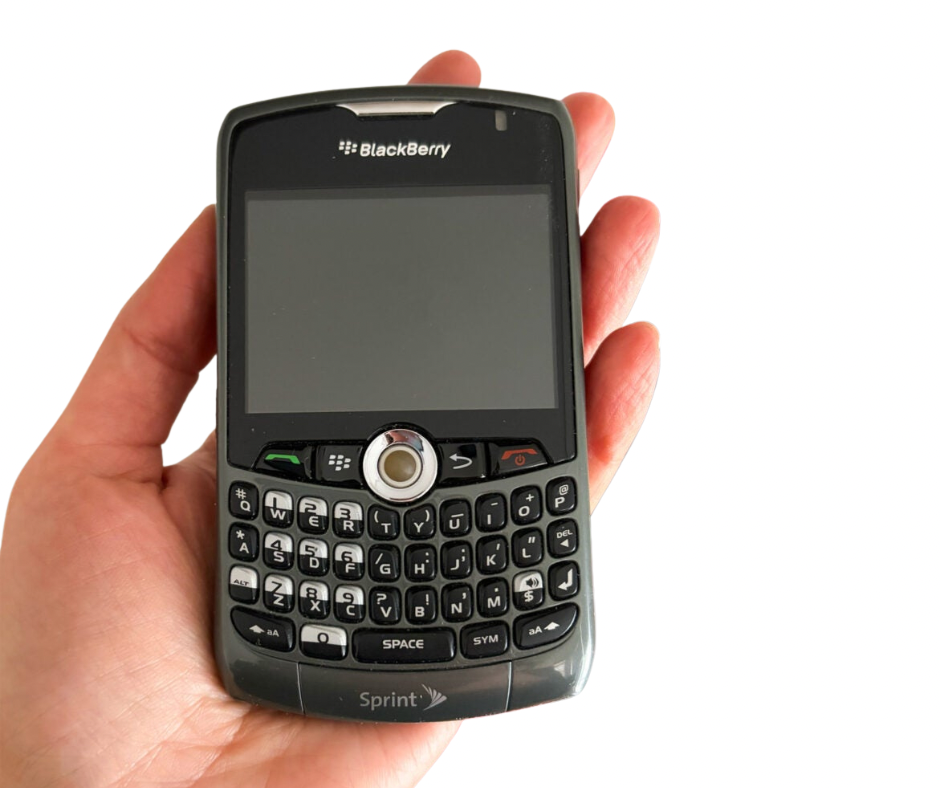
Everyone wrote them off. The little keyboard phone that once ruled boardrooms and airports quietly disappeared — and the world moved on. Except BlackBerry didn't. While nobody was paying attention, the company pivoted its entire business, stopped making phones, and embedded its software into 275 million cars. In this episode, we follow one of the most unexpected comebacks in tech history and pick up five B2 expressions that work in business, career conversations, and everyday life.
⚡ 5 Key Expressions
Expression 01
Also-ran
A competitor that participates but is never a serious contender — forgotten, always behind, never a real threat. The phrase comes from horse racing: the horses that finished but weren't in the top positions were listed in race results simply as "also ran." In everyday English, we use it for companies, products, candidates, or people who are always in the race but never win. The key feeling isn't just losing — it's being irrelevant. BlackBerry had become exactly that in the smartphone era: not a villain, not a hero, just an also-ran.
- "Every other tablet on the market is basically an also-ran — nobody's seriously competing with the iPad."
- "He ran for city council three times but was always an also-ran. This year, that finally changed."
Expression 02
Pivot
To make a deliberate, strategic shift in direction — while keeping one foot planted in what you already know. The image comes from basketball: a player pivots by keeping one foot on the ground as a fixed point while the other swings around to face a completely new direction. In business and career English, to pivot means you aren't abandoning everything — you're redirecting your core strengths toward a new opportunity. BlackBerry pivoted from consumer phones to automotive software, keeping its security expertise as the planted foot. The word always implies intention and control, not failure or retreat.
- "After the funding fell through, the startup pivoted from e-commerce to B2B logistics software — and found its first profitable quarter within a year."
- "I was deep into a finance career, but I pivoted to product design at thirty-two and never looked back."
Expression 03
Go quietly into the night
To disappear, fade out, or give up without resistance — to accept defeat or irrelevance without a fight. The phrase is drawn from one of the most famous poems in the English language: "Do Not Go Gentle into That Good Night" by Dylan Thomas, written in 1951. Thomas was urging his dying father not to surrender passively to death, but to fight, to rage. The line entered everyday English carrying that same emotional weight: going quietly into the night means accepting the end without resistance. When we say a company, a brand, or a person did not go quietly, we mean they fought back — they refused to simply disappear.
- "The brand had lost its core audience and most analysts expected it to go quietly into the night — instead, it relaunched with a completely new identity and grew 40% in a year."
- "My grandfather was like that — stubborn to the end. He was not going to go quietly into the night about anything."
Expression 04
Make headway
To make meaningful progress, especially against difficulty, resistance, or slow conditions. You don't make headway on easy things — the phrase implies the path is hard, the progress is hard-won, and it took real effort to move forward at all. Think of pushing your head into a strong wind: every step requires force. In business, "making headway" often describes progress on negotiations, transitions, restructuring, or any situation where the outcome was uncertain and the going was slow. BlackBerry spent years quietly making headway in the automotive software space while the rest of the world had written it off.
- "The team has been in contract negotiations for three months, but they're finally making headway on the key sticking points."
- "After struggling with advanced grammar for a year, I'm starting to make real headway — it's finally clicking."
Expression 05
Declare victory
To formally and publicly announce that you have succeeded — that the struggle is over and you have won. The phrase always implies that there was a real battle, a genuine period of difficulty or uncertainty. You don't declare victory over something trivial. The weight of the announcement comes from everything that came before it. When BlackBerry's CEO said "We are no longer a company in transition," that was a declaration of victory — and it landed with force precisely because of how long and hard the transition had been. In everyday use, the phrase can be used seriously or with humor, but the implication of real effort is always there.
- "After five consecutive years of losses, the CEO stood at the annual shareholder meeting and declared victory — the company had finally returned to profit."
- "I walked out of that final exam, sat down on the steps, and declared victory. Four years. Done."
🎭 The Dialogue: Back from the Dead
Maya is a product manager at a tech firm. Alex is her friend who follows the markets. They're grabbing lunch near the office on a Friday — and the conversation takes an unexpected turn toward a company neither of them had thought about in years.
📍 A lunch spot near the office, Friday afternoon. Maya is scrolling through her phone. Alex sets down two trays.
Maya: Did you see BlackBerry's earnings this week? I almost did a double take.
Alex: Right? Everyone assumed that company was an also-ran — completely out of the race.
Maya: I had no idea they pivoted so hard into automotive software. It's a totally different business now.
Alex: Exactly. And they haven't gone quietly into the night, either. Their software is in two hundred and seventy-five million cars.
Maya: That's wild. So they've actually been making headway this whole time while the rest of us weren't paying attention.
Alex: Quietly, yes. Three straight years of profit. Now management is ready to declare victory.
Maya: I mean, if your software is running in that many vehicles, maybe you've earned it.
Alex: The CEO literally said: "We are no longer a company in transition." That's a big statement.
🧠 Episode Quiz
Can you answer this?
BlackBerry phones were famously nicknamed "CrackBerry" because users were so addicted to them. But which US President was so attached to his BlackBerry that his own security team held serious meetings about whether he could keep it in the White House?
- A — Donald Trump, who was known for his heavy smartphone use.
- B — Barack Obama, who fought to keep his device after taking office.
- C — George W. Bush, who received one as a gift from a foreign dignitary.
✅ Answer: B — Barack Obama. His security team at the NSA held genuine debates about whether the device could be secured to White House standards. They eventually allowed it — but only after significant modifications to the hardware and software. He was, in the truest sense, not about to go quietly into the night on that one.
📚 Bonus Vocabulary
Double take (noun/verb phrase) — the instinctive reaction of looking at something a second time because it surprised or confused you. Maya uses it in the opening line of the dialogue. It implies the information was unexpected enough to make you stop and re-check. "I did a double take when I saw the price tag — I thought it said thirty dollars, but it was three hundred."
Write off (phrasal verb) — to dismiss someone or something as a failure, a lost cause, or no longer worth considering. "Everyone wrote them off years ago." It comes from accounting, where writing something off means removing it from the books as worthless. "Don't write him off yet — he's been in tougher situations and always found a way."
In transition (phrase) — in the middle of a major change, not yet arrived at the destination. The CEO's line "we are no longer a company in transition" lands so powerfully because of this phrase. Being in transition implies uncertainty, instability, and unfinished business. Coming out of it means the work is done. "She described herself as being in transition — between careers, between cities, between versions of herself."