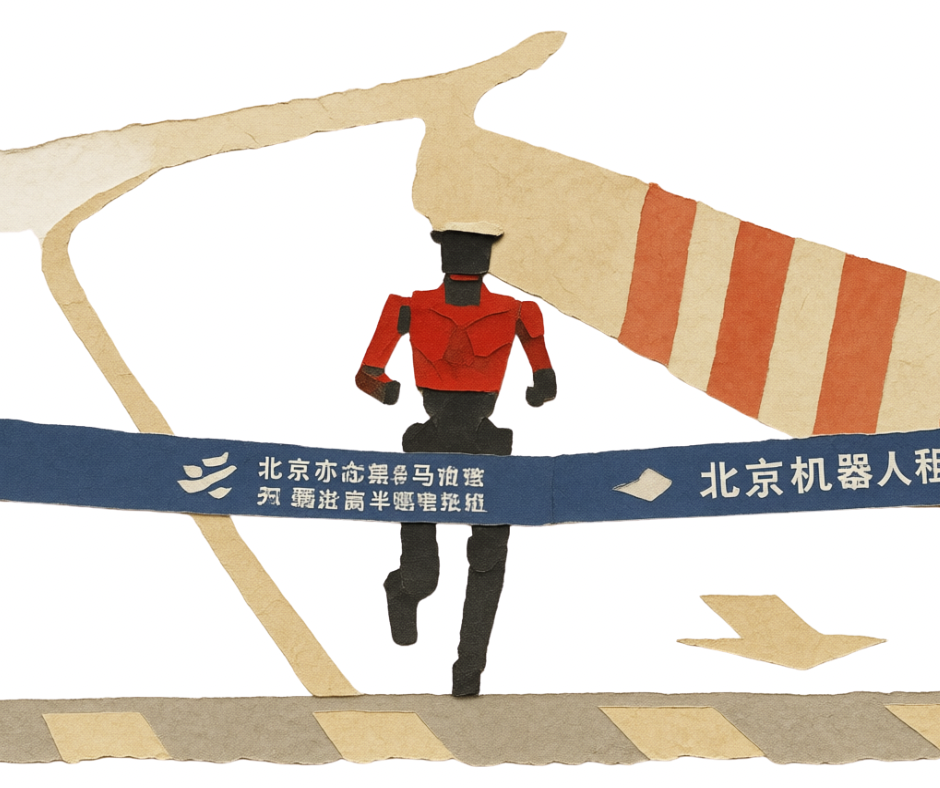
A bipedal robot named Lightning just crossed a half-marathon finish line nearly seven minutes ahead of the fastest human in the race — and the English lesson hiding inside that story is just as impressive. In this episode, we break down the Beijing robot race and pick up five B2 expressions you'll use in business, tech conversations, and everyday life.
⚡ 5 Key Expressions
Expression 01
Run away with
To win something easily and convincingly, leaving the competition far behind. The key is the preposition "with" — it completely changes the meaning of "run away." Without it, you're fleeing. With it, you're dominating. This phrase always implies a clear, decisive victory — not a narrow win. It works for competitions, awards, promotions, and debates. The subject can be a person, a team, or even a machine. When the robots in Beijing didn't just win but dominated every other competitor in the race, they ran away with it.
- "She ran away with the regional sales award — nobody else was even close."
- "Our team ran away with the hackathon. Three other groups didn't even finish."
Expression 02
Shatter a record
To break a record by such a dramatic margin that the old mark is essentially obsolete. The image is deliberate: glass shattering into pieces — not a clean break, but complete destruction. This is an important distinction from "break a record," which is neutral and simply means you beat the previous best. "Shatter" signals that the margin was jaw-dropping, not incremental. When Lightning finished the half-marathon in 50 minutes and 26 seconds, it didn't just beat the human record of 57 minutes and 20 seconds — it shattered it.
- "The new chip shattered every benchmark we had on file — engineers had to rebuild the test."
- "She shattered the company record for new client sign-ups in her very first quarter."
Expression 03
Make strides
To make significant, meaningful progress over time — especially in a field, skill, or project that requires sustained effort. A stride is a long, confident step forward, and the idiom carries that same energy: deliberate, forward-moving, and visibly advancing. Crucially, "make strides" implies progress that is real and measurable, not just effort. It's ideal for describing improvement in careers, technology, health, or learning. In the context of the robot race, humanoid robotics has made strides — a year ago, these machines could barely maintain a jogging pace.
- "The research team has made significant strides in reducing the drug's side effects."
- "I've been making real strides with my public speaking — my last presentation went much better."
Expression 04
Show one's cards
To reveal your true intentions, capabilities, or strategy — especially after a period of keeping them hidden or ambiguous. The idiom comes from poker, where showing your cards ends the suspense and makes your hand visible to everyone. In real life, a country, company, or person "shows their cards" when they make a public move that reveals what they've been building toward all along. The opposite — "keep one's cards close to one's chest" — means staying deliberately secretive. China hosting high-profile humanoid competitions is showing its cards: the investment is real, the ambition is undeniable.
- "The startup finally showed its cards at the product launch — turns out they'd been building an AI layer the whole time."
- "He's been quiet about the promotion, but I think he'll show his cards at the next board meeting."
Expression 05
In full force
Operating at full scale, with complete energy and maximum participation — nothing held back. This phrase is used to describe something that has fully arrived or is running at its highest intensity. It works for seasons, trends, events, crowds, or movements. When humanoid competitions are happening "in full force" across China, it means they are no longer experiments — they are mainstream, large-scale, and accelerating. Note that "force" here is not about physical strength; it refers to scale and completeness. You'll hear this phrase constantly in business and news contexts.
- "Earnings season is here in full force — we have results from twelve companies coming in this week alone."
- "The conference kicked off in full force on Monday with over three thousand attendees."
🎭 The Dialogue: The Race Is Over
Maya and Alex work at the same company. It's lunch break, and Alex has the robot race highlights playing on his monitor. Maya rolls her chair over — and the conversation takes a philosophical turn.
📍 Office desks, lunch break. Alex has the robot race highlights open on his monitor. Maya rolls her chair over.
Maya: Did you watch the robot half-marathon in Beijing? Those machines completely ran away with it.
Alex: I saw! And Lightning didn't just win — it shattered the human record by almost seven minutes.
Maya: Humanoid robotics has really been making strides. A year ago they could barely jog.
Alex: China is showing its cards on this one. They've been investing heavily and now the results are undeniable.
Maya: And the timing is interesting — humanoid competitions are now happening in full force over there.
Alex: It makes you wonder how long before they show up in actual road races with regular runners.
Maya: I'd still enter. Nothing to lose at that point.
Alex: Speak for yourself. I have a personal best to protect.
🧠 Episode Quiz
Can you answer this?
Today marks the 130th Boston Marathon — the world's most famous footrace. But the marathon distance itself has an ancient origin. In what year was the first marathon run at the modern Olympic Games?
- A — 1896, in Athens, Greece.
- B — 1904, in St. Louis, USA.
- C — 1912, in Stockholm, Sweden.
✅ Answer: A — The first modern Olympic marathon was run in Athens in 1896. The distance was roughly 40 kilometers, loosely based on the legendary run of the Greek soldier Pheidippides, who supposedly ran from the battlefield of Marathon to Athens to announce a military victory. The standardized 26.2-mile distance wasn't locked in until 1921.
📚 Bonus Vocabulary
Bipedal (adjective) — moving on two legs, as humans do. The winning robot Lightning is described as bipedal, which is what makes humanoid robots technically challenging — balancing and running upright at speed requires enormous computational power. "Most humanoid robots are bipedal, but quadruped designs — four legs — tend to be more stable at high speeds."
Autonomously (adverb) — independently, without external control or instruction. Many robots in the race were operated remotely, but Lightning navigated autonomously — making its own decisions in real time. "The warehouse sorting system now operates autonomously, with no human input needed during the overnight shift."
Speak for yourself (phrase) — a casual but pointed way of saying "that applies to you, not to me." Alex uses it when Maya says there's nothing to lose in entering a race against robots. It implies disagreement with a light, conversational tone. "A: 'We're all terrible at karaoke.' B: 'Speak for yourself — I've been practicing.'"