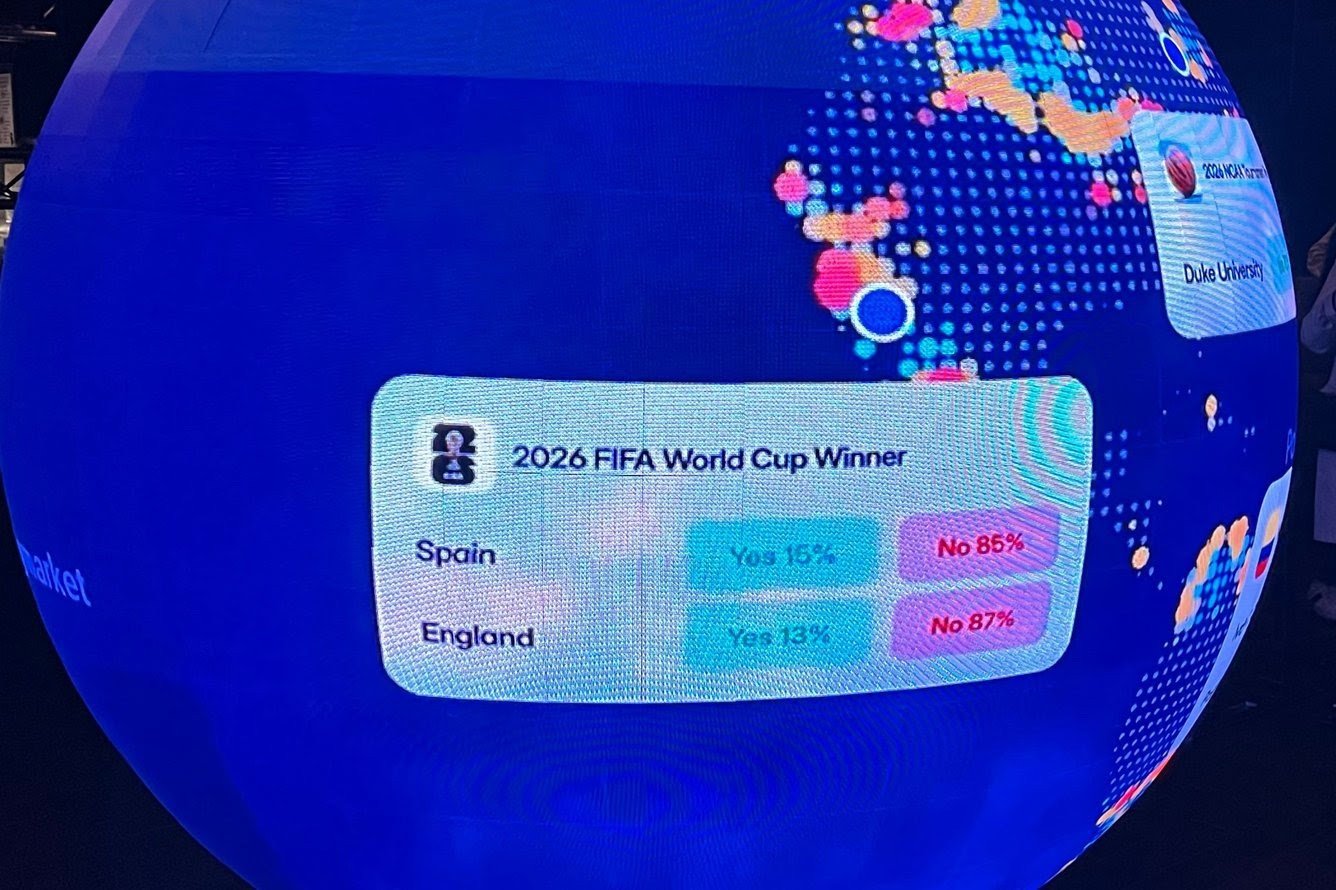
A bipartisan Senate bill could shut down Kalshi and Polymarket — the prediction market platforms that let users bet on March Madness, the World Cup, and even the weather in Chicago. The loophole that made them legal in all 50 states is finally under fire. In this episode, we break down the story and pick up five B2+ English expressions that work far beyond the world of sports gambling.
⚡ 5 Key Expressions
Expression 01
Go bust
To fail completely — a plan, a prediction, a company, or a dream that simply collapses. The image comes from going bankrupt: a business that goes bust has run out of money and has to close. But the phrase has long escaped the world of finance. You can use it for anything that falls apart entirely: a diet, a project, a tournament bracket. In the episode, Maya's March Madness bracket goes bust in the first weekend — which will feel very familiar to anyone who has filled one out.
- "The startup had a brilliant idea but went bust within a year because it never found a sustainable revenue model."
- "We had a whole beach trip planned, but it went bust when three people cancelled at the last minute."
Expression 02
Close a loophole
To fix a gap or ambiguity in a rule that people have been using to do something the rule was probably meant to prevent. A loophole is not an obvious break in the law — it's a clever workaround that is technically legal. Prediction markets like Kalshi have operated in all 50 states, including states where sports betting is illegal, by classifying wagers as financial "swaps" rather than bets. That is the loophole. The new Senate bill aims to close it. You'll hear this phrase constantly in legal, political, and business English — and it also works for policies, contracts, and even school rules.
- "The new tax reform bill is designed to close loopholes that large corporations have exploited for decades."
- "The school closed a loophole that allowed students to leave campus early by simply signing out as 'appointments.'"
Expression 03
Curb
To limit or restrain something — to pull it back without eliminating it entirely. The word comes from the curved piece of metal used to control a horse: you don't stop the horse, you guide and restrain it. That distinction matters. To curb is softer than to ban. When the Senate wants to curb prediction markets, it means imposing controls and restrictions — not necessarily outlawing them outright. You'll see curb in policy headlines constantly: curb inflation, curb spending, curb emissions. But it works just as naturally for personal habits: curb your spending, curb your enthusiasm, curb your coffee habit.
- "The central bank raised interest rates in an effort to curb inflation before it got further out of control."
- "I've been trying to curb my late-night snacking, but it's harder than it sounds."
Expression 04
Embroiled in
Deeply and often unwillingly involved in something messy, controversial, or difficult. When you are embroiled in something, you are not just touching it from the outside — you are tangled up in the middle of it. The word carries a strong negative connotation: nobody gets embroiled in good news. In the episode, Polymarket becomes a licensing partner of MLB right as MLB itself is embroiled in a gambling scandal — the timing, as Alex notes, is not great. The preposition is always in: embroiled in a dispute, embroiled in a scandal, embroiled in a controversy.
- "The company's CEO became embroiled in a fraud investigation just weeks before the planned IPO."
- "Two of our best team members got embroiled in a disagreement that slowed the whole project down."
Expression 05
Susceptible to
Easily affected by something; lacking resistance to it. If you are susceptible to something, it means you don't have much of a defense against it — whether that's a virus, a sales pitch, peer pressure, or bad financial decisions. The word started in medicine — susceptible to infection, susceptible to disease — but it has migrated completely into psychology, marketing, and business English. The preposition is always to, never of or for. Maya uses it with a hint of dark humor at the end of the dialogue: people are simply susceptible to finding new ways to lose money on sports. Which, given the numbers in this story, is hard to argue with.
- "Investors who don't diversify their portfolios are far more susceptible to sudden market downturns."
- "I'm very susceptible to impulse purchases when I'm hungry — I should never go to the supermarket on an empty stomach."
🎭 The Dialogue: Bad Bet
Maya and Alex are colleagues. It's Tuesday morning, March Madness is already causing damage, and a Senate bill is about to make things even more complicated for people who like to put money on sports.
📍 Office break room, Tuesday morning. Alex is eating lunch early. Maya walks in looking slightly defeated.
Maya: I had twenty dollars on Gonzaga winning it all. The bracket went bust in the first weekend.
Alex: Yeah, I heard Kalshi had billions in trades just from the first four days of March Madness. But that whole business might be over soon — Congress wants to close the loophole that lets them operate.
Maya: What loophole? I always thought prediction markets were legal everywhere.
Alex: They are, technically — but only because they're regulated as financial swaps, not bets. The Senate wants to curb that now and put them under the same rules as sportsbooks.
Maya: That feels like it's going to affect a lot of people. Aren't these platforms embroiled in some kind of scandal too?
Alex: Polymarket is a licensing partner of MLB — which is already embroiled in a gambling scandal. Great timing.
Maya: So the whole industry is in trouble. I guess people are just really susceptible to finding new ways to lose money on sports.
Alex: Apparently. Though Kalshi just raised a billion dollars, so somebody still believes in them.
🧠 Episode Quiz
Can you answer this?
March Madness is everywhere this week — but the term wasn't always about college basketball. Where was "March Madness" first used?
- A — A 1939 essay about a high school basketball tournament in Illinois.
- B — A Nike marketing campaign from the 1980s.
- C — A live TV broadcast by a famous sportscaster in 1975.
✅ Answer: A — The phrase was first used by Henry V. Porter, an Illinois high school official, in a 1939 essay about the state basketball tournament. It had nothing to do with college basketball at first. Sportscaster Brent Musburger helped bring it to a national audience in 1982 — which makes option C tempting — but the origin is that 1939 essay. Nike had nothing to do with it.
📚 Bonus Vocabulary
Bipartisan (adjective) — supported by both major political parties, not just one side. The Senate bill targeting prediction markets is described as bipartisan, meaning it has backing from both Republicans and Democrats. In a polarized political environment, bipartisan support is often treated as a sign that a bill has a real chance of passing. "The infrastructure bill passed with bipartisan support, which surprised a lot of political analysts."
Backers (noun) — people or organizations that financially support something, usually a company or project. Despite the controversy around prediction markets, the article notes the industry has had no trouble finding backers — Kalshi raised one billion dollars at a 22 billion dollar valuation. "The documentary couldn't get started until it found enough backers to cover the production costs."
Embroiled in (revisited) — the preposition matters: One small but important detail — you are always embroiled in something, never embroiled with or embroiled by. Prepositions in fixed phrases like this are worth memorizing as a unit: embroiled in a scandal, susceptible to pressure, curb your tendency to. Learning the preposition alongside the word is what makes your English sound genuinely natural.