Gold is supposed to be the ultimate safe haven — the one asset everyone runs to when the world gets scary. So why is it having one of its worst months in fourteen years, right in the middle of a geopolitical crisis? In this episode, we dig into the counterintuitive story behind gold's surprising slump, and pick up five B2+ expressions that travel far beyond the world of finance: in a rut, safe haven, pare back, bullish and bearish, and chicken out. Oh, and there's a taco involved.
⚡ 5 Key Expressions
Expression 01
In a rut
To be stuck in a pattern with no forward movement — doing the same thing over and over with no improvement or escape. The image comes from a literal rut: a deep groove worn into a road by wheels, so deep that a cart can't steer out of it. When gold was surging, everything was moving. Now it can't get traction. That's a rut. The phrase works equally well for people, careers, relationships, and creative projects — any situation where someone is trapped in a loop they can't seem to break.
- "The product team has been in a rut since the last major release — they need a new brief to spark some momentum."
- "I've been eating the same lunch for three weeks. I am deeply in a rut."
Expression 02
Safe haven
A place — physical, financial, or emotional — that offers protection and stability when everything around it is dangerous or unpredictable. "Haven" itself means shelter or harbor, so "safe haven" doubles down on the idea of refuge. In finance, gold has long been considered the ultimate safe haven: when stocks crash, currencies wobble, or wars break out, investors historically pour money into gold because it holds its value. What makes today's story so striking is that gold is failing at the one job it's famous for.
- "During the financial crisis, the Swiss franc became a safe haven for investors across Europe."
- "That little bookshop on the corner is my safe haven — I go there whenever the city feels like too much."
Expression 03
Pare back
To reduce something carefully and deliberately — trimming it down rather than cutting it all at once. The word "pare" comes from the Old French parer, meaning to peel or prepare, and it's the same verb you use when you pare an apple: you remove just the outer layer with precision. To pare back implies restraint and intention. Traders aren't dumping all their gold — they're trimming their positions thoughtfully. That nuance of careful reduction is what separates "pare back" from cruder alternatives like "cut" or "slash."
- "We need to pare back the agenda — the meeting is running two hours and nobody's happy."
- "I'm trying to pare back my screen time before bed. Emphasis on trying."
Expression 04
Bullish / Bearish
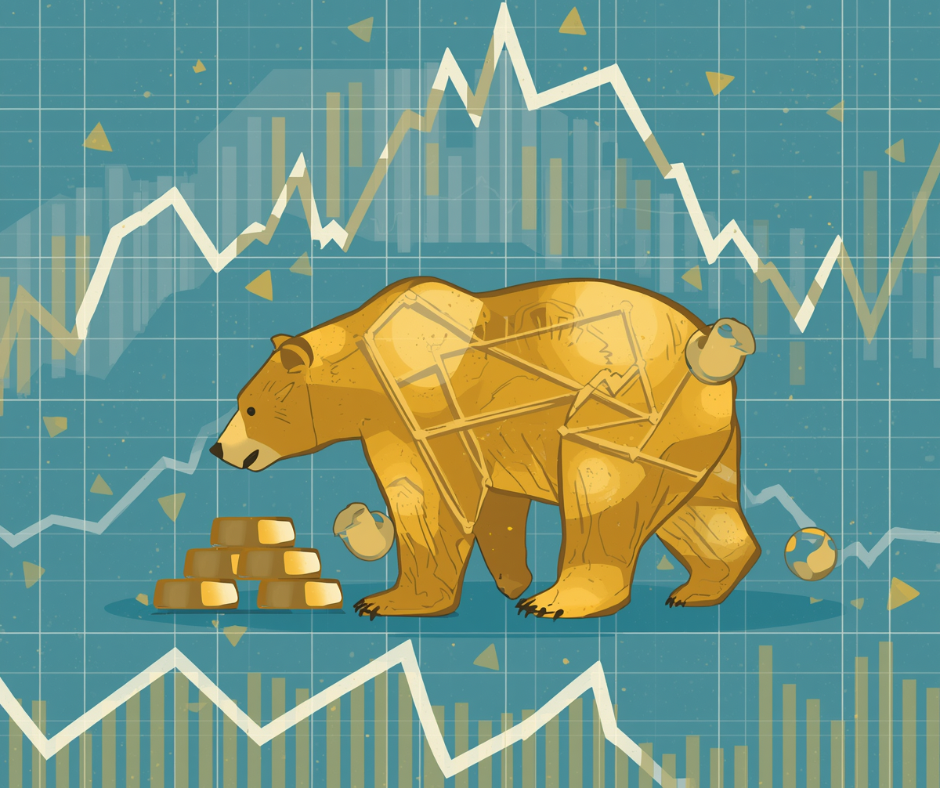
Two of the most useful contrasting terms in financial English — and they've long since escaped the trading floor. A bull charges forward with its horns up: bullish means optimistic, confident, expecting growth or improvement. A bear swipes downward with its paws: bearish means pessimistic, cautious, expecting decline. Today's newsletter headline — "Bullion Goes Bearish" — is a deliberate play on these terms. Analysts remain bullish on gold long-term, even as the short-term picture looks bearish. Outside of markets, the same logic applies to anything you have an opinion about.
- "I'm really bullish on this new neighborhood — the coffee shops are multiplying and rents are still reasonable."
- "She's been bearish about the project from day one. Nothing we say convinces her it'll work."
Expression 05
Chicken out
To lose your nerve at the last moment and back away from something you had committed to doing. "Chicken" as a synonym for cowardly dates back to at least the 1600s in English. To chicken out captures that specific, slightly embarrassing moment when you were ready — and then suddenly weren't. The TACO theory in today's newsletter stands for Trump Always Chickens Out: the idea that the president makes bold threats, and then backs down before real escalation. Investors betting on TACO are essentially betting that the crisis will blow over — which is why they're not rushing into gold. The opposite of chickening out is following through.
- "He was going to ask for a raise and then totally chickened out at the last second."
- "Don't chicken out on me — we signed up for this 5K together and I'm not running alone."
🎭 The Dialogue: Bullion Blues
Maya and Alex are colleagues who follow the markets. It's Tuesday morning and Maya is staring at her portfolio with a look that says everything.
📍 Office break room, Tuesday morning. Maya is scrolling through her phone. Alex pours two coffees and sets one in front of her without being asked.
Maya: Alex, I put a chunk of my savings into gold back in January. I really thought it was the smart move.
Alex: You're not alone. Everyone was bullish on gold at the start of the year — it had just hit an all-time high.
Maya: So why is it in such a rut now? The world is literally on fire and gold is supposed to be a safe haven.
Alex: That's the paradox. A lot of traders are actually paring back their gold positions because they think the geopolitical drama will just blow over.
Maya: You mean they're betting that things will calm down before they get worse?
Alex: Basically. There's even a term for it — TACO. It stands for Trump Always Chickens Out. The idea is that the president backs down before things really escalate.
Maya: So investors aren't running to gold because they think the crisis won't last?
Alex: Exactly. But analysts are still bullish long-term. If you can stomach the short-term pain, gold might still be the right call.
🧠 Episode Quiz
Can you answer this?
Gold has been used as money and a store of value for thousands of years. But which country currently holds the largest official gold reserve in the world?
- A — The United States
- B — China
- C — Germany
✅ Answer: A — The United States holds roughly 8,100 tonnes of gold, more than the next two countries combined. Germany comes in second — not China, which holds significant reserves but officially ranks lower. The US has held the top position for decades, a legacy of the post-WWII Bretton Woods system that made the dollar the world's reserve currency.
📚 Bonus Vocabulary
Geopolitical (adjective) — relating to how geography, politics, and international power interact. It sounds academic, but you'll hear it constantly in financial news. Whenever a conflict, election, or trade dispute affects markets, analysts call it a "geopolitical" event. "The fund manager said geopolitical uncertainty was the biggest risk to her portfolio this quarter."
Stomach (verb) — to tolerate or endure something unpleasant without giving up. Alex uses it at the end of the dialogue: "if you can stomach the short-term pain." The verb form is informal but widely used in business contexts. "I can't stomach another all-hands meeting with no agenda."
Blow over (phrasal verb) — for a problem, conflict, or crisis to pass without serious consequences. It comes from storms: a strong wind blows over, and calm returns. Traders using the TACO logic are betting the current situation will blow over before it gets truly dangerous. "Everyone thought the controversy would blow over in a week — it didn't."