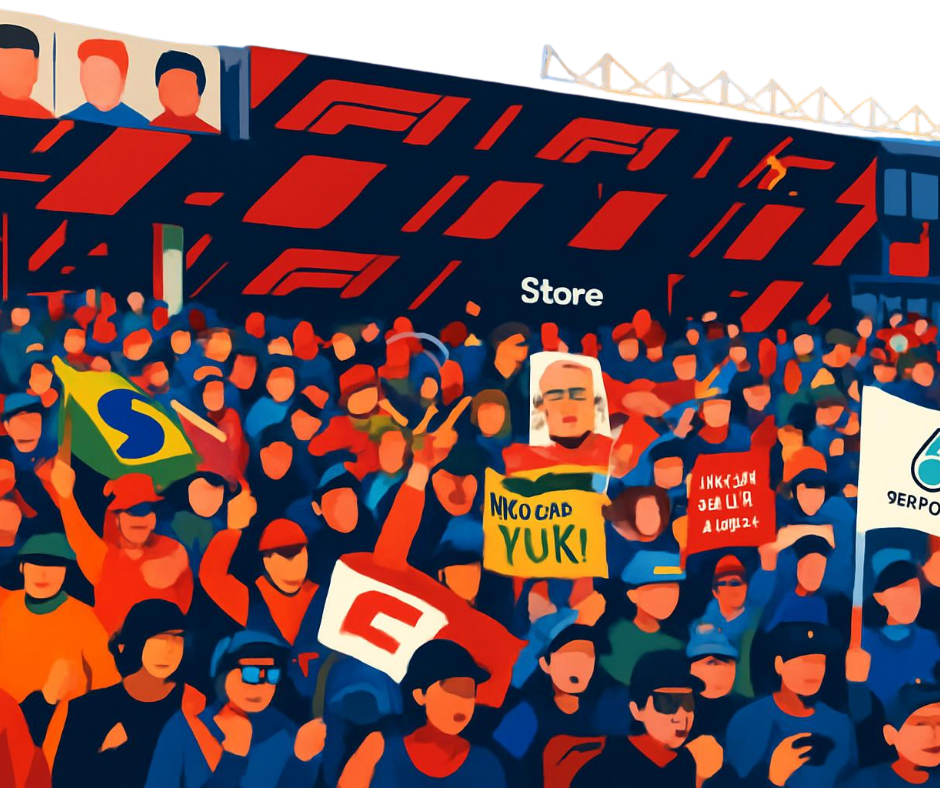
Formula 1 used to be a niche sport for racing obsessives. Now it sells out 24 races a year, generates nearly four billion dollars in revenue, and turns host cities into economic boom towns for a weekend. In this episode, we break down F1's explosive global rise and pick up five B2+ expressions — from business idioms to everyday phrases — that will serve you well far beyond the racetrack.
⚡ 5 Key Expressions
Expression 01
Make it rain
To generate large amounts of money — often with a sense of impressive scale or abundance. The phrase started in American slang, where it literally meant throwing cash into a crowd to show off wealth. In business English, the meaning has evolved: when a company or industry is "making it rain," it's pulling in enormous revenue. The emphasis isn't just on earning money — it's on earning a lot, with energy and momentum behind it. You'll hear it in startup culture, finance conversations, and anywhere people talk about financial performance in a vivid, non-textbook way.
- "Since they launched the subscription tier, that single product line has been making it rain for the whole company."
- "Did you see her signing bonus? She is absolutely making it rain."
Expression 02
Revenue stream
A specific, ongoing source of income for a business or individual. The word "stream" is the key — it implies that money flows in continuously, not just once. Companies talk about having multiple revenue streams because it reduces risk: if one source slows down, others keep the money moving. In F1's case, the sport earns from race promoter fees, broadcast rights, merchandise, sponsorships, and ticket sales — each a separate stream feeding into the same river. This is an essential term in business English that appears constantly in meetings, pitches, and financial reporting.
- "We need to diversify our revenue streams before we scale — right now we're too dependent on one client."
- "His YouTube channel has become a solid revenue stream — he's making more than at his day job."
Expression 03
Pony up
To pay a required amount of money — often when you're somewhat reluctant to do so, but you do it anyway because it's necessary or expected. The origin of this phrase is genuinely debated. One theory traces it to a Latin legal term, "legem pone," which appeared at the top of March payment documents in old English courts — over time, "pone" became "pony." Another links it to British slang for small sums of money. Either way, the modern meaning is clear: you pony up when the cost is significant and you're not thrilled about it, but you pay. It has a slightly grumbling, reluctant energy that makes it very natural in spoken English.
- "The city eventually ponied up the funding for the new stadium after years of negotiation."
- "Come on, pony up — it's just ten dollars for the pizza."
Expression 04
A two-way street
A situation in which both parties give something and receive something — the exchange flows in both directions, not just one. When F1 races come to a city, the city pays millions in promoter fees but earns far more back in tourism and economic activity. The fans pay for expensive tickets but receive an unforgettable experience. Both sides invest; both sides benefit. That is a two-way street. Importantly, this phrase can also be used critically — if someone is taking without giving, you might say "this needs to be a two-way street" as a gentle but clear reminder that contribution is expected from both sides.
- "The partnership works because both teams understand it's a two-way street — we share data, they share distribution."
- "My friendship with her isn't really a two-way street. I'm always the one reaching out."
Expression 05
Appetite (for something)
A strong desire, enthusiasm, or demand for something — used figuratively, far beyond the literal meaning of hunger for food. When we say there is a "huge appetite" for live events, we mean people want them urgently and in large numbers. The word can be used positively ("a growing appetite for innovation") or negatively ("little appetite for more regulation"). Common collocations to remember: a strong appetite for, a growing appetite for, little appetite for, no appetite for. The figurative use is everywhere in business, politics, media, and everyday conversation — it's a high-frequency word that immediately sounds natural at B2 level and above.
- "Investors are showing a strong appetite for AI startups despite the broader market slowdown."
- "After that last group project, I have zero appetite for team assignments."
🎭 The Dialogue: Fast Lane
Maya is a marketing manager who just attended her first F1 race. Alex is a finance analyst who has been following the sport for years. It's Monday morning, and they're catching up over coffee.
📍 Office coffee station, Monday morning. Maya is still buzzing from the weekend. Alex pours two cups.
Maya: I finally went to my first F1 race last weekend. I had no idea the sport was making it rain like this — the whole city felt like a festival.
Alex: Right? It's not just racing anymore. The live experience is massive. Tickets, concerts, merchandise — it's become a serious revenue stream for everyone involved.
Maya: But those tickets weren't cheap. I had to pony up almost five hundred dollars for a three-day pass. I almost said no.
Alex: Was it worth it though?
Maya: Completely. And honestly, it's a two-way street — the city gets packed with tourists, and the fans get this incredible weekend. Everyone wins.
Alex: That's exactly why cities are lining up to host races. They pay F1 millions just for the rights, but the economic return can be enormous.
Maya: I get it now. There's just a huge appetite for this kind of live experience. People want to be there in person, not watching from a couch.
Alex: And F1 figured that out before almost anyone else. That's why they're still accelerating.
🧠 Episode Quiz
Can you answer this?
Formula 1 races start the moment the lights go out. But how many lights are there on the starting gantry — the ones that go on one by one before the race begins?
- A — Three lights
- B — Five lights
- C — Seven lights
✅ Answer: B — Five lights. They illuminate one by one from left to right, building tension over about five seconds. When all five go dark simultaneously, the race begins. It's one of the most iconic countdowns in sports — and it inspired F1's famous phrase: "Lights out and away we go."
📚 Bonus Vocabulary
Promoter fee (noun phrase) — the amount a city or circuit pays to F1 for the right to host a race. It's a standard term in the live events industry. "The promoter fee for a street circuit in a major city can run into the tens of millions of dollars."
Spectator (noun) — a person who watches an event, especially a sporting one, without participating. More formal than "fan" and often used in official reporting. "The 2025 season drew 6.7 million spectators across 24 races."
Economic ripple effect (noun phrase) — the way money spent at one point spreads outward and benefits many surrounding businesses and people, like a ripple spreading across water. "The Grand Prix creates an economic ripple effect — hotels, restaurants, transport companies, and local vendors all benefit."