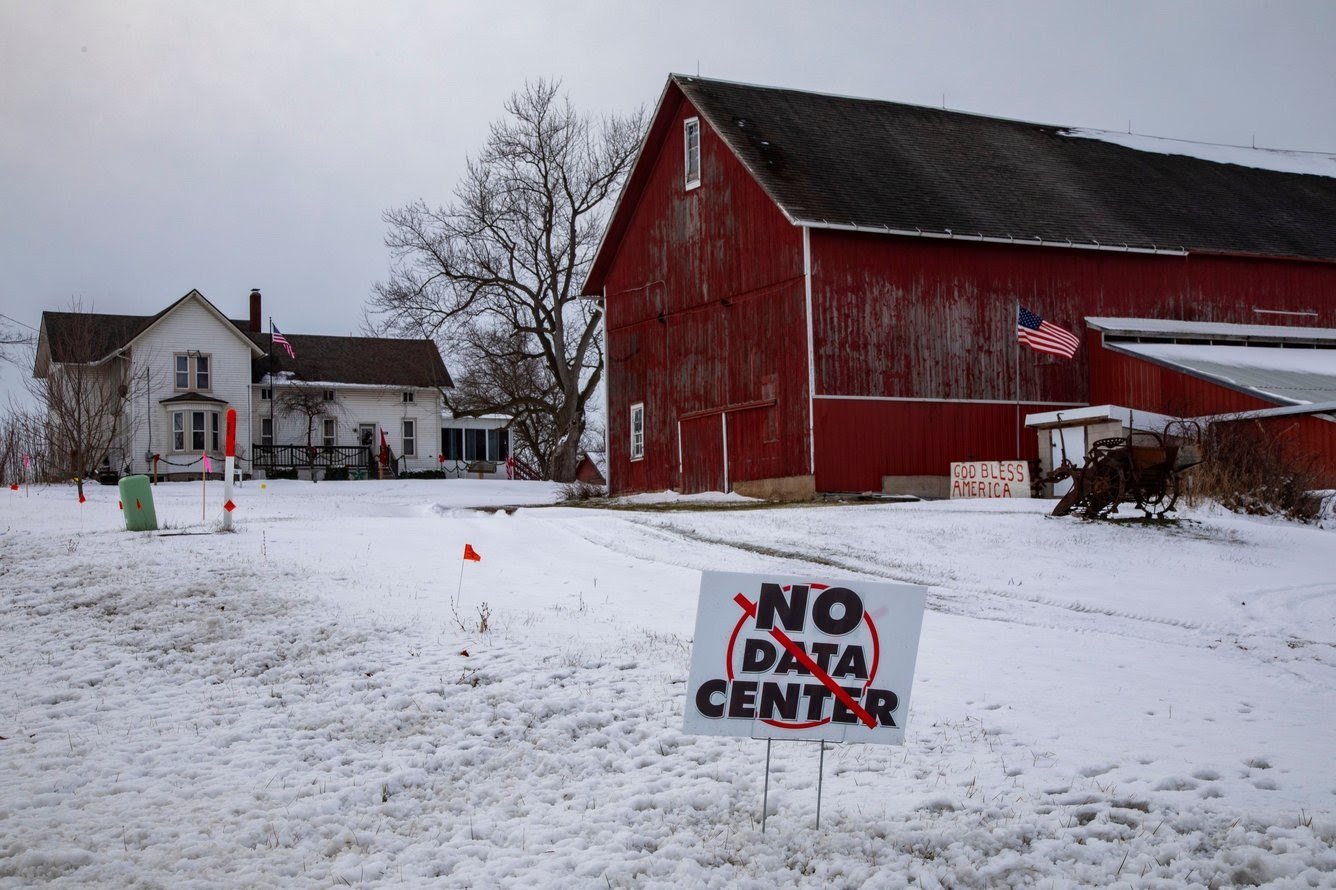
A city councilor in Indianapolis had bullets fired at his home — over a vote on a data center. States across the US are drafting bans. The buildings that quietly power AI, cloud storage, and everything you do online are at the center of one of the most heated political fights in America right now. In this episode, we use that story to learn five expressions that belong in every upper-intermediate learner's toolkit: escalate, place a moratorium on, canary in the coal mine, up for grabs, and push back on.
⚡ 5 Key Expressions
Expression 01
Escalate
To increase in intensity, severity, or seriousness — especially when something that started small grows into something much larger or more dangerous. The word shares its root with escalator: both come from the Latin scala, meaning steps. When a situation escalates, it's climbing those steps toward something worse. It can be used intransitively ("The conflict escalated overnight") or transitively ("The president escalated the dispute"). In business, you'll often hear "escalate to senior management" — meaning to raise an issue to a higher level of authority.
- "What started as a billing complaint escalated into a full legal dispute within two weeks."
- "We need to fix this now — if we ignore it, it's only going to escalate."
Expression 02
Place a moratorium on
To officially pause or temporarily ban something — usually as a deliberate policy decision by an authority such as a government, institution, or company. A moratorium is not necessarily permanent; the word implies a hold while something is being reconsidered or studied. What makes this phrase powerful is the word place — it signals that the action is formal and intentional. You place a moratorium; you don't just have one happen. Maine is moving to place a moratorium on data centers consuming over 20 megawatts, a move that could ripple across the country.
- "The board placed a moratorium on all new spending until the audit was complete."
- "Several cities have placed a moratorium on short-term rentals while they update housing regulations."
Expression 03
Canary in the coal mine
An early warning sign — something small that signals a much bigger danger or problem ahead. The origin is literal: miners once carried caged canaries into coal mines because the birds are highly sensitive to toxic gases. If the canary died, it meant the air was becoming dangerous, and the miners needed to get out immediately. The idiom has long since left the mine. Today, a "canary in the coal mine" is any person, event, or data point that serves as an early indicator of trouble. The key distinction: the canary doesn't cause the problem — it reveals it before things get worse.
- "The sudden drop in customer renewals was a canary in the coal mine — revenue collapsed the following quarter."
- "Her leaving the team was the canary in the coal mine. Four others had quit by the end of the month."
Expression 04
Up for grabs
Available, undecided, and open for anyone to claim or win. If something is up for grabs, no one has secured it yet — and the competition is real. The phrase works across contexts: an election seat is up for grabs, a promotion is up for grabs, even the last slice of pizza is up for grabs. In political reporting, you'll often hear it about contested seats or uncertain outcomes. It carries a sense of opportunity — something valuable is within reach, but only if you move for it. Maine's Senate seat is up for grabs in November, which is exactly why politicians there are paying close attention to the data center debate.
- "The regional sales director position is up for grabs — three internal candidates are being considered."
- "Nobody had signed up for the Friday shift, so it was up for grabs."
Expression 05
Push back on
To actively resist or oppose something — usually in an organized, assertive, and often formal way. The physics metaphor is useful here: something is moving forward, and you are applying force in the opposite direction. Crucially, pushing back doesn't mean simply complaining or expressing discomfort. It implies taking a position and defending it. In the data center story, communities are pushing back on construction projects through courts and ballot measures — organized resistance, not just frustration. In workplace English, "I want to push back on that" is a professional, non-aggressive way to disagree and hold your ground.
- "Several board members pushed back on the proposed merger, citing concerns about cultural fit."
- "I have to push back on that timeline — there's no way we can deliver in three weeks."
🎭 The Dialogue: No Data Centers
Maya is a tech journalist and Alex works in local government. They're catching up over coffee — and the conversation quickly turns to the most unexpected political flashpoint of the year.
📍 A coffee shop near city hall. Maya has her laptop open. Alex drops into the seat across from her.
Maya: Did you hear what happened to that councilor in Indianapolis? Bullets fired at his house over a data center vote.
Alex: I did. This whole situation has really escalated. A year ago it was just angry town halls — now it's getting dangerous.
Maya: Maine is about to place a moratorium on any data center using over twenty megawatts. Other states are watching closely.
Alex: They should. Maine's Senate seat is up for grabs in November, and how politicians handle this could define the whole election.
Maya: Exactly. And communities aren't just venting online anymore — they're seriously pushing back on these projects in the courts and at the ballot box.
Alex: It's a real clash. Data centers bring jobs, but also heat islands, noise, and skyrocketing energy costs.
Maya: The Maine bill could be a canary in the coal mine for the whole country. If it passes, expect a wave.
Alex: I already do. This isn't going away — it's only going to get louder.
🧠 Episode Quiz
Can you answer this?
Data centers consume enormous amounts of electricity. By 2030, the US data center industry is projected to use more electricity than which of the following?
- A — All American households combined.
- B — The entire country of Germany.
- C — Every electric vehicle on the road in the US.
✅ Answer: A — All American households combined. US data centers are on track to consume more electricity than every home in the country put together. That scale of energy demand is a major reason why communities, lawmakers, and utility companies are starting to push back — hard.
📚 Bonus Vocabulary
Backlash (noun) — a strong and often sudden negative reaction from a group of people. The data center story is defined by backlash — public resistance that has moved from frustration to formal legislation. "The policy change triggered an immediate backlash from employees."
Heat island (noun) — an urban area that is significantly warmer than its surrounding rural areas due to human activity. New research shows data centers create heat islands within a six-mile radius, contributing to pollution and public health problems. "City planners are looking for ways to reduce the heat island effect in dense neighborhoods."
Skyrocketing (adjective/verb) — increasing extremely rapidly, often to an alarming degree. Alex uses it in the dialogue to describe energy costs. The word evokes the image of a rocket — fast, vertical, and hard to stop. "Skyrocketing rents have pushed many long-term residents out of the neighborhood."