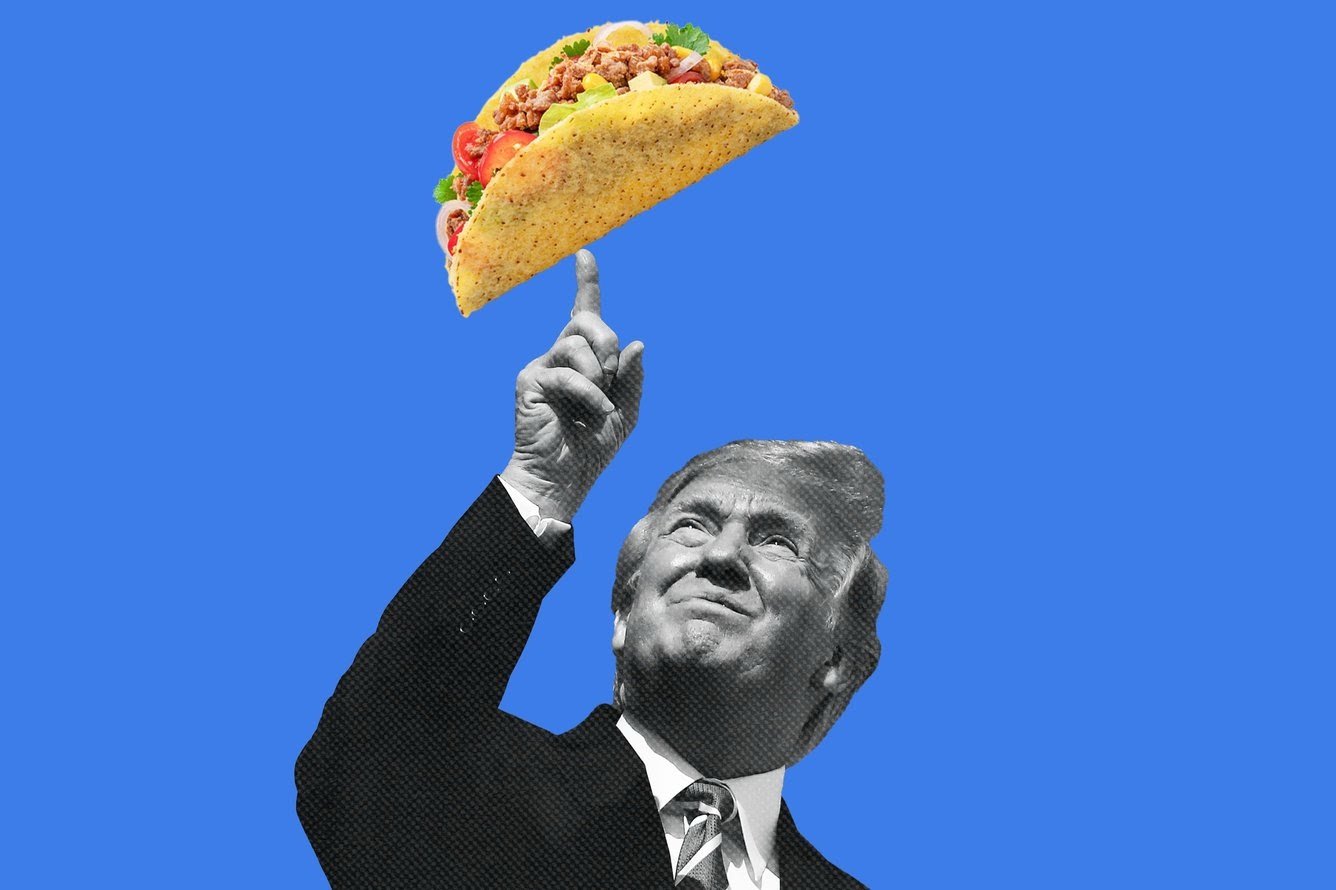
What does a taco have to do with Wall Street? More than you'd think. In this episode, we unpack one of the strangest market patterns of the year — a cycle of dramatic threats, sudden reversals, and chaotic trading days that investors have nicknamed the TACO trade. It's a story about geopolitics, investor psychology, and what happens when markets try to predict the unpredictable. Along the way, you'll pick up five B2 expressions that go well beyond finance and into everyday conversation.
⚡ 5 Key Expressions
Expression 01
Back down
To retreat from a strong position — a threat, a demand, an argument — after initially holding firm. When someone backs down, they had a hard line and then gave it up. The phrase always implies a reversal of something strong, and often carries a quiet sense of weakness or embarrassment. You can back down from a negotiation, a confrontation, a policy — or even a promise. It's one of those phrasal verbs where the direction of the word is literal: you step back, you move away from where you were standing.
- "After weeks of insisting on the original contract terms, the supplier finally backed down and agreed to a revision."
- "I told my brother I wasn't going to his graduation dinner, but he gave me one look and I completely backed down."
Expression 02
In full swing
When something is in full swing, it is operating at peak intensity — at its most active, most energetic point. The phrase likely comes from sports, where a full swing means the complete, powerful arc of a bat or club. But it escaped the sports field long ago. You'll hear it used for parties, campaigns, seasons, crises, and rallies. The key idea is that whatever it describes is not just happening — it is happening at full power. There's a sense of momentum that is hard to stop once something is in full swing.
- "By the third quarter, the company's expansion into Southeast Asia was in full swing."
- "The wedding reception was in full swing by nine — nobody wanted to leave."
Expression 03
Price in
To factor an expected event into your current decisions before it actually happens. This phrase lives primarily in financial and business contexts — when traders "price in" a deal, a rate cut, or a policy change, it means they have already adjusted their positions based on what they expect to happen. The result is that when the event finally occurs, there is little surprise and often a muted reaction. But the logic extends beyond markets: any time you prepare for something before it arrives, you have effectively "priced it in."
- "Markets had already priced in three rate cuts before the Fed made its announcement."
- "I've already priced in the possibility that it might rain — I packed an umbrella just in case."
Expression 04
Wane
To gradually decrease in strength, intensity, or size. The word comes from the lunar cycle — the moon waxes (grows) and then wanes (shrinks). In everyday English, wane is used for anything that fades over time: enthusiasm, influence, popularity, light, optimism, interest. It is a slightly formal word, which makes it especially useful in writing and professional speech. What sets it apart from simply saying "decrease" is the sense of a slow, natural fade — not a sudden drop, but a gradual ebbing away.
- "Support for the policy began to wane after the economic data came in worse than expected."
- "My interest in waking up early has really waned since I started working from home."
Expression 05
Fragile
Easily broken or damaged — but the real power of this word comes when it is applied to abstract things. A fragile ceasefire, a fragile recovery, a fragile friendship, a fragile market. In these cases, fragile warns that the slightest pressure could undo everything. It is stronger than "weak" because it implies that the structure looks intact on the surface, but could shatter without warning. In today's story, analysts used fragile to describe a geopolitical truce — which is perhaps the most important kind of thing to handle with care.
- "The merger talks are fragile right now — one wrong statement from either side could collapse the whole deal."
- "Our friendship feels a bit fragile after that argument. I think we both need to be careful."
🎭 The Dialogue: Green Across the Board
Alex works in finance and Maya is his colleague. It's midmorning — yesterday the markets were in freefall, and today everything has flipped. Maya wants to understand what just happened.
📍 Office break room, Wednesday morning. Maya walks in to find Alex already staring at his phone with an expression she can't quite read.
Maya: Alex, why is everything green today? Yesterday was a disaster.
Alex: The relief rally is in full swing. The president backed down from his threats last night and markets went crazy.
Maya: Backed down? He was so aggressive just two days ago. What changed?
Alex: Nobody knows for sure. But traders had already started to price in a deal — so when it happened, the reaction was massive.
Maya: And now everyone's celebrating. But isn't this pattern getting old?
Alex: It is. And the optimism is already starting to wane. Analysts are warning that the ceasefire is incredibly fragile.
Maya: So we could be right back where we started by Friday.
Alex: Exactly. When the foundation is fragile, don't build too much on top of it.
🧠 Episode Quiz
Can you answer this?
The word "ceasefire" comes up a lot in today's story. But which branch of the United States military was the first to formally use "ceasefire" as an official command?
- A — The Army
- B — The Navy
- C — The Air Force
✅ Answer: A — The Army. The term became standardized through ground warfare, where a clear single command was needed to halt artillery fire along a front line. The Navy uses "cease fire" too, but the Army is credited with formalizing it in military doctrine. Mimyo guessed the Navy — close, but no cigar.
📚 Bonus Vocabulary
Relief rally (noun phrase) — a surge in stock prices driven not by good news, but by the removal of bad news. When a threat disappears or a crisis eases, investors feel relief and buy back in quickly. It's not optimism exactly — it's the exhale after holding your breath. "The market staged a relief rally after the central bank signaled it would pause rate hikes."
Détente (noun) — a relaxation of tension between opposing sides, especially in international relations. Borrowed from French, it literally means "loosening." You'll encounter it in geopolitical reporting whenever two hostile parties step back from confrontation. "The summit produced a fragile détente, though neither side was willing to make formal concessions."
Wax and wane (phrase) — to grow and then shrink; to go through cycles of increase and decrease. The pair is often used together to describe anything cyclical — enthusiasm, power, influence, popularity. "Public interest in the story waxed and waned over the course of the year, peaking whenever new details emerged."