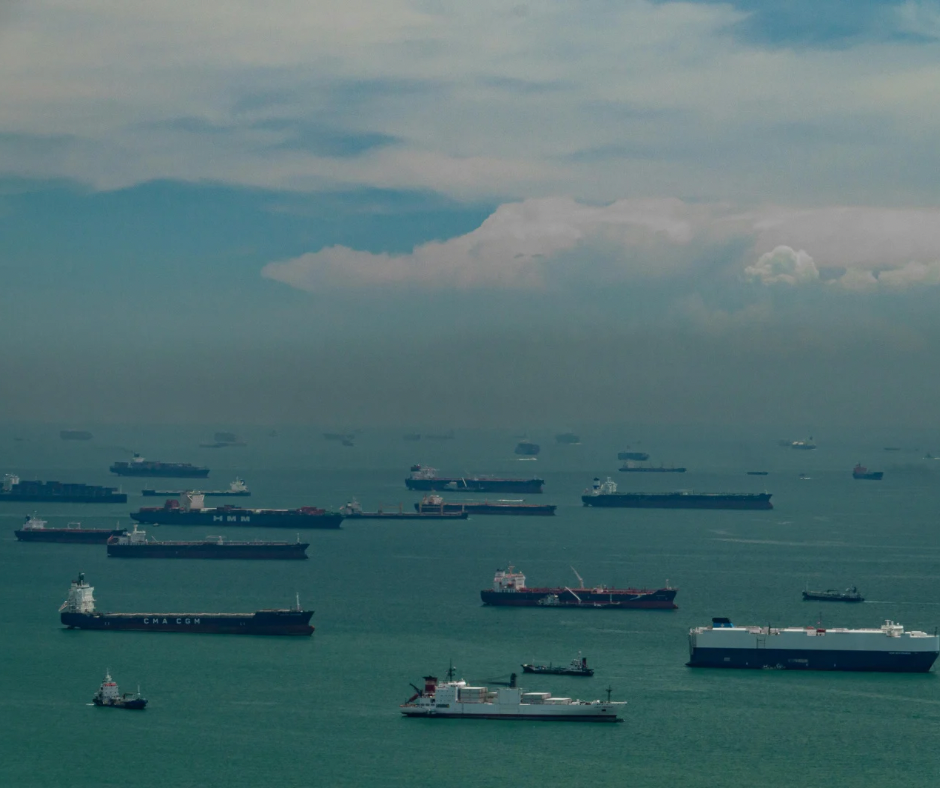
A narrow strip of water — just twenty-one miles wide at its tightest point — carries roughly twenty percent of the world's oil supply every single day. When Iran shut the Strait of Hormuz during a recent conflict with the US, global energy markets held their breath. Now, with a fragile ceasefire in place, ships are trickling back through. The twist? Iran may want the Strait open more than anyone else — because they've quietly set up a crypto toll system, charging ships one dollar per barrel of oil in secret digital transactions designed to dodge international sanctions. In this episode, we unpack the story and the five B2 expressions hiding inside it.
⚡ 5 Key Expressions
Expression 01
A boon for
A welcome benefit or advantage — especially one that arrives at just the right moment. The word "boon" comes from Old Norse, where it originally meant a prayer or a request that was granted. Over time it evolved to mean simply a gift or a blessing. The structure "a boon for" always specifies who benefits: a boon for investors, a boon for exporters, a boon for the economy. In today's story, Iran's crypto toll system — if oil traffic fully recovers — stands to be a massive boon for Iran's digital economy, potentially generating tens of millions of dollars per day.
- "The new direct flight route has been a real boon for tourism in the region."
- "Honestly, working from home has been a total boon for my morning routine."
Expression 02
Make a pretty penny
To earn a surprisingly large sum of money — often with a slightly raised-eyebrow tone, as if the amount is impressive, ironic, or a little audacious. The idiom has been in English since at least the 1700s. Despite the word "penny" — which is nearly worthless — a "pretty penny" means the opposite: a significant amount. The contrast is intentional and gives the phrase its wry character. In today's context, Iran stands to make a pretty penny from its crypto toll scheme, considering an estimated twenty million barrels of oil passed through the Strait every day before the war.
- "The founders made a pretty penny when the startup was acquired — enough to retire on."
- "She sold her apartment at exactly the right time and made a pretty penny."
Expression 03
In the driver's seat
To be in control of a situation — holding the power to decide direction, speed, and outcome. The image is literal and intuitive: the driver controls the vehicle; everyone else is just along for the ride. In business and geopolitics, being "in the driver's seat" implies leverage, agency, and strategic advantage. With control over who passes through the Strait and who pays the toll, Iran has placed itself firmly in the driver's seat of a critical global chokepoint. The phrase also works in reverse — you can "hand someone the driver's seat" or feel like you've "lost your seat at the wheel."
- "After landing three major clients in one quarter, the agency was firmly in the driver's seat during contract negotiations."
- "I finally feel like I'm in the driver's seat of my own career."
Expression 04
Lose its edge
To gradually lose a competitive advantage, sharpness, or dominance that once set you apart. An "edge" in competition is whatever gives you the lead — a technology advantage, a reputation, a currency's reserve status. When that edge dulls, you're still in the game, but you're no longer ahead. The US dollar became the world's reserve currency through the petrodollar agreement with Saudi Arabia in the 1970s. But between Iran's crypto toll and growing acceptance of the Chinese yuan for oil payments, analysts warn the dollar is slowly losing its edge as the unchallenged benchmark of global trade.
- "Some analysts believe Silicon Valley is losing its edge as top engineering talent relocates to other hubs."
- "I haven't practiced in months — I can feel myself losing my edge."
Expression 05
Wind down
To gradually slow, reduce in intensity, or come to a close — usually something that was active, heated, or sustained over time. "Wind down" always implies a process, not a sudden ending. A conflict winds down over weeks or months. A career winds down toward retirement. An evening winds down as guests start heading home. This gradual quality is what separates it from "shut down" (abrupt) or "end" (neutral and instant). In today's story, the big question for oil markets is whether the geopolitical tensions between the US and Iran will wind down fast enough to stabilize energy prices globally.
- "The company began winding down its Southeast Asian operations after three consecutive years of losses."
- "I need at least an hour to wind down after work before I can even think about sleeping."
🎭 The Dialogue: Toll Road
Maya is a currency analyst and Alex works in commodities trading. It's Friday afternoon — the week has been relentless — and they're grabbing a quick coffee before the weekend. The Strait of Hormuz story has been all over their screens.
📍 Office break room, Friday afternoon. Maya is checking her phone. Alex walks in, pours two cups, and sets one down without being asked.
Maya: Did you read about Iran's new crypto toll system at the Strait of Hormuz? One dollar per barrel, collected in secret transactions.
Alex: I did. If traffic through the Strait picks up, that's going to be a real boon for Iran's crypto economy.
Maya: Absolutely. They stand to make a pretty penny from this — we're talking potentially twenty million dollars a day.
Alex: And the timing is interesting. Right now, Iran is basically in the driver's seat. They control who passes and who pays.
Maya: The bigger concern for me is what this does to the dollar. The greenback has already been losing its edge as the world's reserve currency.
Alex: Right. Accepting yuan for payment on top of this just accelerates that trend. It's not a good look.
Maya: Do you think the geopolitical tensions will wind down quickly enough to stabilize oil prices?
Alex: Honestly? The ceasefire is fragile. I wouldn't hold my breath.
🧠 Episode Quiz
Can you answer this?
The Strait of Hormuz is one of the most strategically important waterways in the world. But which two bodies of water does it actually connect?
- A — The Red Sea and the Arabian Sea.
- B — The Persian Gulf and the Gulf of Oman.
- C — The Caspian Sea and the Indian Ocean.
✅ Answer: B — The Strait of Hormuz connects the Persian Gulf to the Gulf of Oman, which leads out to the Arabian Sea and the broader Indian Ocean. Option A describes the area near the Suez Canal. Option C is impossible — the Caspian Sea is landlocked and has no outlet to any ocean.
📚 Bonus Vocabulary
Clandestine (adjective) — done in secret, especially to avoid detection or legal consequences. Alex uses the word in the context of Iran's crypto transactions, which are designed to slip under the radar of international sanctions. It carries a stronger, more deliberate sense of secrecy than simply "private." "The two companies held clandestine talks for months before the merger was officially announced."
The greenback (noun) — an informal nickname for the US dollar, referring to the green ink historically used on American banknotes. It's commonly used in financial journalism when writers want a more vivid or varied term than simply "the dollar." "The greenback weakened significantly against the euro following the Fed's announcement."
I wouldn't hold my breath (phrase) — a sardonic way of saying "don't expect that to happen soon, or at all." Holding your breath implies waiting for something — but you can only hold it for so long. Alex uses it to express skepticism about a quick geopolitical resolution without directly saying "I don't think it will happen." "They've been promising that update for six months. I wouldn't hold my breath."