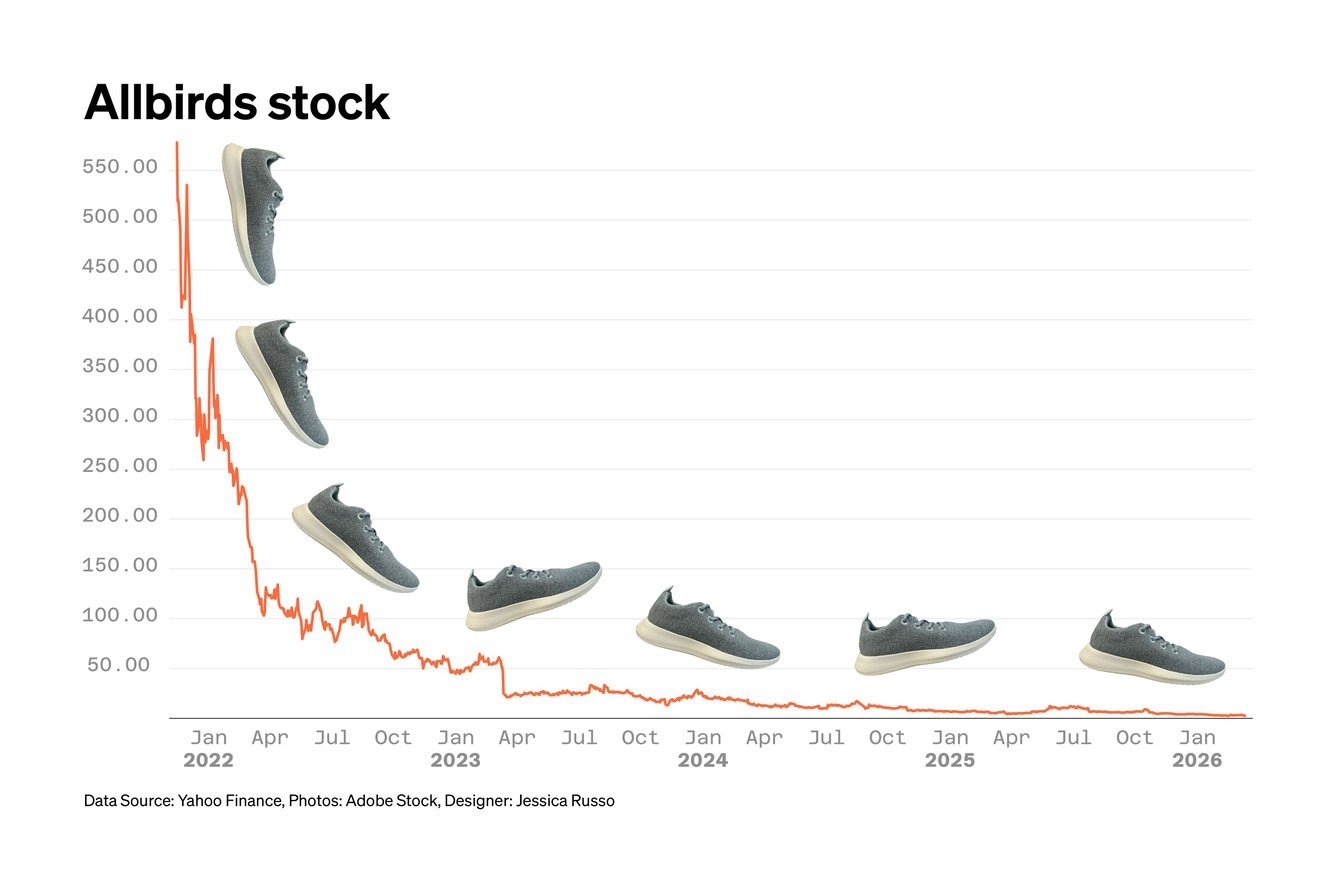
Once worth four billion dollars. Now selling everything for thirty-nine million. The collapse of Allbirds — the wool sneaker brand that Silicon Valley couldn't stop talking about — is one of the most dramatic startup stories in recent memory. And it's packed with English expressions worth knowing. In this episode, we follow the rise and fall of a company that made headlines, embarked on too much too fast, stayed in the red for years, and watched its stock plummet. Five B2 expressions. One spectacular crash landing.
⚡ 5 Key Expressions
Expression 01
Make headlines
To appear in the news in a significant way — to be important enough that journalists lead with your story. The "headline" is the bold title at the top of a news article, so to "make headlines" means your event is the headline itself. You can make headlines for good reasons or bad ones. Allbirds made headlines in 2021 when its stock debuted at a four billion dollar valuation. It made headlines again in 2026 when it sold everything for thirty-nine million. Both were headline-worthy — just for very different reasons. This phrase works for people, companies, products, and events alike.
- "The young researcher made headlines after her climate study was cited by three governments in the same week."
- "My uncle made headlines in our town for accidentally releasing forty pigeons at a council meeting."
Expression 02
Embark on
To begin a significant journey or undertaking — usually something large, important, and carrying a degree of risk or commitment. The word "embark" originally meant to get onto a boat (from the French "barque," meaning ship). Over centuries it became a metaphor: you don't just start something, you board it and set sail. That nautical origin gives the phrase a sense of scale and irreversibility — once you embark, you're on your way. Allbirds embarked on a massive global expansion: sixty brick-and-mortar stores, new product lines, aggressive growth. The ship sailed. Then it sank.
- "After fifteen years in corporate law, she decided to embark on a completely new career in urban farming."
- "We're embarking on a full kitchen renovation next month — I'm already regretting it."
Expression 03
In the red
Losing money — operating at a loss, spending more than you earn. The opposite is "in the black," which means profitable. Both expressions come from traditional bookkeeping: accountants wrote losses in red ink and profits in black ink. The color coding made it instantly clear which direction the money was flowing. Allbirds ended every single year as a public company in the red — meaning it never once turned a profit after going public. For investors, seeing red in the accounts year after year is a serious warning sign. Learn both expressions; they appear constantly in business reporting.
- "The airline has been in the red since the pandemic and still hasn't returned to profitability."
- "I'm in the red this month — three birthdays, one flight, and a very bad decision at the electronics store."
Expression 04
Too big, too fast
To expand or grow at a pace that exceeds what a company — or person, or project — can actually support. The speed of growth outpaces the foundations: the finances, the culture, the systems, the team. "Too big, too fast" always implies a warning or a postmortem. You usually hear it in hindsight, explaining why something collapsed. It's a compact, punchy phrase with no wasted words. In Allbirds's case, the company opened sixty stores globally by the end of 2023 — before it had made a single profitable year as a public company. The math was never going to work.
- "The franchise expanded too big, too fast — by year three, they were closing locations faster than they were opening them."
- "That relationship moved too big, too fast. They were talking about moving in together after two weeks."
Expression 05
Plummet
To fall sharply, steeply, and rapidly — with an implied severity that "fall" or "drop" alone don't carry. The word comes from the Latin "plumbum," meaning lead. A plumb line — a weight on a string used by builders to measure vertical — drops straight down with no hesitation. That's the feeling of "plummet": not a gentle decline, not a gradual slide, but a hard, fast, alarming drop. When Allbirds's sale news broke, the stock jumped briefly, then plummeted sixteen percent in a single afternoon. Use "plummet" when you want the reader or listener to feel the speed and scale of the drop.
- "Consumer confidence plummeted after the central bank raised interest rates for the third time in six months."
- "My motivation plummeted the moment I realized the project deadline had been moved to Friday."
🎭 The Dialogue: Never Worn
Maya and Alex are colleagues catching up in the office. Maya still has a pair of Allbirds in a box at home — unworn. Alex has been watching the stock. Neither of them saw this ending coming.
📍 Office breakroom, Wednesday morning. Maya is scrolling through her phone with the look of someone who just read something upsetting.
Maya: Did you see that Allbirds is selling everything? The whole company, for thirty-nine million dollars.
Alex: I know. They really made headlines back in 2021 — four billion dollar valuation on day one. Everyone I knew was buying those shoes.
Maya: That's when things started to go wrong, honestly. They decided to embark on this massive expansion — sixty stores globally, new product lines, all of it.
Alex: Classic case of too big, too fast. You can't open sixty stores if your core product is one type of shoe.
Maya: And they ended every single year as a public company in the red. Not once did they turn a profit.
Alex: Then when the sale news broke, the stock plummeted — sixteen percent in a single afternoon.
Maya: I still have a pair of those shoes. Never worn. Sitting in the box.
Alex: At this point they might be worth more than the company.
🧠 Episode Quiz
Can you answer this?
Allbirds built its brand on a very specific type of wool. What is it called — and where do the sheep that produce it originally come from?
- A — Merino wool, originally from Spain.
- B — Cashmere, originally from the Kashmir region of South Asia.
- C — Angora wool, originally from Turkey.
✅ Answer: A — Allbirds was built on Merino wool, a fine, soft, breathable fiber from Merino sheep first bred in Spain. Today most Merino wool comes from New Zealand and Australia. The product itself was genuinely good. The business model, unfortunately, was not.
📚 Bonus Vocabulary
Precipitous (adjective) — extremely steep or sudden, and almost always used to describe a fall or decline. The article describes Allbirds's collapse as "a precipitous fall." It's a more formal, literary word than "sharp" or "fast," and it carries extra weight. "The precipitous drop in the company's share price alarmed even its most loyal investors."
Valuation (noun) — the estimated total value of a company, usually calculated by investors during a funding round or IPO. When Allbirds went public, its "valuation" hit four billion dollars — meaning investors collectively decided the company was worth that much. Valuation is a perception of worth, not a guarantee. "The startup's valuation tripled after the funding round, despite the company still operating at a loss."
Shutter (verb) — to close a business permanently, usually with a sense of finality. It comes from the image of closing the shutters on a shop window. Allbirds will "shutter all but two outlets" after the sale. "The chain shuttered twelve locations last quarter as foot traffic failed to recover."