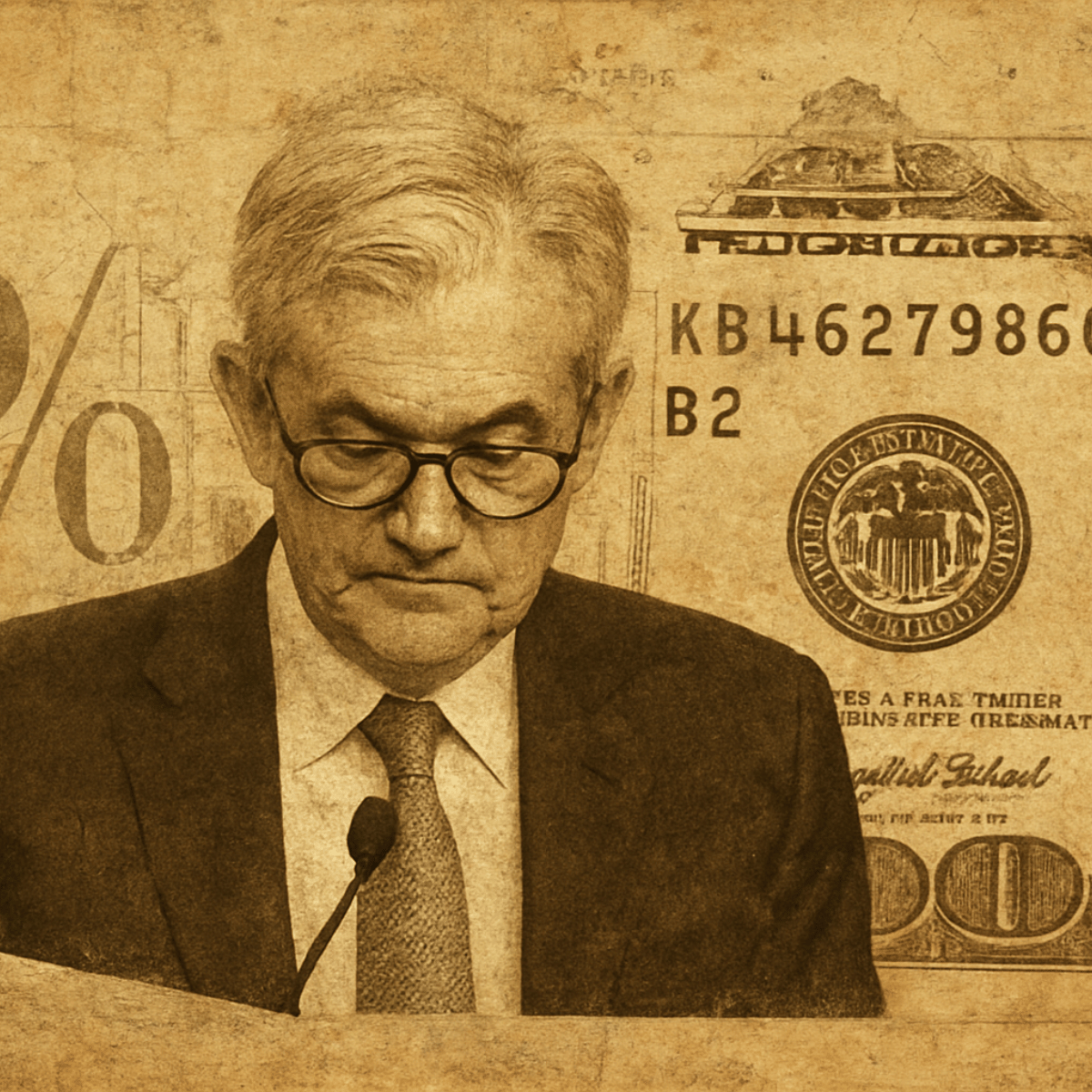
Oil is above $110. Inflation is climbing. And the most powerful central bank in the world has no good options left. When the Federal Reserve is stuck choosing between a recession and runaway prices, that's not just an economics story — it's a masterclass in the English of dilemmas, pressure, and hard decisions. In this episode, we unpack the stagflation trap and pick up five B2+ expressions that will serve you in boardrooms, news articles, and everyday conversations alike.
⚡ 5 Key Expressions
Expression 01
Swing in the other direction
To shift sharply and dramatically from one position, opinion, or trend to the opposite one. The image comes from a pendulum — a weight that swings back and forth in a steady arc. When we say "the pendulum has swung in the other direction," we mean a reversal has happened, often quickly and completely. Morning Brew captures this perfectly: traders spent months expecting rate cuts from the Fed, and then oil prices spiked and suddenly everyone is betting on hikes instead. That kind of total reversal is exactly what this phrase is built for — in markets, in politics, in public opinion, or even in personal relationships.
- "After years of remote-first policies, the pendulum has swung in the other direction — major firms are now requiring five days in the office."
- "My opinion on that restaurant swung in the other direction the moment I saw the bill."
Expression 02
Between a rock and a hard place
Caught in a situation where every available option causes pain or leads to a bad outcome. This is stronger than just "having a tough choice" — it implies there is genuinely no comfortable exit. The rock hurts. The hard place hurts. You are stuck. Morning Brew describes the Fed's dilemma in almost exactly these terms: raise rates and you risk tipping the economy into recession; keep rates low and inflation could spiral again. Neither path is safe. The phrase works in business, career conversations, family decisions, and anywhere a genuine no-win scenario exists.
- "The CFO was between a rock and a hard place — cut the marketing budget and miss growth targets, or keep spending and blow through the runway."
- "I'm between a rock and a hard place: if I tell her the truth, she'll be upset; if I don't, she'll find out later and be even more upset."
Expression 03
Spiral out of control
To move in a dangerous direction with increasing speed, in a way that becomes impossible to stop or reverse. A spiral doesn't just go in one direction — it accelerates as it goes, which is what makes it frightening. In the newsletter, inflation "spiraling out of control" is the nightmare scenario the Fed is trying to prevent: prices rising faster and faster, wages chasing them, expectations becoming self-fulfilling, and the whole cycle feeding itself. This expression is almost always used negatively. You would not say good things are spiraling — you'd say they're growing, compounding, or snowballing instead.
- "Without a clear project lead, the timeline spiraled out of control and the launch was pushed back three times."
- "I meant to spend twenty minutes on social media and then it spiraled out of control — it's been two hours."
Expression 04
Price in
To incorporate an expected future event into a current valuation, decision, or plan — meaning the anticipation of something has already been factored in, so it no longer counts as a surprise. This phrase comes directly from financial markets, where asset prices move based on expectations, not just reality. Morning Brew notes that traders have "priced in" a 95% chance that the Fed will hold rates steady in April — meaning the market has already adjusted for that outcome, and a surprise hike would be genuinely shocking. Beyond finance, you can use this phrase whenever you've mentally accounted for something in advance: in project planning, in negotiations, or in managing your own expectations.
- "The delay was already priced into our project plan — we built in a two-week buffer from the start."
- "I've priced in the possibility that the interview will be tough, so I'm not going in expecting it to be easy."
Expression 05
Trickle
To flow or move in a very small, slow, and steady amount — the opposite of a flood or a surge. The newsletter uses it to describe job growth: not collapsing, but not healthy either — just barely moving, drip by drip. "Trickle" is a verb with enormous range. You'll hear "donations trickled in," "information trickled out," "tourists are starting to trickle back," and of course the famous phrase "trickle-down economics." Whatever the context, the word always signals slowness and small quantity. The contrast with its opposites — flood, pour, surge — is one of the most useful things about it: a trickle that becomes a flood is a story worth paying attention to.
- "Job applications trickled in for the first week, then surged after the role went viral on LinkedIn."
- "Good news has been slow to trickle out of the merger talks — nobody really knows what's happening."
🎭 The Dialogue: No Good Options
Maya is an economist and Alex works in finance. They're grabbing lunch on a Friday and the conversation turns — as it tends to — to oil prices, inflation, and the Federal Reserve's impossible week.
📍 A lunch spot near the office, Friday afternoon. Maya is scanning headlines on her phone. Alex sets down two trays.
Maya: Did you see the futures market this morning? Traders are now pricing in a rate hike by end of year.
Alex: I know. The pendulum has really swung in the other direction fast. A month ago everyone was betting on cuts.
Maya: Oil crossing a hundred and ten dollars will do that. If energy costs keep climbing, inflation could spiral out of control again.
Alex: And if the Fed hikes to fight it, growth slows down. They're completely between a rock and a hard place.
Maya: The OECD already expects growth to slow this year. And job numbers — growth is just trickling along.
Alex: So you've got stagnation and inflation at the same time. That's the stagflation trap.
Maya: The worst part? The market has already priced in rates staying flat for April. Any surprise move would be chaos.
Alex: No good options. Just less bad ones.
🧠 Episode Quiz
Can you answer this?
The Federal Reserve was created to stabilize the US economy and manage monetary policy. But what year was it actually founded?
- A — 1863, during the Civil War era, as part of the National Banking Act.
- B — 1913, when President Woodrow Wilson signed the Federal Reserve Act.
- C — 1944, as part of the Bretton Woods international monetary agreement.
✅ Answer: B — The Federal Reserve was established on December 23, 1913, when President Woodrow Wilson signed the Federal Reserve Act into law. The 1863 National Banking Act created a system of national banks, but not the Fed. And Bretton Woods in 1944 created the IMF and World Bank — the Fed predates both.
📚 Bonus Vocabulary
Stagflation (noun) — a portmanteau of stagnation and inflation, describing an economy where growth is slowing and prices are rising at the same time. It's the worst of both worlds because the usual tools for fixing one problem tend to make the other worse. "The 1970s oil crisis triggered a period of stagflation that economists had previously thought was impossible."
Downstream effects (phrase) — the consequences that flow from an initial cause, often appearing later and in different places. Morning Brew uses it to describe how high oil prices ripple through the broader economy — retailers raise prices, transport costs climb, everything gets more expensive. "The factory closure had significant downstream effects on every supplier in the region."
Reiterate (verb) — to say something again, usually for emphasis or clarity. The newsletter notes that Fed officials "reiterated their consensus of one rate cut this year" — meaning they've said it before and they're saying it again. It implies the message hasn't changed, even if pressure is mounting. "The CEO reiterated the company's commitment to profitability despite the difficult quarter."